TRANSMISSION // 2611.09354v1
Magnetic field geometry changes the pace of simulated reconnection
Source published
Three-dimensional plasma simulations reveal two distinct reconnection regimes: a narrow layer containing coherent magnetic structures, and a broader, strongly corrugated layer that reconnects about three times faster. The result suggests a possible trigger for rapid energy release in solar flares, but does not demonstrate that trigger on the Sun.
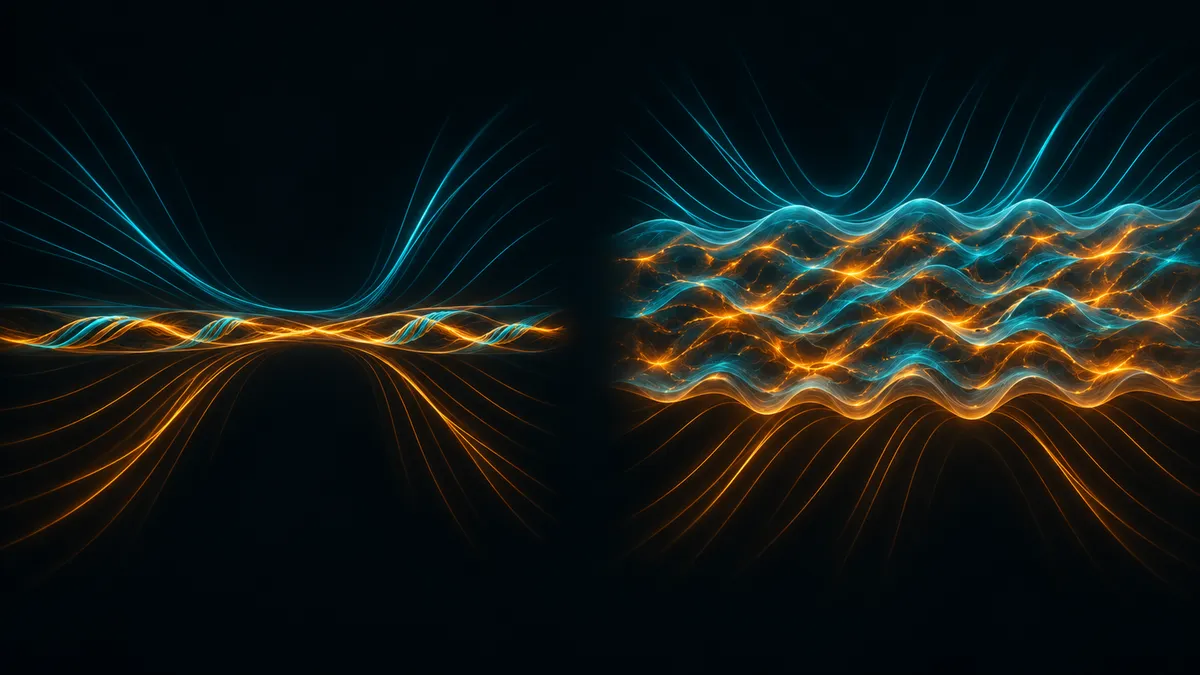
What makes magnetic reconnection suddenly accelerate? A simulation study suggests that the angle between magnetic fields can change not just the speed of reconnection, but the structure and electrical balance of the region where it happens. The paper has been accepted for publication in The Astrophysical Journal Letters.
Magnetic reconnection changes how magnetic fields connect through plasma, releasing magnetic energy in events such as solar flares. A longstanding problem is explaining its speed: the classic Sweet–Parker model predicts reconnection too slow to account for rapid flare energy release under the conditions discussed in this study.
Turbulence offers one route to faster reconnection. But a turbulent reconnection layer need not be completely disordered. It can contain locally coherent bundles of magnetic field lines called flux ropes, which may help regulate the rate.
Qihui Ming and Alexander J. B. Russell, at the University of St Andrews, ask whether changing magnetic shear—the difference in field direction across the layer—can produce a different kind of fast reconnection. Their arXiv manuscript reports a comparison in which nearly opposite fields develop a broader layer and reconnect about three times faster than the guide-field configuration.
Changing the field geometry
The researchers used Lare3d to run three-dimensional resistive magnetohydrodynamic simulations. This approach treats plasma as a conducting fluid coupled to magnetic fields, with finite electrical resistivity allowing magnetic connections to change.
Both main simulations began with two large magnetic flux tubes reconnecting across a central plane. The researchers kept the initial reconnecting field strength, pressure distribution and rate normalization fixed. They changed only the uniform guide field: a magnetic component directed along the layer rather than reversing across it.
The guide-field run used a strength of 0.75 in the simulation's normalized units. The comparison run had no guide field, making the fields anti-parallel across the layer: the strong-magnetic-shear limit. Both used a Lundquist number of 100,000, a measure comparing magnetic transport by the fluid with resistive diffusion.
There was no imposed inflow or external stirring. A small random velocity perturbation supplied an initial seed; the subsequent turbulence developed within the system.
A broader layer, a faster rate
Initially, both runs behaved similarly. Their reconnection rates rose from a slow baseline toward roughly 0.01 times the upstream Alfvén speed, the magnetic characteristic speed used as their common reference.
Once their initially uniform structure along one direction broke down and turbulence developed, their behavior diverged. The guide-field run stayed near 0.01. The anti-parallel run accelerated further, sustaining a rate near 0.03 during the analyzed quasi-steady interval. These numbers are normalized reconnection rates, not fractions of the speed of light.
The structures differed too. With a guide field, the layer contained locally coherent flux ropes and thin, intense current sheets. Without it, the current sheet developed closely spaced wrinkles, or short-wavelength corrugations. Current spread across a substantially broader region rather than remaining concentrated near the center.
Additional simulations found that the faster regime persisted with weak, nonzero guide fields up to at least 0.05. It therefore did not require perfectly anti-parallel fields. However, the authors describe their mapping of the transition between regimes as preliminary.
What sustains the electric field?
The team also separated the average electric field into contributions from mean plasma motion, correlated velocity and magnetic fluctuations, and electrical resistivity. This provided a second diagnostic alongside their measurement of reconnected magnetic flux.
In the guide-field case, fluctuations and resistivity made comparable contributions at the midplane. In the anti-parallel case, the layer was about three times broader, and the fluctuation contribution supplied almost all the average reconnection electric field.
That does not mean resistivity disappeared. Its smaller contribution was distributed across the broad layer, enabling reconnection throughout it. Nor does the fluctuation term alone prove turbulence: as the authors emphasize, correlated departures from an average can produce this term without necessarily being turbulent.
A possible flare trigger, not a demonstrated one
The authors suggest that a velocity-shear instability called Kelvin–Helmholtz instability may help generate the corrugations. Its expected behavior matches several features of their simulations, including suppression by a sufficiently strong guide field. This is a proposed explanation, not an established identification of the mechanism.
The scope is also limited. The main comparison uses one Lundquist number and an idealized fluid model. In the zero-guide-field run, a slower, large-scale kink instability eventually disturbs the layer, restricting the useful analysis window. A quantitative comparison with an existing theory of turbulence-broadened reconnection remains future work.
For solar eruptions, the possibility is intriguing: weakening guide fields could move a current sheet into a faster reconnection regime. But these simulations do not reproduce or observe that transition in an actual flare. Their concrete result is narrower: magnetic geometry can select distinct reconnection states in this model, offering a mechanism to investigate rather than a settled explanation of flare onset.
- magnetic reconnection
- plasma turbulence
- magnetic shear
- guide field
- solar flares
- magnetohydrodynamic simulations
Related reading
Automatically matched by shared topic keywords. These links do not imply that the sources agree or establish a consensus.