TRANSMISSION // 2611.09338v1
Two black hole mergers hint at a shared history, but evidence falls short
Source published
Researchers have identified two gravitational-wave events whose locations, distances and black hole properties are compatible with a sequential merger involving three black holes. However, once an assumed low occurrence rate is included, their statistical analysis favors unrelated events over a connected merger chain.
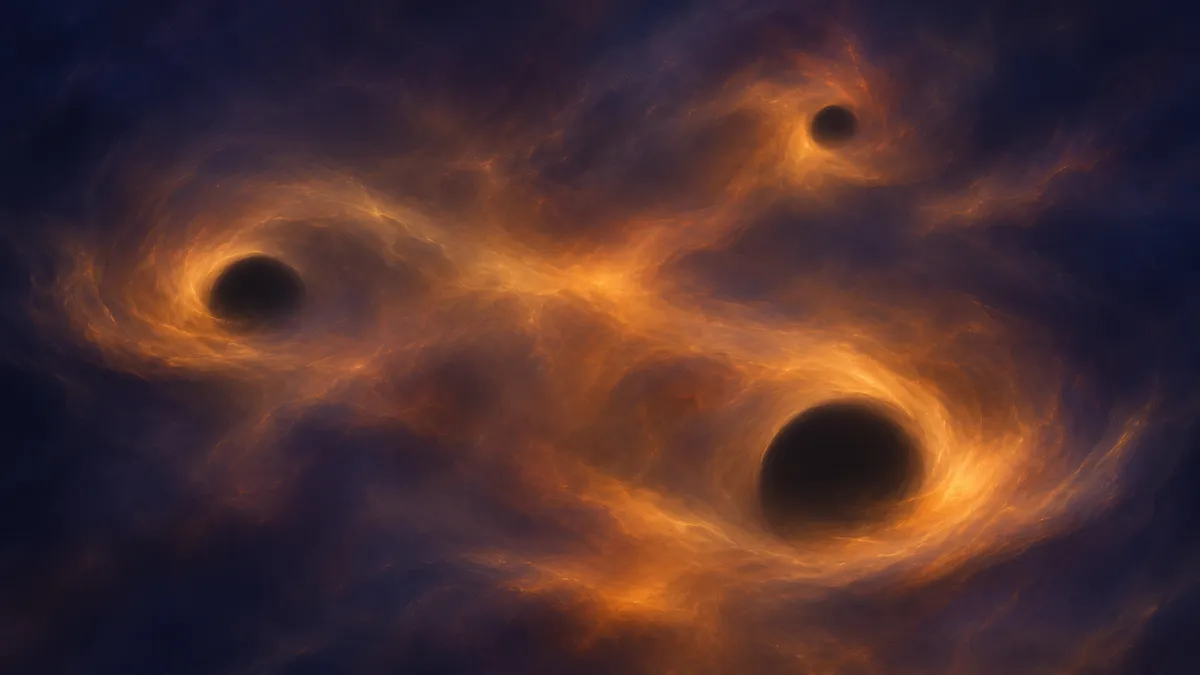
Could a black hole detected merging in July 2023 have merged again that November? A new analysis identifies a possible connection between two gravitational-wave signals, but its authors conclude that the evidence is not strong enough to establish that the events belong to the same merger chain.
A possible repeat merger
The proposed connection involves GW230729_082317 and GW231118_005626, two binary black hole mergers detected during the first part of the LIGO–Virgo–KAGRA collaboration’s fourth observing run. In the researchers’ interpretation, the black hole left behind by the earlier collision could have become the heavier member of the later merging pair.
That would make the events a candidate hierarchical triple merger: three black holes participating in two successive mergers, rather than all three colliding simultaneously. Such a chain could arise within a triple system or through encounters that bring a merger remnant together with another black hole.
Bo Gao and colleagues describe the candidate in a paper posted to arXiv on November 6, 2026. The supplied landing metadata lists the work as accepted by The Astrophysical Journal; the version examined here is the arXiv preprint.
Matching masses and overlapping locations
The team searched GWTC-4 and earlier gravitational-wave catalogs, comparing inferred sky positions, luminosity distances, masses and spins. These measurements are probability distributions rather than exact values, so the search looked for compatible ranges of properties. The two 2023 events emerged as the most strongly correlated pair.
For the July event, the paper reports median initial black hole masses of approximately 12.3 and 7.6 times the Sun’s mass, producing a remnant of about 19.4 solar masses. That remnant’s estimated mass agrees with the inferred mass of the heavier black hole in the November event.
The remnant’s spin is also compatible with that later black hole’s spin, although the individual spin measurements are weakly constrained. The events’ sky-localization and distance distributions overlap, providing another necessary ingredient for a possible connection. These agreements establish compatibility, not proof of a shared source.
To test the association more directly, the researchers jointly analyzed the signals using a model that links the first merger’s remnant mass and spin to a component of the second merger and assigns both events a common location and distance. They compared this with separate analyses treating the events as unrelated.
Why a factor of 110 is not a discovery
The joint analysis produced a Bayes factor of 110 in favor of the connected-merger hypothesis. This statistic compares how well the competing hypotheses account for the data, averaged over their assumed parameter distributions. It is not, by itself, the odds that the proposed connection is real.
Those odds also depend on how plausible the hypotheses are before considering these signals. As an example, the authors assume prior odds of 0.001 for a hierarchical triple association, motivated by an estimate that such mergers constitute only 0.1% of detected binary black hole mergers.
Multiplying by the Bayes factor gives posterior odds of approximately 0.1—roughly one to ten in favor of association versus non-association. Under that assumption, unrelated events remain favored. The result therefore depends importantly on the adopted prior, and the authors do not claim a confirmed merger chain.
Searching for a physical setting
The team also examined the July signal for orbital eccentricity—departure from a circular orbit—and acceleration toward or away from Earth. Either could provide additional evidence of a nearby companion or dynamical interactions. Neither was significantly detected, although the researchers emphasize that these non-detections do not exclude a dynamical origin.
Using the SpaceHub simulation code, with relativistic corrections including energy loss through gravitational waves, they explored possible formation pathways. Their modeled long-lived primordial triple struggled to remain stable under conditions required by the candidate pair. This disfavors that scenario within the configurations studied, rather than excluding every possible triple arrangement.
The authors instead favor dynamical encounters, particularly interactions between two binaries within the gas disk of an active galactic nucleus. Such an environment could help retain a merger remnant and enable another collision. However, the scattering simulations are exploratory, neglect black hole spin effects and do not identify an observed host environment.
Conditional limits on cosmic rates
The study also estimates how frequently hierarchical triple mergers could occur. Its calculations account for observing periods, gaps between runs, detector sensitivity and assumed delays between successive mergers. They apply a 50% detection-efficiency reduction to allow for reduced sensitivity to eccentric binaries.
Assuming no confirmed detections, the resulting 90% confidence upper limits range from approximately 4.2 to 75.3 events per cubic gigaparsec per year, depending on the delay model. The tightest limit uses a maximum delay of ten years. These are model-dependent population constraints—not evidence that this particular pair is connected. Establishing a merger chain will require stronger observational support.
- gravitational waves
- black holes
- hierarchical triple mergers
- GW230729_082317
- GW231118_005626
- Bayesian analysis
- active galactic nuclei
- GWTC-4
Related reading
Automatically matched by shared topic keywords. These links do not imply that the sources agree or establish a consensus.
Could displaced black holes give cosmic rays an extra boost?
Source published
Shared keywords: active galactic nuclei
Hyperion’s Densest Regions Show More X-ray-Active Black Holes
Source published
Shared keywords: active galactic nuclei
Webb maps gas and stars moving differently around faint active black holes
Source published
Shared keywords: black holes
How a Black Hole’s Jets Could Disrupt Its Own Fuel Supply
Source published
Shared keywords: active galactic nuclei
Galactic Gas May Preserve Traces of Fading Black Hole Activity
Source published
Shared keywords: active galactic nuclei