TRANSMISSION // 2611.09330v1
Cluster galaxies show a subtle nitrogen–oxygen abundance offset
Source published
A study of 3,308 nearby star-forming galaxies finds a small chemical offset in galaxy clusters, but no significant difference between cosmic voids and intermediate-density environments. Stellar mass predicts departures from the main nitrogen–oxygen abundance relation better than recent star formation does.
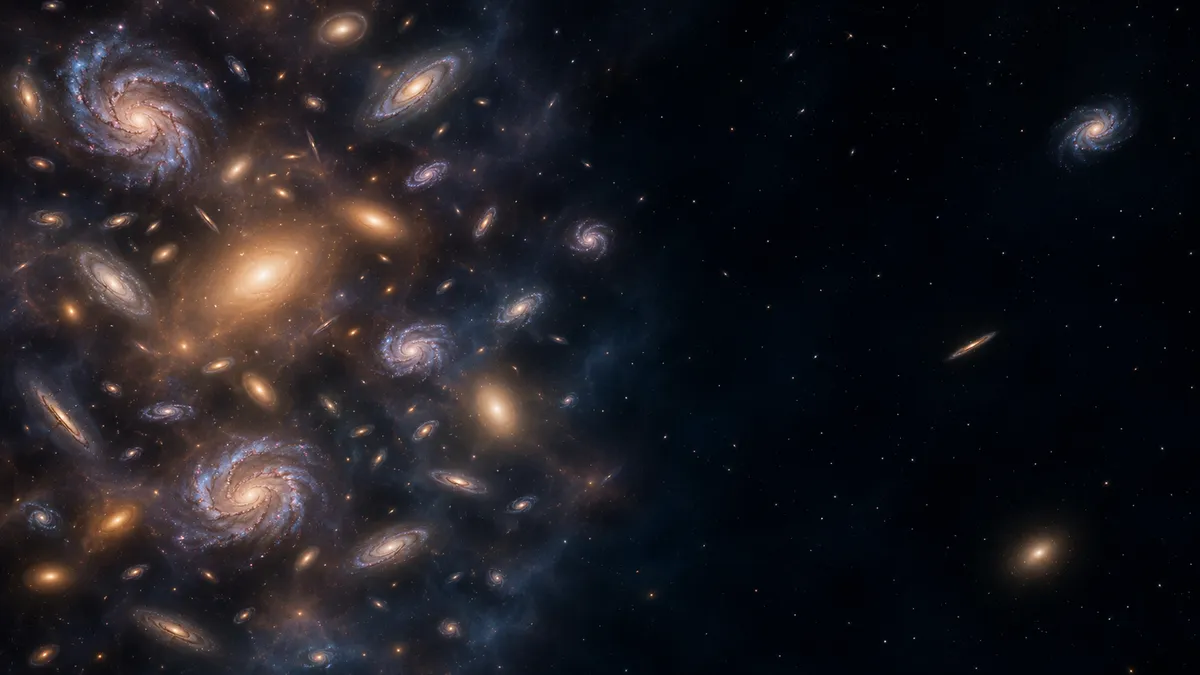
Galaxies in crowded clusters show a subtle chemical difference from those in less densely populated surroundings, according to a new analysis of Sloan Digital Sky Survey spectra. The findings suggest that the cluster environment may alter how galaxies acquire and retain gas, although the observations cannot identify a unique cause.
A chemical comparison across the cosmic web
A study led by Yllari K. González-Koda of the University of Granada finds that nearby star-forming galaxies in clusters follow a slightly different relationship between nitrogen and oxygen abundances from galaxies in less crowded environments. Galaxies selected from the inner regions of cosmic voids, meanwhile, show no statistically significant difference from the study’s intermediate-density comparison population.
The work examines the nitrogen-to-oxygen abundance ratio, N/O, alongside oxygen abundance relative to hydrogen, O/H. These quantities provide complementary clues to galaxy evolution: oxygen is released mainly by short-lived massive stars, while nitrogen comes from stars spanning a broader range of masses and lifetimes. Their relationship therefore carries information about chemical enrichment and the movement of gas into and out of galaxies.
The paper was posted to arXiv on November 6, 2026. Although the supplied version is an arXiv preprint, its landing metadata states that it has been accepted for publication in Astronomy & Astrophysics.
Measuring light from galaxy centres
The researchers used a galaxy sample assembled within the CAVITY project, which studies galaxies in cosmic voids. They divided galaxies into three categories: clusters, voids, and non-cluster/non-void environments. Void galaxies were selected within 0.8 times their void’s effective radius. The intermediate-density comparison category includes non-cluster galaxies at or beyond that threshold, potentially including void outskirts; it is not a sample exclusively of cosmic filaments.
After selection cuts and emission-line quality requirements, the main abundance analysis included 610 cluster galaxies, 414 void galaxies and 2,284 galaxies in the intermediate category. Their redshifts range from 0.025 to 0.050.
The Sloan Digital Sky Survey spectra were collected through three-arcsecond fibres, sampling central regions out to radii of roughly 0.78–1.56 kiloparsecs, rather than entire galaxies. The team modelled the starlight, subtracted it to isolate emission from ionised gas, corrected for dust extinction and selected galaxies whose emission was dominated by star formation.
Chemical abundances were inferred using calibrated ratios of bright emission lines. For the main analysis, oxygen estimates used oxygen and hydrogen lines rather than nitrogen lines, avoiding a known source of bias when investigating nitrogen enrichment. Alternative abundance methods provided checks on the results.
Stellar mass outperforms recent star formation
To investigate why galaxies scatter around the main N/O–O/H relationship, the team fitted a smooth curve through median measurements and calculated each galaxy’s vertical departure from it. They similarly removed the main oxygen-abundance trends from other galaxy properties before comparing the remaining variations.
Stellar mass and a mass-to-size measure used as a proxy for gravitational potential were the strongest predictors tested, with Spearman correlation coefficients around 0.42. Galaxy colour followed at about 0.38. Redder, more massive galaxies tended to have higher N/O at a given oxygen abundance.
By contrast, total star formation rate and central star formation rate per unit area showed correlations of only about 0.1. Specific star formation rate—star formation divided by stellar mass—had a stronger association, but the authors suggest that part of it may arise from its built-in dependence on mass.
These results do not establish that recent star formation is irrelevant. They apply to this selected sample and the timescales probed, and stellar mass may also be measured more reliably than star formation rate.
A small cluster offset, not a simple nitrogen shortage
At the oxygen-rich end of the sample, cluster galaxies lay systematically below the overall N/O–O/H relationship, with typical logarithmic offsets around −0.02 dex and departures reaching roughly −0.025 dex. Void galaxies showed no significant offset from the intermediate-density population.
The comparison depends crucially on what is held fixed. Cluster galaxies had lower N/O at fixed oxygen abundance, yet slightly higher N/O and higher oxygen abundance at fixed stellar mass. The oxygen enhancement was larger, producing the downward displacement in the N/O–O/H diagram. The study did not find a significant corresponding difference in star formation rate at fixed mass.
Plausible mechanisms and remaining limits
The authors discuss two possible explanations involving the gas between cluster galaxies. Reduced supplies of fresh, relatively unenriched gas could let galaxies become more chemically enriched as they consume their remaining fuel, a process called strangulation. Alternatively, pressure from the surrounding cluster gas could help retain or recycle material enriched by stars.
Neither mechanism is directly demonstrated. Tests involving measurement thresholds, matched samples and alternative calibrations supported the environmental pattern, but systematic uncertainties remain. One simultaneous abundance-estimation method produced enough scatter that the mass correlations could not be established as statistically significant.
Single-fibre spectra also mix unresolved star-forming regions and possible secondary sources of ionisation. Differences in galaxy size could affect the regions sampled. Spatially resolved spectroscopy of consistently selected galaxies across environments will be needed to separate these effects and test the proposed gas-cycle explanations.
- galaxy evolution
- galaxy clusters
- cosmic voids
- nitrogen-to-oxygen ratio
- chemical abundances
- stellar mass
- Sloan Digital Sky Survey
- CAVITY
Related reading
Automatically matched by shared topic keywords. These links do not imply that the sources agree or establish a consensus.
Stellar motions support an excess of small stars in massive galaxy cores
Source published
Shared keywords: galaxy evolution
Galaxy Images Offer Clues to Billions of Years of Star Formation
Source published
Shared keywords: galaxy evolution
What dust can reveal about galaxies that stopped making stars
Source published
Shared keywords: galaxy evolution
Early disk galaxies show a different mass–speed pattern
Source published
Shared keywords: galaxy evolution
Distant galaxy lenses offer a new sample for studying cosmic evolution
Source published
Shared keywords: galaxy evolution