TRANSMISSION // 2611.09259v1
Better blood-pressure forecasts did not establish reliable surgical warnings
Source published
A retrospective study used machine learning to forecast the accumulated depth and duration of low blood pressure during surgery. The models improved statistical forecast scores, but alert performance depended on the warning policy and threshold, highlighting the gap between predicting physiological burden and demonstrating a useful clinical warning system.
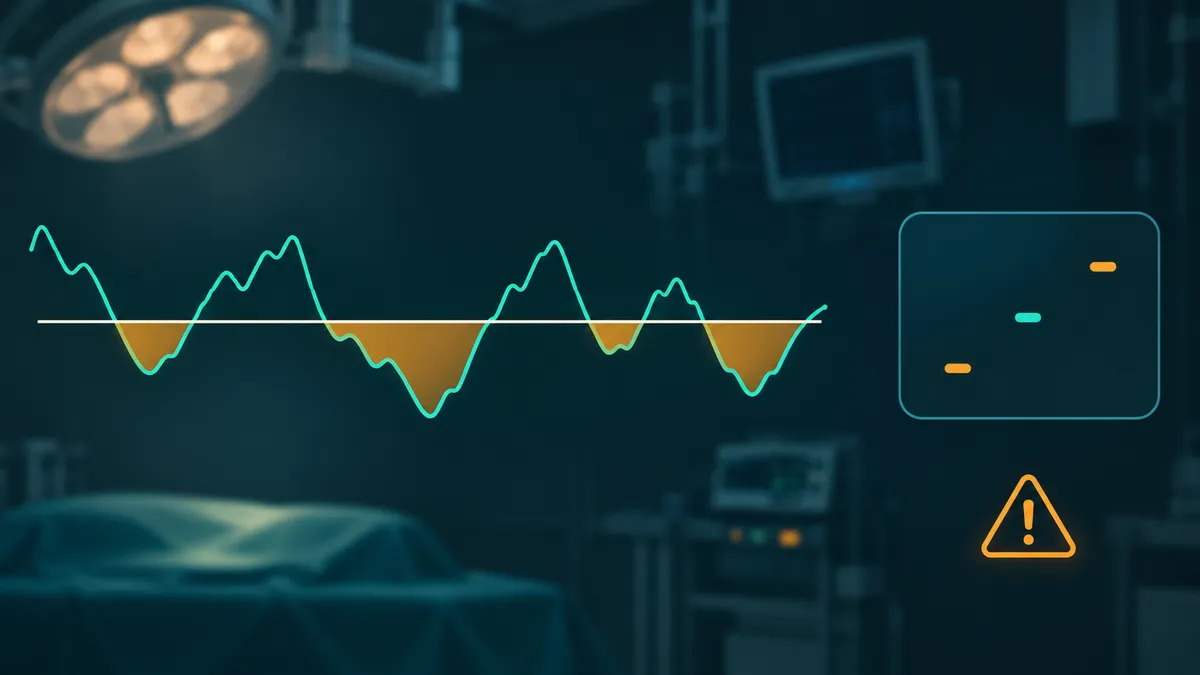
A brief, shallow blood-pressure dip and a prolonged, deep drop are different events, yet a yes-or-no prediction can treat them alike. A new study forecasts their accumulated burden instead. Its central finding is also a caution: better numerical predictions did not establish reliable early warnings under the alert policies and operating thresholds tested.
Yunfan Zhao, whose paper lists an affiliation with GE Healthcare, examined whether machine learning could estimate cumulative low blood pressure over the next 15 minutes of surgery. Posted to arXiv on November 6, 2026, the work is a preprint, not an established peer-reviewed clinical finding. It reports a retrospective benchmark rather than a trial of a system used to guide care.
The target was mean arterial pressure, or MAP, a measure of average arterial pressure across the heartbeat. Instead of predicting only whether MAP would fall below 65 millimetres of mercury, the study calculated how far below that threshold it fell and for how long. Adding these deficits over 15 minutes produced a burden measured in mmHg-minutes. The threshold defines the experiment; it is not a personalised treatment recommendation, and the burden is not a validated substitute for patient harm.
The analysis used public, de-identified VitalDB recordings from one hospital. Eligible cases involved adults receiving general anaesthesia with invasive arterial-pressure monitoring. The final forecasting dataset contained 100,247 overlapping windows from 3,423 surgical cases involving 3,304 people. These windows were repeated observations, not independent patients or hypotension episodes.
Pressure readings were reduced to medians in 10-second bins, without carrying earlier measurements forward to fill gaps. Each prediction used the preceding 30 minutes of history. Labelled examples required complete observations throughout the following 15 minutes, while prediction times were spaced five minutes apart. All procedures belonging to the same person stayed in the same training, validation or test group, reducing the risk of learning patient-specific patterns that also appeared in testing.
The forecasting models were gradient-boosted decision trees, not language models. They used pressure-history summaries, age and sex. Comparators included a population-based forecast, a calibrated persistence forecast based on the latest MAP, and a learned model using only that latest reading. More detailed models either predicted burden directly or learned a correction to persistence. An additional feature set described recent accumulated deficits and finer-resolution pressure dips.
Rather than estimating just one typical outcome, the models predicted the median, 90th percentile and 95th percentile of future accumulated burden—not future pressure trajectories. A well-calibrated 90th-percentile estimate should have roughly 90% of outcomes at or below it across the evaluated population; that is not a guarantee for an individual patient. The three quantiles were fitted separately and could cross, so they should not be treated as a coherent full predictive distribution.
Performance was measured with pinball loss, which penalises errors asymmetrically. At the 90th percentile, underestimation receives nine times the penalty of equal-sized overestimation. Lower scores are better, but they are not ordinary average absolute errors.
In the prespecified test comparison at the 90th percentile, the residual model scored 2.256 mmHg-minutes against 2.900 for calibrated persistence. The difference was −0.644, with a 95% subject-bootstrap interval from −0.814 to −0.487. Metrics gave each patient equal overall influence, and uncertainty calculations resampled whole patients rather than treating overlapping windows as independent.
Direct prediction performed slightly better, scoring 2.196. Adding the finer-resolution features lowered that score only to 2.193; the uncertainty interval for this incremental difference included zero. Thus, a favourable result during validation did not establish a clear additional gain in testing. Models, analysis definitions and alert thresholds were recorded with cryptographic hashes before test predictions.
The warning experiment exposed a larger limitation. An episode required at least two consecutive complete minute medians below 65 mmHg, with additional eligibility and censoring rules. The analysis tested simple threshold alerts, alerts requiring two consecutive qualifying prediction times, and hysteresis, which uses a lower threshold to switch an alert off. These policies used the predicted 90th-percentile burden as their score. A continuously active alert could not repeatedly claim credit for later episodes.
For direct prediction with additional features, the two-consecutive-time rule captured 96 of 589 eligible test episodes: sensitivity of 16.3%, with precision of 14.0%. These figures describe a specific operating point: its threshold was selected on validation data to maximise sensitivity subject to a budget of no more than 0.25 unmatched alerts per decision-exposure hour, then frozen for testing. At that threshold, the actual test unmatched-alert rate was 0.230 per decision-exposure hour, and median lead time among captured episodes was six minutes. The validation budget was a selection constraint, not a guarantee of the same achieved rate in testing; performance depended on both policy and threshold.
The exposure denominator counted five minutes per eligible decision time, not independently verified continuous monitoring hours. Precision counted all alert activations, including those during ongoing episodes and duplicate activations, whereas the unmatched-alert rate used unmatched activations alone. The limited sensitivity and precision at this operating point do not support a claim of clinically reliable early warning.
The study also lacks external and prospective validation. Missing observations and retrospective anaesthesia boundaries could affect selection and replay. Plausibility screening did not eliminate all measurement artefacts. Crucially, recorded future pressure already reflected existing treatment, so the analysis cannot show what would have happened without care or whether responding to a new warning would help. Its contribution is a reproducible separation of forecast accuracy from alert behaviour—not evidence of patient benefit.
- intraoperative hypotension
- blood pressure forecasting
- mean arterial pressure
- machine learning
- quantile regression
- VitalDB
- clinical alerts
- retrospective study
Related reading
Automatically matched by shared topic keywords. These links do not imply that the sources agree or establish a consensus.
Machine learning connects atomic physics to simulations of stellar winds
Source published
Shared keywords: machine learning
PHISHREV+ uses explicit rules to reconsider phishing alerts
Source published
Shared keywords: machine learning
Satellite links detect rain better when neighboring receivers share information
Source published
Shared keywords: machine learning
Heart failure prediction models need stronger validation, review finds
Source published
Shared keywords: machine learning
When do AI-generated survey answers reflect real patterns?
Source published
Shared keywords: machine learning