TRANSMISSION // 2611.09211v1
Optical spectra reveal magnetic activity in 46 MeerKAT-selected stars
Source published
Follow-up observations of 99 radio- and X-ray-selected stars found calcium emission tracing heated stellar atmospheres in 46 targets. The study connects optical activity with X-rays and possible flares, but finds no statistically significant relationship between activity and rotation within its sample.
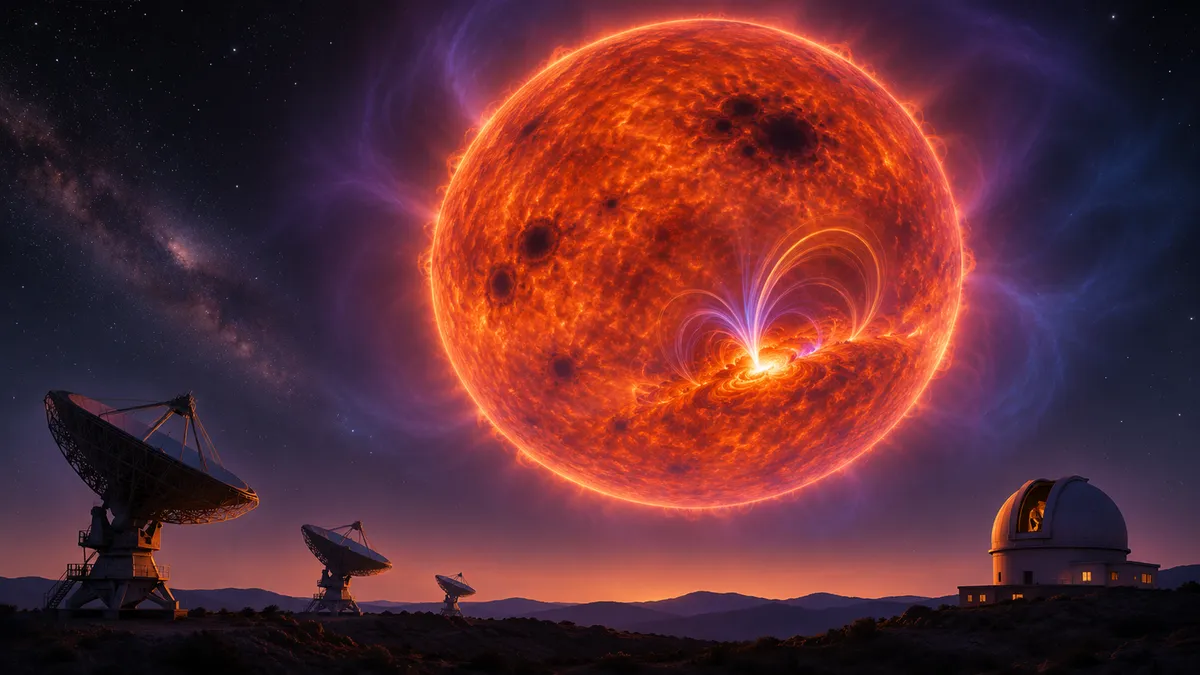
Stars detected at radio and X-ray wavelengths can also reveal their magnetic activity through distinctive features in visible light. A new spectroscopic study reports those signatures in 46 stars selected from the MeerKAT Galactic Plane Survey, while highlighting how changing activity and observations taken at different times complicate the picture.
Astronomers following up stars identified through the MeerKAT Galactic Plane Survey have found optical evidence of magnetically heated atmospheres in 46 of 99 targets. The results bring together radio, visible-light and X-ray observations, offering a more detailed view of stars whose magnetic activity changes over time.
Okwudili D. Egbo and colleagues describe the findings in a study published in Monthly Notices of the Royal Astronomical Society, volume 553, issue 1, November 2026, article stag1821 (DOI: 10.1093/mnras/stag1821). This article draws on the study’s arXiv v1 manuscript rather than the journal version. Their strongest conclusions concern the detection of activity itself. Other proposed connections, particularly between activity and stellar rotation, remain less firmly established by this sample.
Reading a star’s atmosphere
A star’s visible surface, or photosphere, lies beneath the chromosphere and the still more extended corona. Magnetic fields generated through stellar rotation and the movement of hot material can transfer energy into these outer layers. Different wavelengths reveal different aspects of that process: optical emission lines trace the chromosphere, while X-rays reveal hot coronal gas.
The researchers selected 99 stars classified as G, K or M types using Gaia data, drawing from an earlier catalogue combining MeerKAT radio sources with optical and X-ray counterparts. These spectral classes include Sun-like stars and cooler stars.
Initial observations with the Mookodi instrument on South Africa’s Lesedi telescope examined hydrogen’s H-alpha line, an activity indicator in red light. Follow-up spectroscopy used SpUpNIC on the South African Astronomical Observatory’s 1.9-metre telescope and the High Resolution Spectrograph on the Southern African Large Telescope.
These instruments split starlight into its component wavelengths. The team searched for bright emission cores in lines produced by singly ionised calcium: the H and K lines near the violet end of the optical spectrum, and three lines in the near-infrared known as the infrared triplet.
Calcium signatures in 46 stars
The authors report calcium H and K emission in 39 stars and infrared-triplet emission in 18. Eleven stars appear in both groups, giving 46 distinct detections. Hydrogen emission provided additional evidence of activity in some targets.
For the 39 stars with H and K measurements, the researchers calculated indices describing calcium emission strength. One compares the line cores with nearby background light; another expresses the chromospheric emission relative to the star’s total energy output. They estimated measurement uncertainties from spectral noise, the placement of that background level and the integration of the lines.
The authors report that 37 of these 39 stars exceed their adopted benchmark for the Sun’s activity minimum. However, their first index is an instrumental measurement, not calibrated onto the standard Mount Wilson system. That distinction matters when comparing absolute values with other surveys. Activity measurements also showed substantial scatter among stars of similar colour, rather than a simple dependence on stellar temperature.
Connections across wavelengths
For 35 stars with calcium H and K measurements, the team used eROSITA X-ray fluxes and distance estimates to calculate X-ray luminosities. They compared these with estimates of each star’s total luminosity, finding a positive association between relative X-ray output and chromospheric activity.
Some stars also emitted more radio power than expected from the commonly used Güdel–Benz relationship between radio and X-ray luminosity. The authors suggest variability or flaring could contribute. They did not, however, find a clear direct correlation between calcium activity and radio luminosity.
Published period measurements were available for 32 stars, all with periods shorter than about six days. Although activity showed a slight tendency to decline with increasing period, the relationship was not statistically significant. A linear fit explained only about 6% of the variation. The sample therefore does not independently establish a rotation–activity relationship.
Flares and the importance of timing
The researchers also searched ATLAS optical brightness records for flares. They smoothed away slower variations, estimated the local noise and flagged departures exceeding three times that noise level. They present five examples of stars showing flaring behaviour and report that some events coincide with spectroscopic activity detections.
Such coincidences support a shared magnetic origin, but do not establish that every emission feature was caused by a flare. The spectra largely provide snapshots, and observations from different instruments were sometimes separated by up to a year. Calcium and hydrogen emission generally tracked each other more tightly when measured simultaneously.
The observing programme also had uneven sensitivity, and follow-up targets were chosen partly because they already showed activity. Consequently, 46 detections among 99 targets cannot be treated as the prevalence of active atmospheres among stars generally. Coordinated, repeated observations would help distinguish persistent heating from rotation, activity cycles and brief flares.
- MeerKAT
- stellar magnetic activity
- chromospheres
- stellar spectroscopy
- calcium emission
- stellar flares
- eROSITA
- Galactic Plane Survey
Related reading
Automatically matched by shared topic keywords. These links do not imply that the sources agree or establish a consensus.