TRANSMISSION // 2611.09156v1
Satellite links detect rain better when neighboring receivers share information
Source published
A Genoa study finds that combining signals from nearby satellite microwave links improves machine-learning classification of wet and dry periods. A random forest model outperformed the tested convolutional neural network, but the results come from a small regional dataset with complete measurements.
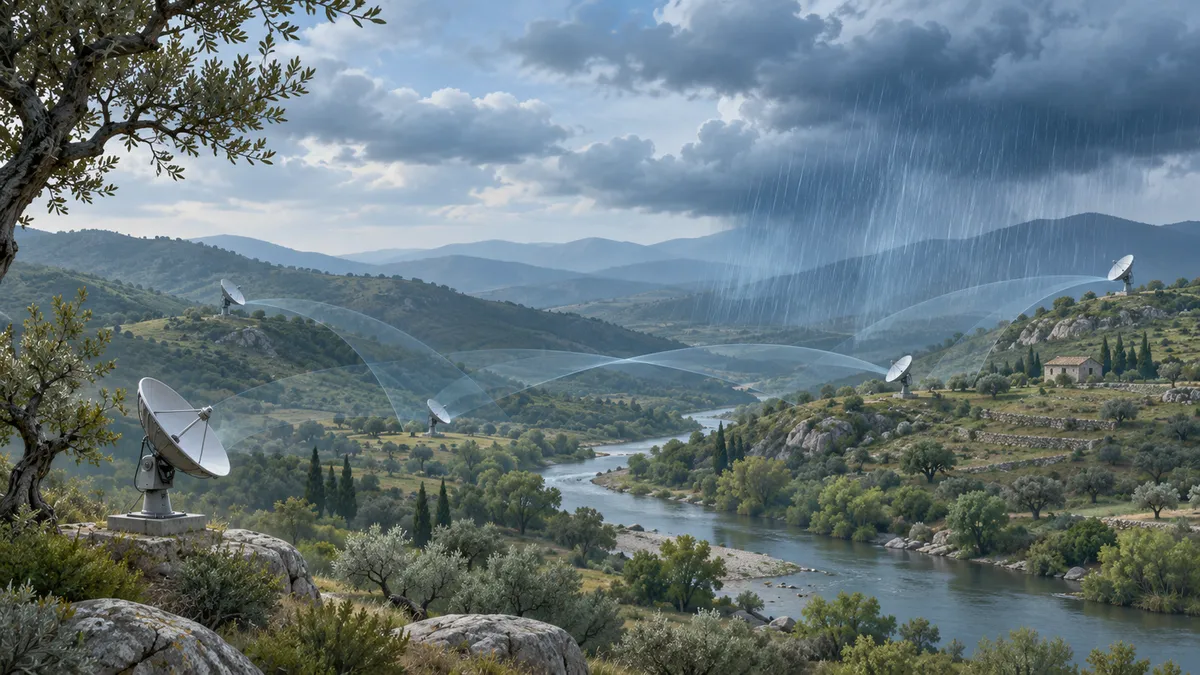
Rain weakens microwave signals traveling from satellites to ground receivers. Researchers have investigated whether those changes can help monitor rainfall—and whether a receiver becomes a better rain detector when its model also uses information from neighboring links. A new preprint reports encouraging results from Genoa, Italy, while leaving broader operational reliability untested.
Turning signal changes into rainfall clues
Microwave links offer an opportunity to observe rainfall indirectly: rain along the route from a satellite to a ground receiver reduces the received signal power. The challenge is to translate those measurements into a useful distinction between wet and dry conditions.
A study by Mostafa Ftouni and colleagues asks whether that distinction becomes more reliable when machine-learning models consider several nearby links together, rather than treating each link independently. Nearby receivers may encounter the same rainfall event, while links pointing toward different satellites provide observations along different paths.
The work was posted on arXiv on November 6, 2026. It is a preprint, and its findings should be treated as preliminary rather than established evidence of performance across other locations or operational networks.
Four groups of neighboring links
The researchers used measurements collected between January 2021 and August 2024 from 16 Smart Rainfall System sensors across seven sites in Genoa’s Polcevera River Basin. The sensors received Ku-band satellite microwave signals.
They organized the links into four groups of four. Receivers either shared a site or were approximately three kilometers apart. Some links pointed toward different satellites, allowing the models to combine information from differently oriented signal paths.
This was not a continuous evaluation covering every day of those years. The researchers selected rainfall-significant days with complete measurements from all four links in a group. Depending on availability, the groups contained 32, 30, 24 or 20 days. Days with missing measurements in any member link were excluded.
Weather radar supplied the reference rainfall estimates. The team extracted rainfall information where each link’s path intersected the radar grid, labeling an observation wet when the radar-derived intensity reached at least 0.1 millimeters per hour. These labels therefore represent agreement with a radar-based reference, not a direct measurement of rain everywhere along each signal path.
Comparing two ways to learn
The study tested a random forest and a two-dimensional convolutional neural network. A random forest combines decisions from many decision trees; a convolutional neural network learns patterns directly from arrays of measurements.
Both models received information from the target link and its three neighbors. The random forest used 11 features extracted from each link’s signal window, while the neural network used the signal sequences directly. For comparison, the researchers also trained random forests using only the target link.
Input windows covered either the preceding 15 or 30 minutes. Satellite-link measurements were sampled every minute, while labeled examples were aligned with the radar’s five-minute timestamps. Each link took a turn as the target, with a separate model trained for it.
For evaluation, the researchers held out one entire day at a time and trained on the remaining days. They used validation data to select model settings and decision thresholds, and assigned greater weight to rainy examples because dry observations were more common.
What improved—and what the scores mean
The main comparison favored combining links. The multi-link random forest achieved a higher harmonic mean of rain-detection recall and dry-period specificity than the single-link version across the tested links. Recall measures the fraction of wet observations detected; specificity measures the fraction of dry observations correctly recognized. Their harmonic mean rewards a balance between the two, rather than simply counting correct predictions overall.
For the Murta–Turksat link with a 15-minute window, this balanced score increased from 81.2% with a single link to 86.1% with multiple links. Dry-period specificity rose from 79.8% to 86%, while light-rain recall increased from 76% to 80%.
The random forest also delivered a better overall balance than the tested two-dimensional neural network. Longer windows generally helped the neural network, whereas random-forest performance changed relatively little. The authors suggest that the extracted features may suit this limited dataset better, but that is an explanation rather than a demonstrated universal advantage.
A promising detector, not a finished monitoring system
The multi-link random forest took 131 milliseconds per sample on a Raspberry Pi 4, comfortably below the one-minute sensor sampling interval. That supports the computational feasibility of local processing, but does not establish end-to-end operational reliability.
Important limits remain. The study covers a small area, relatively few links and selected days with complete data. Performance with missing inputs, other climates, different receiver spacing or other satellite configurations needs further investigation. Its demonstrated task is wet/dry classification—not rainfall forecasting, accurate intensity retrieval or flood warning. The practical finding is narrower: in this regional test, neighboring satellite links supplied useful information for recognizing rain.
- rainfall detection
- satellite microwave links
- machine learning
- random forest
- convolutional neural network
- Genoa
- environmental monitoring
Related reading
Automatically matched by shared topic keywords. These links do not imply that the sources agree or establish a consensus.
Machine learning connects atomic physics to simulations of stellar winds
Source published
Shared keywords: machine learning, random forest
PHISHREV+ uses explicit rules to reconsider phishing alerts
Source published
Shared keywords: machine learning
Separating black hole signals from glitches in simulated LISA data
Source published
Shared keywords: machine learning
Pairing predictive AI with a medical reference chatbot to explain diabetes classifications
Source published
Shared keywords: random forest
Bitcoin forensics benchmark loses ground under time-ordered evaluation
Source published
Shared keywords: random forest