TRANSMISSION // 2611.09141v1
Spiking AI estimates power-converter wear from current signals in simulations
Source published
Researchers use simulated three-phase current measurements to estimate resistance changes in power-converter switches. The approach combines circuit-inspired signal encoding with a spiking neural network, but hardware performance and energy savings remain unproven.
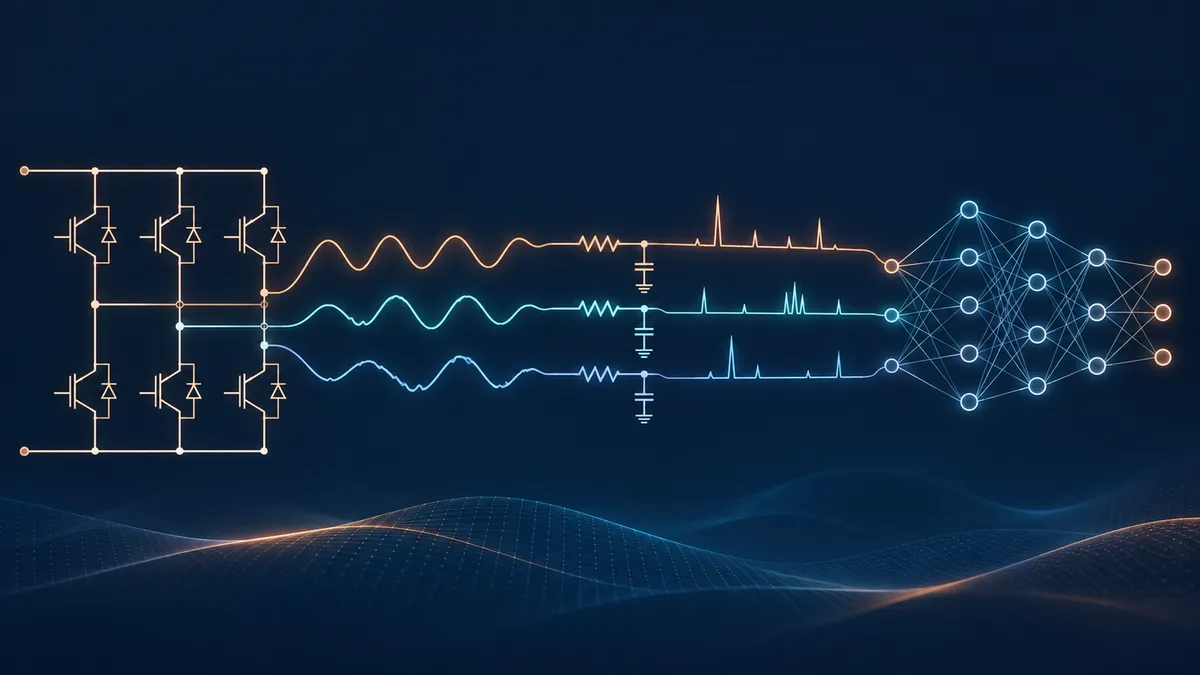
Small departures from a converter’s intended current waveform may carry clues about its components’ condition. A new preprint explores how artificial neurons could turn those departures into estimates of electrical resistance, without directly measuring each switch’s voltage drop.
A circuit-inspired artificial intelligence system could help monitor power-electronics components using three-phase AC current measurements, according to a preprint by Yubo Song, Pascal A. Schirmer and Subham Sahoo. Their study demonstrates resistance estimation in simulations, while identifying ambiguities and noise sensitivity that limit individual-device diagnosis.
The paper, Circuit Theory-Informed AI for Condition Monitoring in Power Electronics, was posted on November 6, 2026, as arXiv:2611.09141v1. Its landing page states that the manuscript has been accepted for the Proceedings of the 2026 IEEE Design Methodologies Conference. The evidence discussed here comes from the supplied preprint.
Turning current errors into spikes
The target is a power semiconductor’s on-state resistance: its resistance while conducting. The authors treat an increase in this quantity as an indicator of degradation. Rather than measure it directly, they infer it from changes in the converter’s output currents.
Their simulated system is a grid-connected DC-to-AC converter with six switching devices. It operates with a 400-volt DC supply, a 50-hertz fundamental frequency and a 10-kilohertz switching frequency. The monitoring method compares each phase’s measured current with its intended sinusoidal reference.
For each phase, the researchers square that difference and integrate it over time. They then pass the resulting numerical signal through a resistor-capacitor filter. This produces a quantity interpreted as an artificial neuron’s membrane potential. The paper explicitly describes the initial conversion as a numerical mapping, rather than a physically dimensioned current relationship.
A leaky integrate-and-fire neuron accumulates stimulation while also allowing it to decay. When its membrane potential reaches a threshold, it emits a spike. In latency coding, information is represented by when that spike first occurs: stronger input can produce an earlier event.
The demonstrated encoding window spans 40 milliseconds, or two fundamental cycles, with current sampled at 10 kilohertz. Eight thresholds per phase provide 24 input channels. Their spike sequences are represented using 100 time steps, and spikes are expanded into bursts of five to make sparse inputs more informative to the network.
Learning resistance patterns
The neural network has two hidden spiking layers of 64 neurons each and six output neurons. It combines output membrane potentials and firing rates to estimate the six devices’ resistance increases.
All data were generated in PLECS circuit simulations. The basic training set contains 4,096 combinations, formed by assigning each device one of four resistance increases: 0, 0.3, 0.6 or 0.9 ohms. Training runs extend to 400 epochs. Additional evaluations use an expanded dataset containing another 4,096 random combinations, shuffled and divided into 80% training and 20% testing.
The simulations define resistance increases relative to an ideal starting point in which every device has zero on-state resistance. They examine increases up to one ohm. That setup is a numerical demonstration, not a measurement of actual component aging.
The reported training curve reaches an R² score of about 0.808 and a mean squared error of about 0.021 after 400 epochs. Those are training metrics, not independent evidence of deployment accuracy. A separate assessment uses 1,000 random test combinations; the authors report that most predictions align with their assigned resistance values, while noting room for improvement through more data and tuning.
Where the approach falls short
Some switches produce similar current signatures because of the converter’s geometric symmetry. Consequently, different internal resistance patterns can be difficult to distinguish from AC currents alone. The authors also examine predicting resistance sums for device groups, rather than resolving every switch separately.
Noise poses another limitation. Tests add white Gaussian noise to sampled currents at signal-to-noise ratios of 70, 50 and 30 decibels, evaluated relative to the nominal 10-amp current rating. The authors report behavior closer to the noise-free case at sufficiently high signal-to-noise ratios, but warn that excessive noise can prevent convergence by generating misleading spikes.
The study does not establish measured energy savings or performance on operating converter hardware. Its efficiency argument rests on the potential of event-driven spiking computation. Likewise, “data-light” primarily describes limited sensing inputs; the model still learns from thousands of simulated examples and requires current reference signals.
Additional voltage or switching information, alternative encodings and online learning are proposed extensions, not demonstrated capabilities. The present contribution is a simulation-based route from current deviations to resistance estimates—not yet a validated system for predicting equipment failure or remaining lifetime.
- power electronics
- condition monitoring
- spiking neural networks
- neuromorphic computing
- latency coding
- resistance estimation
- circuit simulation
Related reading
Automatically matched by shared topic keywords. These links do not imply that the sources agree or establish a consensus.