TRANSMISSION // 2611.09140v1
SPDMX turns public-domain scores into a large open collection of musical parts
Source published
SPDMX pairs synthesized instrument tracks with MIDI across 253,982 songs. Its open rendering pipeline offers substantial material for music-machine-learning research, but synthetic sound, uneven instrument coverage and limited listening evaluation constrain what the release demonstrates.
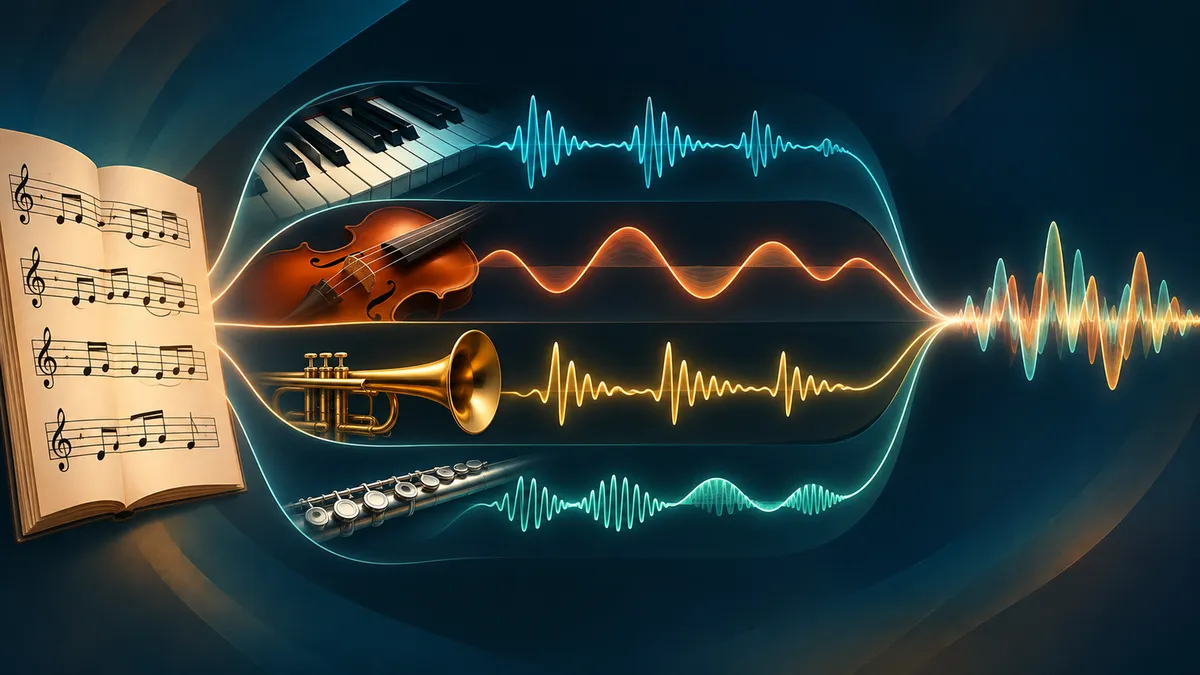
Teaching a computer to separate instruments requires examples where the individual parts are already available. SPDMX creates those examples from public-domain musical scores, trading the realism of studio recordings for scale, aligned musical instructions and an openly reusable synthesis pipeline.
A finished music recording blends instruments together. For researchers teaching computers to recover those instruments, the ideal training example also includes each part separately. These isolated tracks, called stems, provide a target against which a model’s output can be compared. Yet large collections of redistributable musical stems remain difficult to assemble because of recording costs and copyright restrictions.
Phillip Long, Eduardo Escoto, Julian McAuley and Zachary Novack at the University of California, San Diego describe an alternative: synthesize the parts from public-domain scores. Their SPDMX dataset contains 253,982 songs, 490,159 mono stems and 5,469 song-hours of audio. The work is an arXiv preprint, submitted on November 6, 2026, and has not been peer reviewed.
What the collection contains
SPDMX builds on PDMX, a collection of public-domain scores. Each song comes with MIDI, which encodes musical instructions such as note pitches, timing and instrument assignments. Shared identifiers let users connect the audio to scores and other information in PDMX.
The distinction between songs and multitrack songs matters. Only 88,403 songs, or 34.8%, contain at least two stems. Those songs account for 2,734 song-hours—roughly half the collection’s duration. The other 165,579 songs have a single stem and can support tasks such as synthesis or transcription, but do not provide multiple sources to separate.
“Song-hours” counts each song’s duration once, rather than adding up the durations of all its stems. Among the resources surveyed in the paper, the authors identify SPDMX’s multitrack subset as the largest openly licensed synthetic collection by this measure. Their comparison lists 145 hours for Slakh2100 and 1,411 hours for CocoChorales. This is a comparison of scale, not proof of better sound or better trained models.
Choosing how each instrument sounds
The researchers first corrected instrument assignments when MIDI program codes disagreed with recognizable track names—for example, a violin part encoded as piano—and removed tracks without note events.
They then compared rendering approaches. FluidSynth converts MIDI into audio using soundfonts, collections of instrument sounds. A basic approach used one soundfont bank; a varied approach selected from several redistribution-compatible banks by instrument category and added light reverberation.
For supported strings, brass and winds playing one note at a time, the team also tested MIDI-DDSP, a neural synthesizer. Parts with simultaneous notes, unsupported instruments and other ineligible tracks fell back to FluidSynth. Voice-category tracks used choir or voice soundfonts, not synthesis of sung lyrics.
Eight listeners rated the perceived realism of 10-second excerpts, with two stems representing each of ten instrument categories. Conditions were shuffled and unlabeled, and ratings ran from zero to 100. The authors used this small pilot to guide design rather than establish statistical significance. When basic and varied rendering scored similarly, they retained varied rendering to preserve diversity.
The final recipe uses basic rendering for drums, organ and guitar; varied rendering for piano, voice, mallet and miscellaneous instruments; and MIDI-DDSP hybrids for eligible strings, brass and winds. These choices reflect the pilot’s preferences, not a demonstrated improvement across every track.
Keeping parts and mixtures consistent
After rendering, the team normalized stems toward a loudness target of −23 LUFS with peak limiting. To retain an element of the balance encoded in MIDI, they then scaled each stem using its maximum note-on velocity relative to the song’s maximum. A shared anti-clipping gain kept the combined signal within range while preserving the relationship between the parts and their sum.
The release supplies mono FLAC stems at 44.1 kHz. Multitrack songs also include a mono mixture equal to the linear sum of their stems. The authors distribute the rendered audio, MIDI and release tables under CC BY 4.0 and describe an open pipeline that avoids proprietary commercial instrument libraries.
What remains unproven
SPDMX is not a substitute for every kind of recorded music. Piano accounts for more than half the stems, most songs are single-stem, and the score-derived MIDI has quantized timing and dynamics. Every stem is mono. MIDI-DDSP generates audio at 16 kHz before upsampling, so those tracks do not acquire the full frequency bandwidth of native 44.1 kHz recordings.
The listening pilot is too small to establish absolute realism across the corpus. The paper also reports that project-page separation and transcription checks indicate usable alignment between synthesized audio and its labels, but supplies no numerical results for those checks in the paper itself. Its clearest contribution is therefore a large, openly reusable collection with paired musical instructions—not demonstrated gains on real-recording benchmarks.
- SPDMX
- music datasets
- public-domain scores
- audio synthesis
- source separation
- MIDI
- multitrack audio
- machine learning
Related reading
Automatically matched by shared topic keywords. These links do not imply that the sources agree or establish a consensus.
Machine learning connects atomic physics to simulations of stellar winds
Source published
Shared keywords: machine learning
PHISHREV+ uses explicit rules to reconsider phishing alerts
Source published
Shared keywords: machine learning
Satellite links detect rain better when neighboring receivers share information
Source published
Shared keywords: machine learning
Heart failure prediction models need stronger validation, review finds
Source published
Shared keywords: machine learning
Can AI read cosmic structure without becoming overconfident?
Source published
Shared keywords: machine learning