TRANSMISSION // 2611.09139v1
CARGO trains simulated vehicles to distinguish helpful cooperation from avoidable risk
Source published
A reinforcement-learning framework uses inferred vehicle interactions and predicted risky outcomes to guide cooperative highway merging. It outperformed seven comparison methods on success and crash rates in simulation, but difficult merges remained largely unsuccessful, and its safety claims depend on model accuracy and restrictive assumptions.
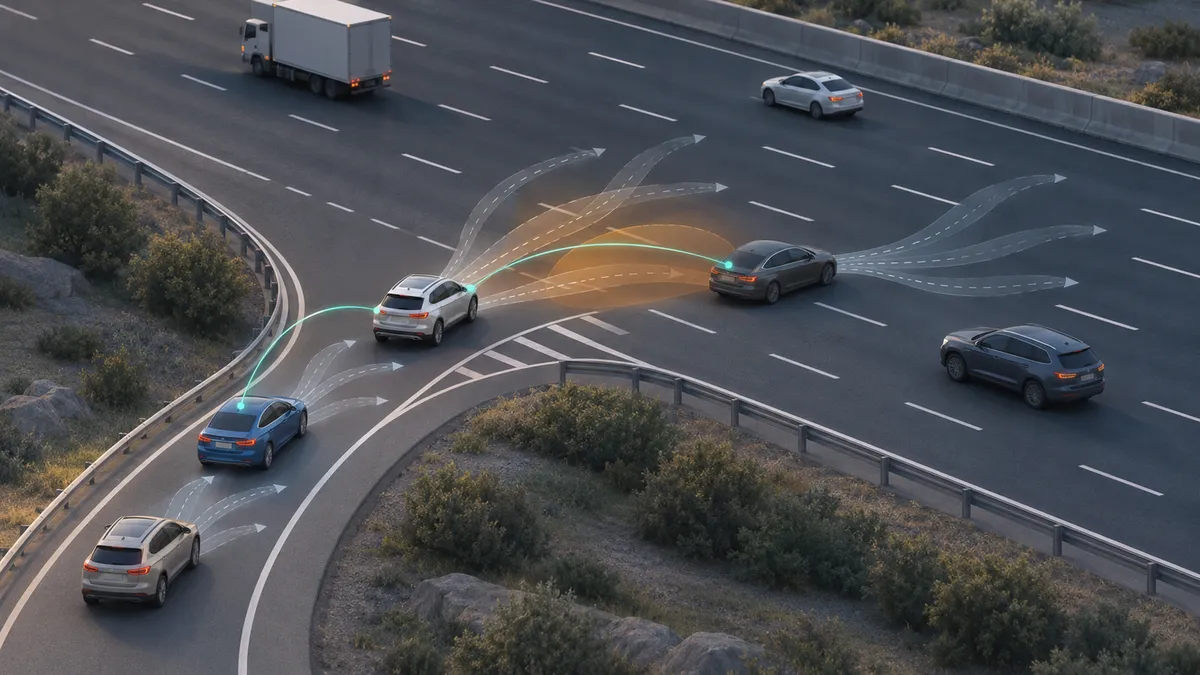
When one vehicle brakes near a highway entrance, is it helping another merge, reacting to congestion, or correcting a danger someone else created? CARGO, a new research framework, tries to separate these possibilities so automated vehicles can learn whom to help—and which behavior needs changing.
A vehicle exposed to danger is not necessarily the vehicle that created it. Likewise, influencing another driver is not automatically helpful. These distinctions motivate CARGO, a multi-agent reinforcement-learning framework developed by Jingjia Teng, Yang Li and Wenjie Huang at Hunan University.
Their paper, posted to arXiv on November 6, 2026, is a preprint rather than established, peer-reviewed evidence. It examines cooperative on-ramp merging in a simulator, where automated vehicles learn alongside vehicles controlled by mathematical models of human driving.
Separating influence from coincidence
Reinforcement learning trains decision-making policies through rewards and penalties. Here, each automated vehicle chooses among five high-level actions: changing lanes left or right, accelerating, decelerating or maintaining speed. Its observations include its own motion and information about up to four nearby vehicles.
CARGO first tries to infer which automated vehicles influence one another. This is harder than detecting correlated behavior: two vehicles might slow together because of shared congestion, not because one caused the other to brake.
The framework compresses recent observation and action histories into a probabilistic representation of shared, partly hidden traffic conditions. It then predicts another vehicle’s next action under different actions by the source vehicle, keeping the inferred context fixed. Repeated samples of that context reveal how uncertain an inferred influence is. Only sufficiently strong, confident connections are retained.
Calling these connections causal requires assumptions, including that the available observations and inferred context adequately account for factors affecting both the source action and the recipient’s response. Learning a hidden-context representation does not, by itself, establish that those assumptions hold.
Rewarding help and targeting risk
CARGO uses influence in two separate ways. For cooperation, it combines whether an action encourages or discourages another vehicle’s behavior with an estimate of whether that behavior benefits the team. This supplies an additional training reward for facilitating useful actions or discouraging harmful ones—not simply for exerting influence.
For safety, a conditional diffusion model generates possible future observations under alternative actions. A separate predictor assigns safety costs reflecting collisions and vehicles approaching one another too quickly. The system emphasizes the worst generated outcomes: in the reported setup, it predicts five future steps, generates eight response samples and averages the two highest cumulative costs for its tail-risk estimate.
An action receives a responsibility score when its predicted risk exceeds the expected risk under a reference policy that favors lower-risk alternatives. Risk imposed on one affected vehicle cannot be cancelled by a reduction for another. This is a computational allocation of avoidable predicted risk, not a judgment of legal responsibility.
The framework then checks proposed learning updates against estimated safety limits with reserved margins. If correction is needed, higher-responsibility agents receive stronger risk-reduction requirements, capped by how much a small policy change could plausibly achieve. Requirements are reduced if they cannot be satisfied together. The procedure can fall back to safety-only correction or reject the update.
These auxiliary models operate during training. Deployed policies use local observations without running the causal and diffusion models.
What the simulations found
The researchers used a modified highway-env simulator with three traffic densities, ranging from four to six vehicles in total at low density to eight to ten at high density. Human-driven vehicles followed programmed driving models with small random perturbations; no actual human drivers participated.
Seven comparison methods included other multi-agent learning approaches and model predictive control. Learning methods trained for two million environment steps across three random seeds. Each density was tested over 300 episodes, distributed across three test seeds.
CARGO recorded the highest merging success and lowest crash rates in all three settings. At high density, success reached 31.00%, compared with 18.67% for the strongest success-rate baseline, model predictive control. That is a 12.33-percentage-point increase, reported as a 66.04% relative improvement.
Its high-density crash rate was 4.67%, versus 10.67% for the strongest crash-rate baseline, Safe-MAA2C—a reported relative reduction of 56.23%. Those headline comparisons therefore use different baseline methods. Success required every initial ramp vehicle to merge without any collision, so avoiding a crash did not necessarily mean completing the task.
Removing components weakened performance. Without the cooperation incentive, high-density success fell to 2.33%. Controlled interaction tests also showed fewer false influence connections with uncertainty-aware modeling, although substantial false connections remained when direct influences were weakest.
Why this is not a safety guarantee
The results remain simulation evidence from a particular road layout, small vehicle groups and simplified human behavior. Even the full method failed to achieve successful merging in most high-density episodes. Merging-time comparisons also include only successful episodes.
The mathematical analysis concerns predicted risk and sufficient local conditions for preserving task performance. It does not guarantee collision-free driving. Empirically chosen safety margins do not establish reliable error bounds, and generating more futures cannot eliminate a biased prediction model. CARGO offers evidence for combining cooperation incentives with targeted training corrections, not proof that the resulting vehicles are ready for public roads.
- CARGO
- multi-agent reinforcement learning
- cooperative driving
- on-ramp merging
- causal attribution
- risk prediction
- diffusion models
- autonomous vehicle simulation
Related reading
Automatically matched by shared topic keywords. These links do not imply that the sources agree or establish a consensus.
CoSafe coordinates safety interventions across self-driving cars
Source published
Shared keywords: cooperative driving
Can language-model feedback help edge servers share resources?
Source published
Shared keywords: multi agent reinforcement learning
PEEK improves diffusion image scores at matched denoiser-evaluation budgets
Source published
Shared keywords: diffusion models
Can safety checks help AI plan routes for multiple agents?
Source published
Shared keywords: diffusion models
A robot's-eye view, generated from outside video
Source published
Shared keywords: diffusion models