TRANSMISSION // 2611.09128v1
Hot Jupiter magnetism may depend on where their extra heat goes
Source published
A modeling study predicts that inflated hot Jupiters could have strong or weak magnetic fields depending on where energy enters their interiors. The authors provide a public Python tool and approximate formulas, but emphasize that the predictions remain uncertain and existing observations cannot yet distinguish the scenarios.
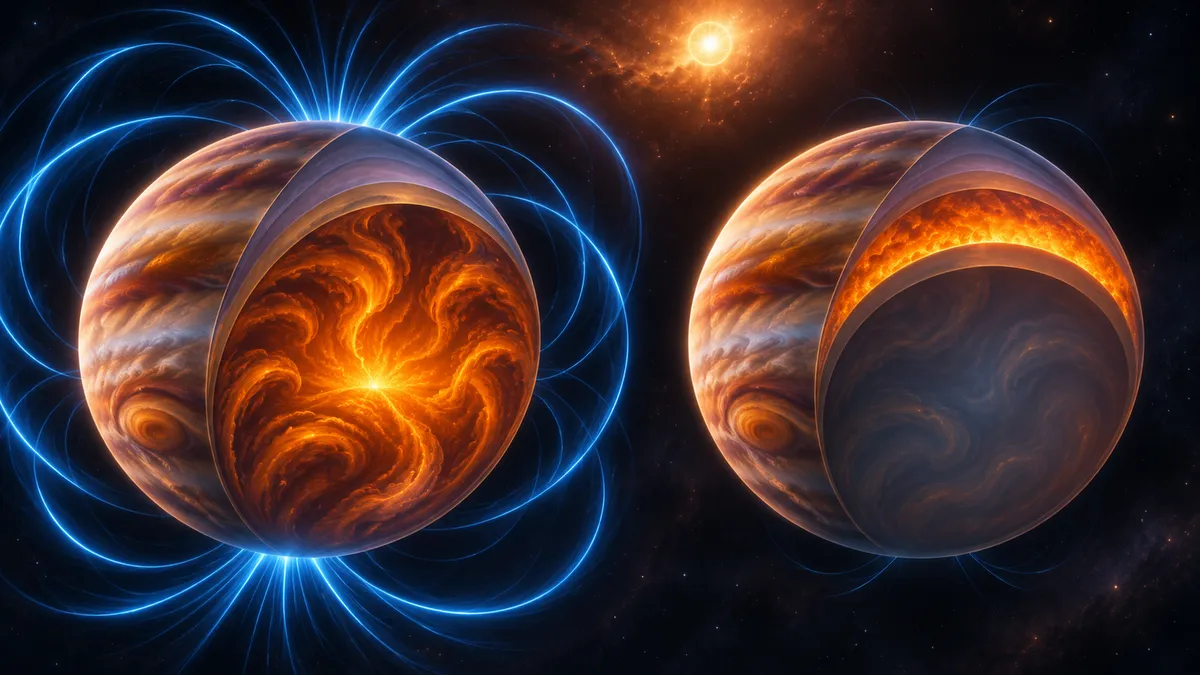
A giant planet can be swollen by extra heat without developing an especially strong magnetic field. A new preprint explores how the depth of that heating could make otherwise similar hot Jupiters magnetically very different.
Hot Jupiters are gas giants that orbit close to their stars, often completing a year in just a few days. Many are larger than standard planetary evolution models predict. Whatever keeps them inflated may also influence their magnetic fields—but adding heat does not necessarily make their internal magnetic engines stronger.
A preprint led by Albert Elias-López of Leiden University explores that distinction. The researchers predict surface magnetic fields ranging from below Jupiter’s strength to tens or roughly a hundred gauss, depending on where the inflation-producing energy is deposited. Gauss is a unit of magnetic-field strength; Jupiter’s equatorial surface dipole is about 4.2 gauss.
The work was posted to arXiv and is listed as submitted to Astronomy & Astrophysics, under review. It offers model predictions, not new magnetic-field detections or established evidence for a particular heating mechanism.
Two ways to inflate a planet
Planetary dynamos generate magnetic fields through the motion of electrically conducting material. In giant planets, this includes hydrogen compressed into a metallic, conducting state. Convection—the movement of material transporting heat—helps power that process.
The team used MESA, a planetary and stellar evolution code, to calculate one-dimensional interior models. They compared two idealized heating arrangements rather than committing to one explanation for inflation.
In the deep-heating case, extra energy enters the interior where it can increase the heat transported through the dynamo. In the shallow-heating case, it enters outer convective layers above the metallic-hydrogen region. That heating can maintain a large radius while reducing the deep convection available to generate magnetism. It can also create stable layers that suppress convection locally.
The researchers combined those interiors with an existing relationship between convective power and magnetic-field strength. They assume the deep interiors remain in a regime where rotation strongly influences convection, even though hot Jupiters generally rotate more slowly than Jupiter. Their calculation also applies a rotation-related reduction in convective velocity, calibrated against Jupiter, after computing the planetary evolution; its feedback on that evolution is not included.
From interior models to practical estimates
Each heating scenario used approximately 5,000 evolutionary models, spanning 0.3 to 12 Jupiter masses and a wide range of irradiation and heating efficiencies. The interpolation grids use models evolved to five billion years. Interpolation estimates values between simulated cases, allowing measured mass, radius, incoming stellar radiation and orbital period to produce magnetic-field predictions.
Of 620 catalogued planets initially within the relevant parameter ranges, approximately 426 received field estimates after planets smaller than the models’ unheated reference radii were excluded. Further cuts removed marginally inflated planets and cases requiring unusually large heating efficiencies, leaving 356 planets to calibrate the inflated-planet formulas.
Deep heating generally produced equatorial surface dipole fields of about 10–100 gauss. Shallow heating yielded roughly 0.1–10 gauss, commonly one or two orders of magnitude weaker. These are predictions for the large-scale, bar-magnet-like component at the surface, not the stronger fields that may exist inside the planet.
The simplest approximate formulas are Bstrong ≈ 19 M^0.6 R^1.7 gauss and Bweak ≈ 0.8 M^1.5 R^-1.2 gauss, where M and R are mass and radius in Jupiter units. Larger radius therefore predicts stronger magnetism in the deep-heating formula but weaker surface magnetism in the shallow-heating formula. The authors recommend their public Python interpolator when more detailed estimates are needed: the formulas capture broad trends, not every planet’s modeled behavior.
Why observations do not yet settle the question
Earlier estimates based on possible magnetic interactions between planets and their stars favor fields of tens to around 100 gauss, broadly matching the strong-field scenario. Atmospheric wind measurements for seven ultra-hot Jupiters instead suggest upper limits of a few gauss, closer to the weak-field picture.
Neither comparison is straightforward. Star–planet interaction estimates depend on uncertain energy-conversion efficiencies. Atmospheric limits rely on assumptions about how magnetic forces brake ionized winds. Atmospheric, polar and equatorial dipole fields are also different quantities; converting between them requires uncertain assumptions about field geometry. The studies probe different planetary populations.
The theoretical limits matter too. The two scenarios deliberately use different assumed outer dynamo boundaries to widen the predicted range, so heating depth alone does not account for the entire contrast. The adopted dynamo relationship has not been directly validated for inflated hot Jupiters. Complex magnetic geometries could make their dipole components substantially weaker, especially in shallow-heating models.
The authors treat the results as order-of-magnitude estimates, adopting a representative factor-of-two systematic uncertainty rather than a formal confidence interval. Composition can cause larger shifts in individual cases. Constant heating and irradiation, simplified interiors and the representative age further limit applicability, particularly to young planets.
Future wind measurements, star–planet interaction studies and radio searches could test these scenarios together. Existing hot-Jupiter radio non-detections do not rule out strong fields: emission may be faint, absorbed, intermittent or directed elsewhere. For now, the study provides a framework for testing how inflation and magnetism are connected, not a verdict on which heating process dominates.
- hot Jupiters
- exoplanet magnetic fields
- planetary inflation
- planetary dynamos
- interior heating
- MESA
- radio observations
- Python
Related reading
Automatically matched by shared topic keywords. These links do not imply that the sources agree or establish a consensus.