TRANSMISSION // 2611.09069v1
UniRGBA adds transparency to a pretrained video generator—with trade-offs
Source published
ByteDance researchers report a targeted adaptation of Wan2.1 that generates video with transparency. Tests show stronger visual-effects reconstruction and several generation gains, but not uniformly better performance or unchanged RGB quality.
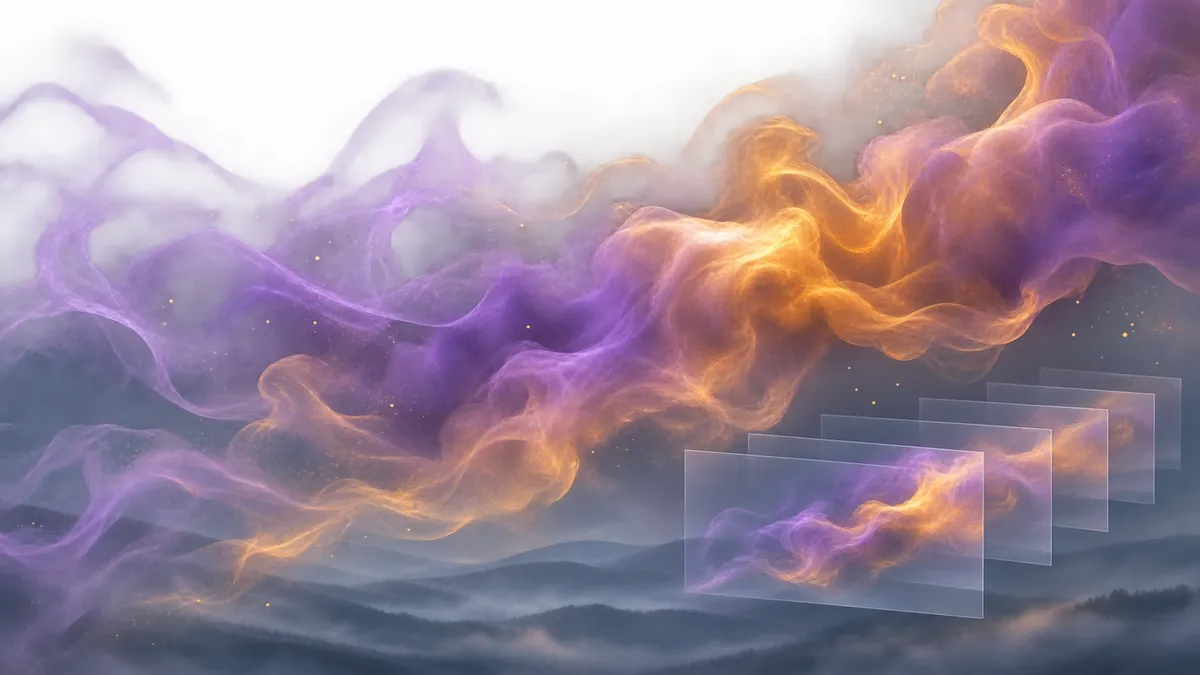
Generating convincing smoke is only part of the challenge for video effects: editors also need transparency information to place it over another scene. UniRGBA aims to produce color and transparency together while reusing a pretrained video model.
Why transparency needs more than a cutout
Most video generators produce red, green and blue channels, or RGB. Compositing effects onto another background also requires an alpha channel, which specifies how opaque each pixel should be. Smoke, flames and scattered particles need gradual transparency, not simply a boundary separating an object from its surroundings.
In a preprint submitted to arXiv on November 6, 2026, ByteDance researchers Lei Xu, Zhuo Li, Yongyi Jin and Aoyu Wang describe UniRGBA, an adaptation of the Wan2.1 video-generation system. Their central proposal is to add transparency support through targeted changes rather than build a separate alpha-processing architecture.
The authors argue that approaches trained on foregrounds extracted from ordinary footage can struggle with diffuse visual effects. Their experiments focus on that effects-oriented setting, rather than establishing performance across every kind of transparent video.
Changing the compression system
UniRGBA makes its main architectural changes to the variational autoencoder, or VAE. This component compresses video into the latent representation used by the diffusion transformer and decodes that representation back into video.
The researchers expand the VAE’s input and output from three color channels to four RGBA channels. They retain the existing latent dimensions rather than adding a separate alpha-token stream. Newly added channel weights start at zero, preserving the original RGB behavior at initialization; that does not guarantee identical behavior after training.
Only selected layers near the encoder’s input and decoder’s output are updated—about 5% of the VAE’s parameters. Most of the compression network remains frozen.
Training combines color and alpha reconstruction, perceptual similarity, and checks on how reconstructed footage looks when composited over random background colors. Another term encourages the adapted latent distribution to remain close to that of the frozen original RGB encoder. This is a soft constraint intended to limit drift, not a mathematical guarantee that existing capabilities remain unchanged.
A second training stage adds a small adversarial objective on composited outputs to refine details. For text-to-video generation, the team then uses DoRA, a parameter-efficient adaptation method, to update parts of the pretrained diffusion transformer without adding alpha-specific attention or conditioning branches.
Stronger reconstruction, but not everywhere
The final VAE was trained on 17,000 internally curated transparency-bearing effects videos. On the reported RGBA benchmark, its overall peak signal-to-noise ratio, or PSNR, reached 29.16 decibels, compared with 25.00 for Wan-Alpha. Higher PSNR indicates closer pixel-level reconstruction. Alpha-channel PSNR increased from 30.50 to 34.45 decibels.
The improvements were not universal. Wan-Alpha scored better on the reported masked-region alpha PSNR: 22.54 versus UniRGBA’s 22.02. Moving from UniRGBA’s first to second training stage also slightly reduced structural similarity and masked-region RGB fidelity, despite improving several overall measures.
Ordinary RGB reconstruction provides another important qualification. On 5,000 WebVid test samples, UniRGBA scored below the original Wan2.1 VAE on all three headline reconstruction measures: PSNR, structural similarity and perceptual distance. PSNR was 33.41 rather than 36.73 decibels. Those results do not support a blanket claim of unchanged RGB reconstruction quality.
Generation gains and remaining gaps
The transformer adaptation used 2,357 RGBA video-caption pairs, with captions generated automatically and checked by people. The researchers held out 100 RGBA videos for generation evaluation.
Against Wan-Alpha, UniRGBA scored higher on automated measures of text alignment, naturalness, motion smoothness and resistance to temporal flickering. However, its aesthetic-quality score was lower: 0.4694 versus 0.5232. It exceeded TransPixeler on all five reported RGBA generation metrics.
A separate RGB-generation comparison used a manually selected 100-sample WebVid subset. UniRGBA improved several scores, including aesthetics and naturalness, but scored lower on text alignment and dynamic degree, with slightly lower motion smoothness. The evidence therefore points to mixed preservation of RGB-generation performance, not improvement on every dimension.
What the preprint establishes
The results suggest that a relatively small architectural intervention can make a pretrained generator useful for transparent visual effects. Their reach remains limited by internal effects-focused data, automated evaluation and testing at 832×480 resolution. Higher resolutions and longer temporal windows remain future work.
Image-to-video support is illustrated qualitatively, without a standardized quantitative comparison. As preprint findings, the reported gains should be read as evidence for this particular approach and evaluation setting—not proof of universal superiority or lossless preservation of the original model.
- UniRGBA
- video generation
- alpha channel
- transparency
- diffusion models
- Wan2.1
- visual effects
- variational autoencoder
Related reading
Automatically matched by shared topic keywords. These links do not imply that the sources agree or establish a consensus.
NextGAN trains a critic to guide faster image and video generation
Source published
Shared keywords: video generation
A robot's-eye view, generated from outside video
Source published
Shared keywords: diffusion models
An image-editing model explores gene and shape signals in kidney cells
Source published
Shared keywords: diffusion models
Giving AI Image Representations a Direction for Change
Source published
Shared keywords: variational autoencoder
Teaching Video Generators Which Emotional Cues to Trust
Source published
Shared keywords: video generation