TRANSMISSION // 2611.09039v1
Neutron star binaries may get their chance after a cluster’s black holes leave
Source published
Simulations suggest that some wide neutron star–star binaries can form late in a star cluster’s life, after black holes stop dominating close gravitational encounters. The study produced three systems meeting broad Gaia-sensitive criteria, but their long, eccentric orbits do not explain the full observed population.
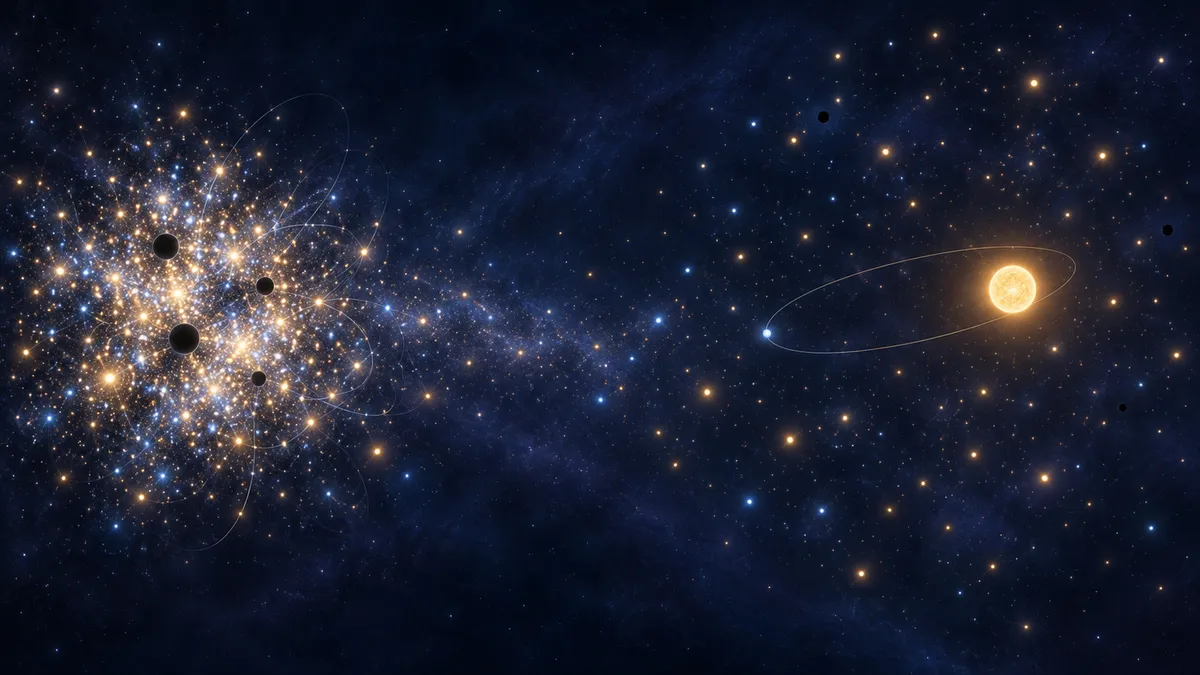
For a neutron star seeking a stellar companion, being in a crowded cluster may not be enough: timing matters too. A new preprint suggests that black holes dominate the encounters that build binaries early on, leaving some neutron stars to acquire companions billions of years later.
Gaia has revealed otherwise inconspicuous binaries in which a visible star orbits a dark companion without significant ongoing mass transfer. The preprint describes three reported dormant black holes and 21 neutron star candidates. Their relatively wide orbits pose a formation puzzle: ordinary binary evolution can shrink or merge a pair, while the explosion that creates a neutron star can break it apart.
Close gravitational encounters in star clusters offer another route, allowing compact objects to acquire new companions. Yet earlier simulations generally produced Gaia-like neutron star binaries much less readily than black hole binaries.
Ryutaro Iwakura and colleagues investigate whether that shortage partly reflects how long simulations follow a cluster. Their preprint, listed on arXiv as accepted for publication in The Astrophysical Journal, finds a late opportunity for neutron stars after the cluster’s black hole population dwindles.
Following clusters into old age
The team ran 20 simulations using the PeTar gravitational dynamics code, coupled to models of single-star and binary evolution and the Milky Way’s gravitational field. Each cluster initially contained 10,000 solar masses, with half that mass inside a radius of 0.5 parsecs. Ten simulations used each of two chemical compositions, with heavy-element mass fractions of 0.02 and 0.002.
The clusters followed circular Galactic orbits 12 kiloparsecs from the Galactic center. These deliberately chosen conditions encouraged black holes to be depleted early while allowing the clusters to survive for billions of years. The calculations continued to seven billion years, by which point the clusters had lost more than 95% of their initial mass.
Neutron star retention depended strongly on assumptions about their birth velocities. Most neutron stars formed in ordinary core-collapse supernovae escaped. Alternative channels received small or zero velocity kicks, allowing more remnants to remain. The adopted treatment of an evolutionary stage in which two stars share an envelope also prevented isolated binary evolution from producing detached compact binaries, helping isolate the dynamical pathway.
Present in the core, but not getting the encounters
Black holes, generally the heaviest objects, concentrated toward the cluster center and dominated strong gravitational encounters there. Their numbers typically declined sharply during the first one to two billion years. The researchers defined a cluster as black-hole-depleted when fewer than two remained within its tidal boundary.
Crucially, some neutron stars were already in the core before this transition. Their spatial distribution showed no abrupt change when the black holes disappeared. The authors therefore interpret the transition not as neutron stars suddenly reaching the right location, but as their gaining access to encounters previously dominated by black holes.
Across all runs, the team identified 11 dynamically assembled black hole–main-sequence binaries and nine neutron star–main-sequence binaries. Here, dynamically assembled means that the compact object acquired its current companion through an interaction inside the cluster, rather than retaining an original partner.
For comparison with Gaia, the researchers selected binaries with periods between 100 and 10,000 days that had escaped their clusters or remained after effective cluster dissolution. These broad criteria are not a model of Gaia’s actual detection process.
Four black hole binaries and three neutron star binaries qualified; all seven explicitly escaped before the simulations ended. Each qualifying neutron star pair formed after black hole depletion in its own cluster, approximately 2.93, 5.13 or 6.56 billion years into the calculation. Two neutron star binaries formed and escaped very early, but their periods were too short to qualify.
A pathway, not a population-wide explanation
One traced example began with two stars that evolved into white dwarfs, merged and produced a 1.87-solar-mass neutron star through accretion-induced collapse, with no birth kick. It remained single for roughly 1.5 billion years before undergoing repeated encounters and companion exchanges. Its final pairing, with a 1.01-solar-mass star, formed around 2.93 billion years and escaped shortly afterward.
The three qualifying neutron star systems had periods of roughly 5,000–6,300 days and eccentricities of 0.69–0.97, indicating strongly elongated orbits. They favor the wide, eccentric end of the relevant parameter range. The authors suggest that late assembly, after cluster expansion, leaves limited opportunities for further encounters to tighten their orbits.
Three systems cannot establish a reliable formation efficiency, and these compact, deliberately selected clusters do not represent all cluster environments. In the traced example, black hole depletion also coincided with surviving main-sequence stars becoming comparable in mass to the neutron star, so their individual contributions cannot be separated. The study supports a delayed formation pathway—not a complete explanation of Gaia’s neutron star candidates.
- neutron stars
- binary stars
- star clusters
- Gaia
- black holes
- N-body simulations
- stellar dynamics
- accretion-induced collapse
Related reading
Automatically matched by shared topic keywords. These links do not imply that the sources agree or establish a consensus.
How collapsing star clusters could help build early massive black holes
Source published
Shared keywords: star clusters, stellar dynamics
Stellar Accelerations and Jerks Could Help Gaia Find Hidden Black Holes
Source published
Shared keywords: binary stars
Stellar Motions Put NGC 3227’s Black Hole at About 12 Million Suns
Source published
Shared keywords: stellar dynamics
Close companions are unlikely to explain most slow-spinning stars in open clusters
Source published
Shared keywords: binary stars
Stellar motions sharpen the estimate of M87’s black hole mass
Source published
Shared keywords: stellar dynamics