TRANSMISSION // 2611.08925v1
Close companions are unlikely to explain most slow-spinning stars in open clusters
Source published
A preprint comparing stellar velocities in 40 open clusters with simulated binary populations finds less orbital-motion scatter than expected if close companions had slowed most of the selected stars. The result challenges tidal braking as the dominant explanation, without ruling out individual binaries or identifying the main alternative.
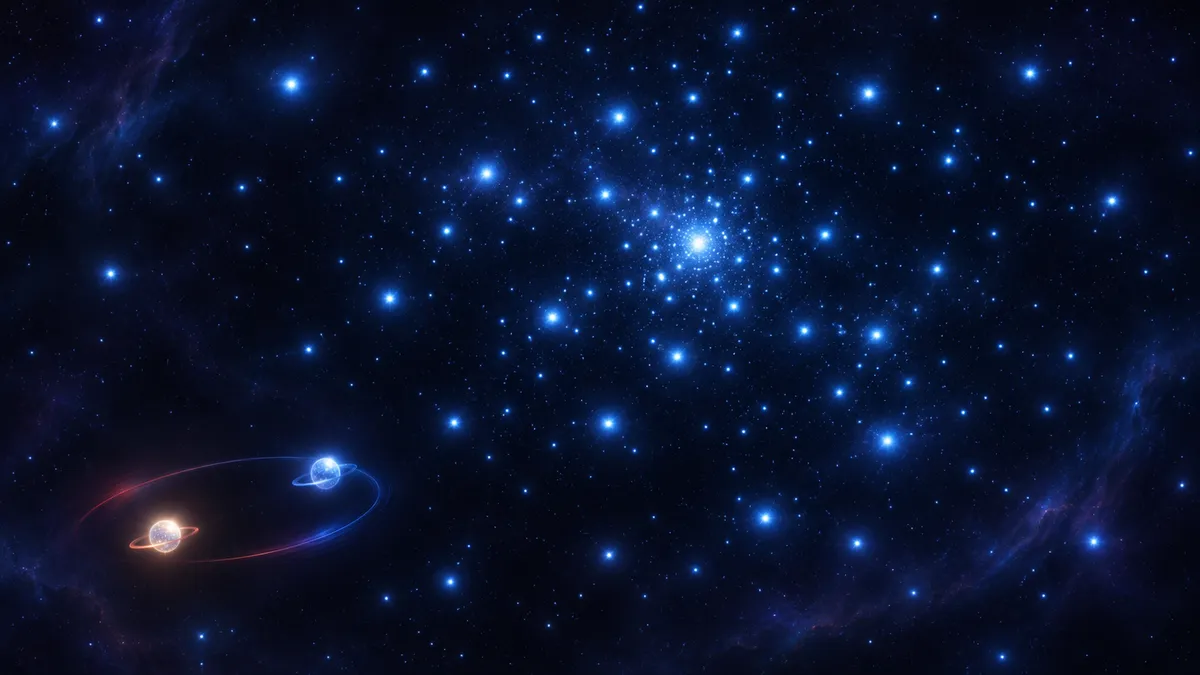
Why do some stars in young clusters spin much more slowly than their neighbours? A close companion could act as a gravitational brake, bringing a star’s rotation into step with its orbit. But a new preprint finds that the stars’ motions generally lack the strong signature expected if this process were responsible for most slow rotators.
A proposed brake with an observable signature
In clusters younger than about two billion years, stars can occupy a surprisingly broad region of a colour–brightness diagram near the main-sequence turn-off, where stars begin leaving their main hydrogen-burning stage. These extended turn-offs, and sometimes split main sequences, are widely attributed primarily to differences in stellar rotation.
The puzzle is not simply that slowly rotating stars exist. Some clusters contain a substantial, sometimes distinct, slow-spinning population. One proposed explanation is tidal braking: gravitational interactions with a binary companion can synchronize a star’s rotation with its orbital motion, slowing an initially rapid spinner.
That explanation makes a testable prediction. Stars orbiting close companions should move towards and away from us at appreciable speeds. A population dominated by such binaries should therefore show a broad spread of radial velocities—the component of motion along our line of sight.
In their preprint, submitted to arXiv on November 6, 2026, Zixun Zhan, Chenyu He, Weijia Sun and Chengyuan Li test that prediction using ground-based spectroscopy and Gaia’s third data release.
Selecting stars and measuring their motions
The team used spectra from the Very Large Telescope’s GIRAFFE instrument and the Southern African Large Telescope’s Robert Stobie Spectrograph for eight benchmark clusters. These observations supported a larger analysis of 40 Milky Way open clusters; the samples overlap and should not be counted as 48 independent clusters.
For the ground-based data, the researchers fitted synthetic absorption-line profiles to estimate radial velocities and projected rotation speeds. Their refined selection excluded stars with projected speeds above 200 kilometres per second, candidate near-equal-mass binaries and identified spectroscopic binaries.
The Gaia analysis selected stars with estimated masses between 1.5 and three times the Sun’s mass, using their location near the blue edge of the colour–brightness diagram. This is a proxy for the slow-rotator population, not a direct classification of every star. It can include moderately rotating stars viewed nearly along their rotation axes.
For each cluster, the researchers measured the spread in stellar radial velocities using an estimator designed to resist extreme outliers. Repeatedly resampling the measurements supplied uncertainty estimates. They also corrected the Gaia dispersions for measurement errors and the cluster’s internal velocity spread.
Making a fair comparison with binaries
The researchers simulated 10,000 binary systems for each of four fixed orbital periods: 10, 100, 500 and 1,000 days. The models assumed circular orbits, randomly oriented orbital planes and companion-to-primary mass ratios between 0.3 and 0.9.
Their synchronization calculation indicated that efficient tidal braking within the cluster ages should mainly occur in close systems with periods of roughly 10 days or less. Wider systems served as comparison cases.
Crucially, Gaia’s published velocities for the bright stars used here are medians of repeated observations, not single-epoch snapshots. Combining measurements suppresses part of a binary’s orbital signal. The simulations therefore treated ground-based snapshots separately from Gaia-like observations, approximating Gaia’s clustered sampling over its 34-month observing baseline.
For 10-day binaries, the predicted velocity dispersion fell from about 36 kilometres per second in single-epoch observations to about 18 kilometres per second with Gaia-like sampling.
Less scatter than the close-binary models predict
All 40 Gaia clusters had central dispersion estimates below their corresponding 10-day model predictions. Thirty also fell below the 500-day model, and 25 below the 1,000-day model. These comparisons concern population-level velocity spreads: they do not measure individual binary periods.
A stricter selection, retaining approximately the bluest 30% of turn-off stars, left 26 clusters with enough measurements. Their distribution was broadly similar, and all central estimates remained below the 10-day prediction. This argues against the result being simply an artefact of an overly broad selection.
The ground-based benchmarks likewise showed no dispersion exceeding the 10-day prediction. However, measurement noise affected some clusters substantially, while one unusually offset star largely drove the high dispersion in NGC 6134.
What remains unresolved
The result challenges tidal braking as the dominant explanation, not the existence of binaries. Undetected companions, especially wider or lower-mass ones, remain possible. The simulations simplify real populations, which contain mixtures of orbital periods, and some cluster samples are small. Individual uncertainty ranges also limit how sharply clusters can be distinguished from model predictions.
The study does not establish what produces most slow rotators. It narrows one proposed explanation. The authors argue that individual-epoch radial velocities expected from Gaia DR4 should enable a more direct test of binary motion across a larger stellar sample.
- stellar rotation
- open clusters
- tidal braking
- binary stars
- radial velocities
- Gaia DR3
- extended main-sequence turn-offs
Related reading
Automatically matched by shared topic keywords. These links do not imply that the sources agree or establish a consensus.
Stellar Accelerations and Jerks Could Help Gaia Find Hidden Black Holes
Source published
Shared keywords: binary stars, gaia dr3
Colours of 5,377 Star Clusters Trace the Milky Way’s Patchy Dust
Source published
Shared keywords: gaia dr3
A binary star in Sagittarius’s Teapot reveals its orbit—and a distance problem
Source published
Shared keywords: binary stars
A white dwarf’s abrupt magnetic switch hints at compact atmospheric regions
Source published
Shared keywords: stellar rotation
How two young stars may draw gas from a shared reservoir
Source published
Shared keywords: binary stars