TRANSMISSION // 2611.08882v1
Tracing X-ray polarization to probe a black hole’s surroundings
Source published
A methods chapter explains how KerrC combines simulations of curved light paths, scattering and disk reflection to interpret X-ray brightness and polarization together. Applications to Cygnus X-1 illustrate its potential—and the assumptions behind inferred corona shapes and black hole spins.
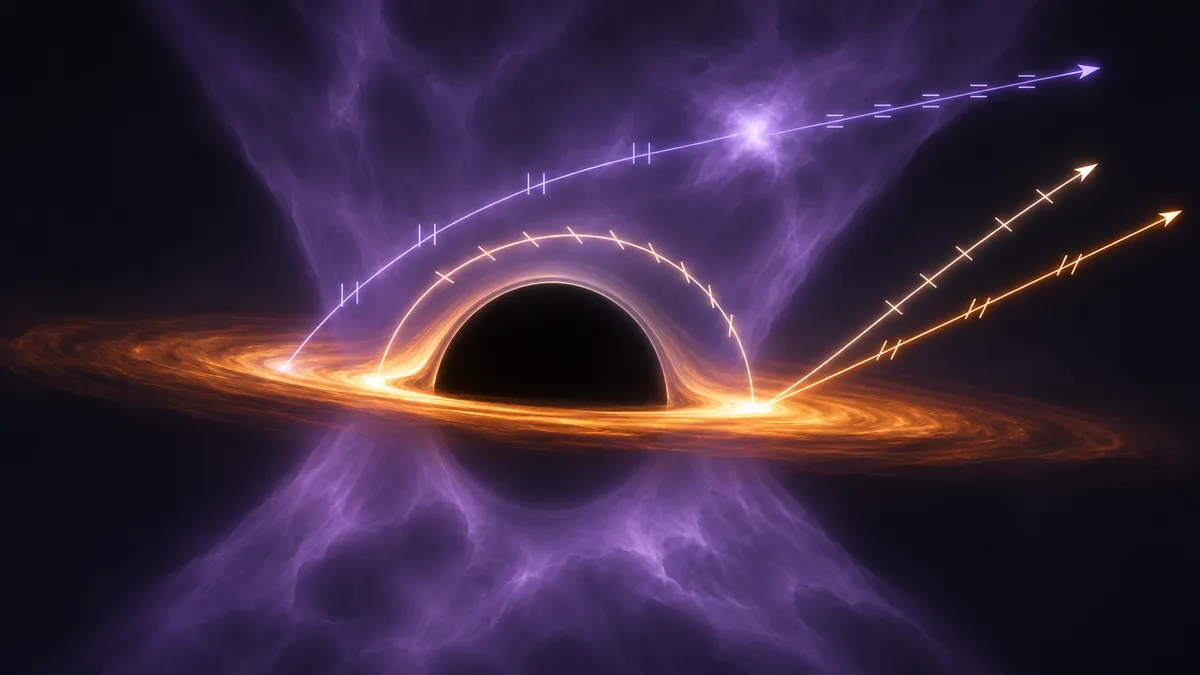
X-rays carry more than an energy signature. Their polarization can also reveal how light scattered through hot gas or returned to an accretion disk under gravity’s pull. The KerrC framework models these intertwined journeys to investigate the environments of stellar-mass black holes.
What can the orientation of X-ray light reveal about material surrounding a black hole? An energy spectrum records how much radiation arrives at different energies. Polarization adds information about the preferred orientation of the light’s electric field, which depends on its emission and scattering history. Interpreting both together requires a model connecting those histories to observable signals.
In a methods chapter posted to arXiv on November 6, 2026, Kun Hu and Henric Krawczynski describe the KerrC framework and applications from earlier studies. The chapter explains an existing modeling approach rather than announcing a new observing campaign. Its central aim is to connect X-ray spectra and polarization to the geometry of hot gas and the spin of an accreting black hole.
Following light through curved spacetime
Black hole X-ray binaries contain a stellar-mass black hole drawing matter from a companion star. The model assumes a geometrically thin, optically thick accretion disk that produces thermal radiation. Some disk photons encounter a corona: hot, dilute plasma whose electrons can transfer energy to the photons through inverse Compton scattering, producing higher-energy X-rays.
KerrC draws on simulations generated by the xTrack code. These follow photon packets—statistical representatives of many photons—from the disk through the curved spacetime around a rotating black hole. The calculation tracks each packet’s motion and polarization, including changes from scattering and the transport of polarization along curved light paths.
Photons need not travel directly outward. Gravity can bend them back onto the disk, and corona scattering can redirect them there too. After reflection, they may scatter again. Tracking these sequences matters because disk reflection and corona scattering are not cleanly separated stages: a single photon can experience both repeatedly before escaping.
The simulated corona can take several prescribed forms, including a wedge surrounding the disk, a conical structure along the rotation axis, or a configuration inside a truncated disk. For the wedge-shaped configuration alone, the chapter reports roughly 100,000 simulated parameter combinations, with 20 million photons followed per run.
Making a simulation library usable
Running that many photon trajectories during every comparison with observations would be costly. Instead, KerrC interpolates among stored simulations to predict intensity and linear-polarization spectra. These predictions can be combined with instrumental responses and other components when fitting data using the Sherpa analysis package.
Reflection requires additional treatment. A fully ionized disk scatters radiation differently from a partially ionized disk, whose atoms produce energy-dependent absorption and emission features. KerrC calculates the radiation striking different disk regions and uses the xillver reflection tables to reweight reflected photon events according to local conditions.
This is an important approximation, not a complete replacement of every reflection calculation. The reflected polarization remains based on Chandrasekhar’s scattering-atmosphere treatment. A faster version, KerrClight, also uses that fully ionized description for reflection intensity, avoiding the more expensive table-based processing.
What Cygnus X-1 illustrates
The chapter reviews applications to Cygnus X-1. In its hard spectral state, where corona emission dominates, earlier IXPE observations measured about 4% polarization in the 2–8 kiloelectronvolt band, oriented close to the radio jet’s direction. The models discussed favor a corona extending along the disk rather than vertically along the jet axis. Scattering in those different geometries produces different preferred polarization directions. The chapter also cites hard-X-ray measurements from XL-Calibur with roughly 5% polarization aligned with the jet.
The soft state presents another puzzle. Although thermal disk emission dominates the spectrum, IXPE measured approximately 2% polarization still aligned with the jet. The chapter describes a model explanation involving returning radiation: photons bent back onto the disk and reflected before escape. Reflected light can have a strong influence on the combined polarization even when direct light supplies most of the flux.
Within the soft-state interpretation described, reproducing the signal requires a dimensionless black hole spin above 0.96. That is a model-dependent inference, not a direct measurement independent of the assumed disk and corona physics.
Where the interpretation remains conditional
The framework uses prescribed disk and corona structures and interpolates across a finite simulation grid. The authors identify moving, outflowing coronae as a planned improvement; such motion could enhance polarization without requiring large viewing inclinations or near-maximal spin. They also plan to include how returning radiation heats the disk and changes its temperature profile. That heating feedback is not yet incorporated self-consistently in the described model.
The chapter therefore illustrates both the information polarization adds and the assumptions needed to interpret it. This account uses the supplied full-paper text extraction; equations, figure details and table layouts may not be reproduced reliably by that extraction.
- black hole X-ray binaries
- X-ray polarization
- KerrC
- accretion disks
- coronal geometry
- Compton scattering
- returning radiation
- Cygnus X-1
Related reading
Automatically matched by shared topic keywords. These links do not imply that the sources agree or establish a consensus.
Viewing Angle May Help Explain Black Hole Binaries’ X-Ray Spectral Turning Points
Source published
Shared keywords: accretion disks, black hole x ray binaries
Why black hole flickers form crosses, webs and diagonal ridges
Source published
Shared keywords: black hole x ray binaries
A shared explanation for web-like patterns in black-hole X-ray variability
Source published
Shared keywords: black hole x ray binaries
Could displaced black holes give cosmic rays an extra boost?
Source published
Shared keywords: accretion disks
How a Black Hole’s Jets Could Disrupt Its Own Fuel Supply
Source published
Shared keywords: accretion disks