TRANSMISSION // 2611.08828v1
Quasar winds reach across galaxies—and may contain several distinct flows
Source published
Keck observations of seven nearby quasars trace warm ionized gas thousands of light-years from their centers and reveal overlapping velocity components. The findings suggest complex outflow histories, but their masses, energy budgets and interpretation remain uncertain.
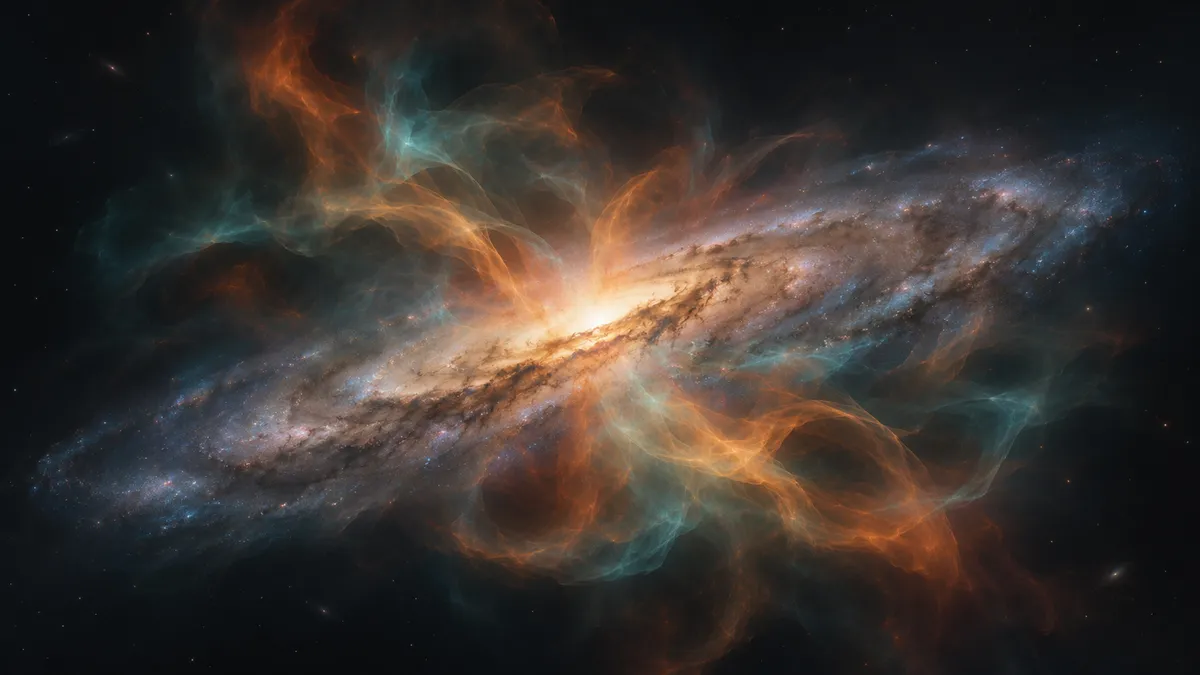
How far can a quasar push gas through its host galaxy? Sensitive observations reveal outflowing material reaching distances comparable to the visible stellar disks—and suggest that some galaxies contain more than one distinguishable flow.
A galaxy’s central black hole can influence gas far beyond its immediate surroundings. Matter falling toward the black hole powers a brilliant active galactic nucleus; sufficiently luminous examples are called quasars. Winds associated with this activity may redistribute the gas from which stars form. But measuring their reach—and deciding how much material they carry—is difficult.
In an arXiv preprint posted on November 6, 2026, Alison Coil and colleagues report observations of seven nearby quasars using the Keck Cosmic Web Imager, or KCWI. Their findings reveal extended warm ionized outflows and several distinguishable velocity components within individual galaxies. They do not directly establish that these winds shut down star formation.
Taking a spectrum across a galaxy
The team observed the targets with the Keck II telescope in November 2018. Six are classified as Type 2 active nuclei, while one, I Zw 1, is a narrow-line Type 1 source. The sample spans redshifts of roughly 0.04–0.12 and was selected from quasars already known to have high-velocity outflows. It is therefore not an unbiased census of quasars.
KCWI records a spectrum at each small patch of an observed field. This lets astronomers map not just where gas shines, but how its emission lines shift and broaden across a galaxy. Shifts reveal motion toward or away from us; broad profiles indicate a spread of velocities along the line of sight.
The researchers fitted several emission lines simultaneously, including lines from oxygen ions and hydrogen. They allowed up to four Gaussian components—smooth mathematical profiles—to represent gas with different motions. Usually, one component traced relatively quiet or rotating host-galaxy gas, while broader or shifted components traced outflows. Spatially coherent velocity maps helped assess those assignments.
Winds on the scale of stellar disks
The analysis identified 13 outflowing velocity components across the seven targets. Resolved outflows generally reached radii of about 4–10 kiloparsecs, or roughly 13,000–33,000 light-years, with a reported median radius of seven kiloparsecs. One compact component remained poorly constrained because nuclear emission and diffraction spikes contaminated its apparent extent.
In many cases, the outflowing gas reached distances comparable to the detected stars in the host galaxy. The measurements also approached the expected sizes of quasars’ extended narrow-line regions: gas illuminated by the active nucleus, rather than necessarily all moving outward.
For some targets, the new measurements substantially increased previously reported outflow sizes. A wider field and sensitivity to faint emission can recover gas missed by narrower observations. Nevertheless, the new radii are not guaranteed outer boundaries. Still fainter or more diffuse material could remain undetected.
Several motions do not always mean several episodes
Five of the seven quasars showed multiple outflowing components. The clearest complex example, F05189−2524, contained three blueshifted components in addition to the host-galaxy component.
These structures could record separate episodes of black-hole activity. Within individual galaxies, faster components generally reached similar or smaller radii than slower ones, consistent with the possibility that faster flows were launched more recently.
That is an interpretation, not a measured history. Geometry can also create separate spectral components. In F07598+2601, for example, the authors could not cleanly distinguish multiple outflows from the approaching and receding sides of one cone-shaped flow. Blending between fitted components introduces further uncertainty. The observed incidence of multiple components should not be read as the fraction of all quasars undergoing repeated outflow episodes.
The uncertain accounting of mass and energy
To estimate ionized-gas masses, the team corrected hydrogen emission for dust absorption and assumed an electron density of 100 particles per cubic centimeter. They then combined those masses with characteristic velocities and radii to estimate mass-loss rates and kinetic power.
Electron density is the dominant uncertainty. The observations lacked the principal density-sensitive diagnostic discussed in the paper, and plausible densities vary widely. Because inferred mass scales inversely with density, adopting 500 rather than 100 electrons per cubic centimeter would reduce the estimated masses and associated energy quantities fivefold. The authors describe uncertainties of at least an order of magnitude.
Faster components generally had higher inferred mass-flow rates and kinetic power. Those trends partly reflect the calculation itself: mass-flow rate depends on velocity divided by radius, and kinetic power adds a further velocity-squared dependence. They are not independent proof that faster components contain more gas.
Finally, these observations trace only warm ionized material, not the full molecular, neutral and hotter gas inventory. The strongest result is a spatial and kinematic one: sensitive, wide-field spectroscopy reveals extended, complicated quasar outflows. Their total impact on galaxy evolution remains harder to measure. This account uses the supplied full-paper text extraction; figure details, equations and table layout may not be preserved reliably.
- quasars
- active galactic nuclei
- ionized gas
- galactic outflows
- integral field spectroscopy
- Keck Cosmic Web Imager
- galaxy evolution
Related reading
Automatically matched by shared topic keywords. These links do not imply that the sources agree or establish a consensus.
Galactic Gas May Preserve Traces of Fading Black Hole Activity
Source published
Shared keywords: active galactic nuclei, galaxy evolution, integral field spectroscopy
What millimeter waves reveal about gamma-ray blazars
Source published
Shared keywords: active galactic nuclei
Hyperion’s Densest Regions Show More X-ray-Active Black Holes
Source published
Shared keywords: active galactic nuclei
How JWST Could Trace the Seeds of the First Massive Black Holes
Source published
Shared keywords: galaxy evolution
How a Black Hole’s Jets Could Disrupt Its Own Fuel Supply
Source published
Shared keywords: active galactic nuclei