TRANSMISSION // 2611.08824v1
Measuring stars more directly sharpens the sizes of their planets
Source published
Observations of eight planet-hosting stars combine visible and infrared interferometry with Gaia distances to measure stellar radii. The best results approach 2% precision, while a detailed example shows how better stellar measurements and updated transit data tighten estimates of planetary size and mass.
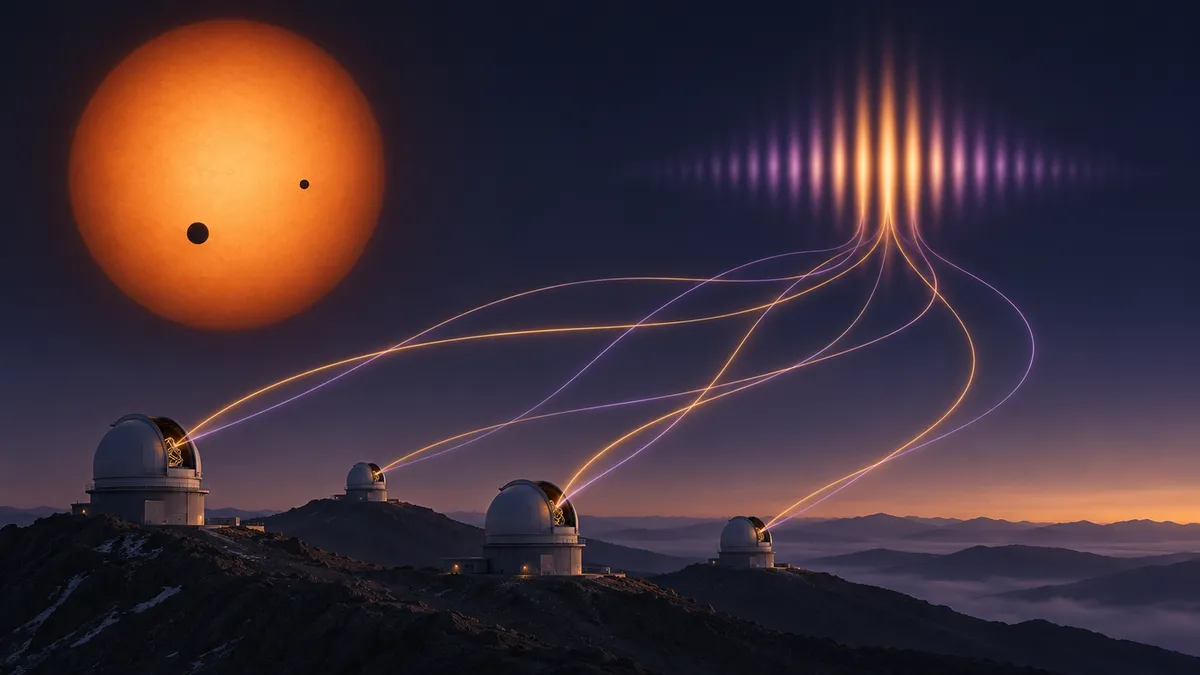
How large is a distant planet? Often, the answer depends on how well astronomers know its star. A new preprint combines measurements from several telescopes to establish a more direct stellar ruler—and examines how honestly its uncertainties can be estimated.
A planet passing in front of its star blocks a fraction of the starlight. That dip helps reveal the planet’s size relative to the star, rather than its physical size on its own. An uncertain stellar radius therefore carries uncertainty into the planetary radius, affecting attempts to interpret the planet’s composition.
Hugo Nowacki and colleagues address that dependence with observations of eight exoplanet-hosting stars. Their study, posted as an arXiv preprint on November 6, 2026, measures how wide the stars appear in the sky and combines those measurements with distances from Gaia. The supplied manuscript does not report journal acceptance.
Combining light across several telescopes
The team used the six-telescope CHARA Array at Mount Wilson, California. Interferometry combines light collected at separated telescopes, providing information about angular sizes too small for an individual telescope to resolve at the same wavelengths.
Three instruments supplied observations in different wavelength ranges: SPICA in visible light, MIRC-X in the near-infrared H band, and MYSTIC in the infrared K band. The analysis combined repeated visits, although not every instrument supplied usable data on every visit. Observations of calibrator stars helped track changes in the response of the instruments and atmosphere.
The researchers did not reconstruct detailed pictures of the stellar surfaces. Instead, they fitted the measured interference signal with a disk whose brightness decreases toward its edge, an effect called limb darkening. They first fitted each wavelength band separately, then combined the bands to estimate a shared angular diameter.
An angular diameter describes apparent width. Together with distance, it gives the star’s physical radius. This avoids relying on stellar evolution models to supply the radius, but it is not entirely assumption-free: the analysis still uses a prescribed surface-brightness profile and limb-darkening coefficients drawn from model grids.
Two percent is the best result, not the typical one
Across the eight stars, the median relative uncertainty in radius was 5.9%. The best measurements, for HD 219134 and the giant star 14 Andromedae, reached about 1.9%. Their radii were approximately 0.754 and 10.80 times the Sun’s radius, respectively, before additional transit information was applied to HD 219134.
The distinction matters. The paper’s approximately 2% performance level describes the best results under the observing and analysis conditions studied, not a precision achieved for every target. Stars that appear smaller generally remain harder to measure accurately. Despite the potential resolution advantage of visible light, the authors report that SPICA’s most useful measurements currently tend to overlap the spatial scales sampled by MIRC-X.
The team also estimated systematic differences by comparing individual-band diameters with their combined result. Their weighted comparison gave 1.5%, while an unweighted calculation gave 5.1%, strongly affected by two discrepant visible-band measurements. This is an internal consistency assessment, rather than an independent demonstration that every radius is accurate to 1.5%.
Checking the error bars
A central question was whether fitting procedures produce believable uncertainties. The researchers generated simplified artificial observations with known stellar diameters, an imposed bias and added Gaussian noise. They compared a grid search over possible diameters with gradient descent and Markov chain Monte Carlo implementations.
In these tests, the grid approach produced broader uncertainty intervals that enclosed the known diameter within one quoted standard deviation. The other implementations gave substantially smaller uncertainties and missed the input value by more than their stated errors suggested.
Those findings support the authors’ chosen procedure for this analysis. They do not establish that gradient descent or Monte Carlo methods are generally unreliable. The paper explicitly restricts the comparison to a one-parameter disk model, and notes that the simulated noise does not represent all the complexity of real observations.
Passing the measurement on to planets
The team demonstrated the planetary consequences using HD 219134, whose planets b and c cross the star. Combining interferometry, Gaia measurements, updated transit parameters and radial-velocity information, their EXO software estimated the star’s radius at 0.752 ± 0.014 solar radii.
The two planets’ radii were 1.484 ± 0.028 and 1.459 ± 0.028 Earth radii. Compared with an earlier analysis using a similar approach, the authors report roughly 50% smaller radius uncertainties and 30% smaller mass uncertainties. These gains reflect the combined observations and analysis, including refined transit information—not interferometry alone.
An unresolved limitation remains: the inferred stellar mass differs from estimates based on stellar oscillations at roughly the two-standard-deviation level. The authors identify orbital eccentricity, which can affect transit-derived stellar density, as a possible issue to investigate. The study improves the measurements needed to explore planetary interiors; it does not settle those interiors or eliminate every source of uncertainty.
- stellar radii
- exoplanets
- interferometry
- CHARA Array
- Gaia
- HD 219134
- measurement uncertainty
Related reading
Automatically matched by shared topic keywords. These links do not imply that the sources agree or establish a consensus.