TRANSMISSION // 2611.08795v1
MotionDecipher turns gait measurements into AI-assisted clinical descriptions
Source published
MotionDecipher combines signal processing, clinician-defined rules and retrieved examples to draft gait descriptions. In a single-laboratory study, it outperformed directly prompted language models, but its results do not establish autonomous clinical reliability.
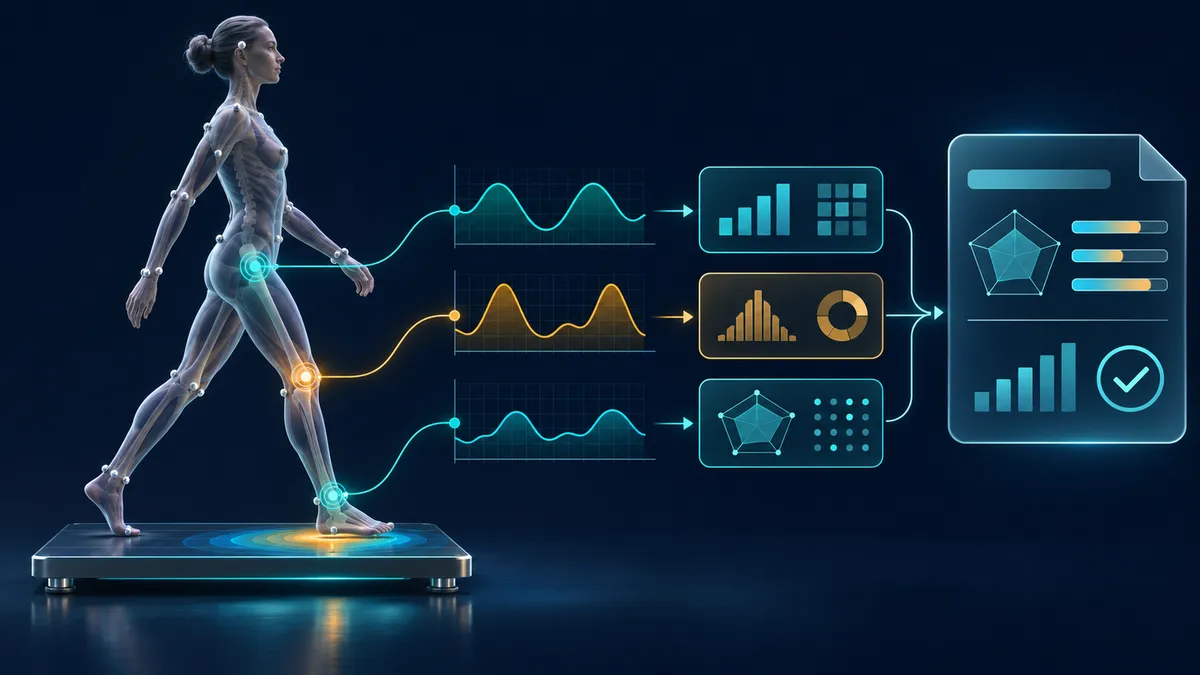
Walking measurements contain more information than a language model can reliably interpret unaided. MotionDecipher prepares those measurements before asking an AI to write, producing stronger results in a study involving data from 122 patients and 46 controls.
Preparing movement data before asking AI to write
Clinical gait analysis translates measurements of walking into descriptions of joint movements and forces. Writing those descriptions requires specialists to interpret complex waveforms, identify important abnormalities and express them precisely. MotionDecipher, developed by Mingrui Ma and colleagues at the University of Illinois Urbana-Champaign and Stanford University, tackles this descriptive reporting task—not diagnosis or personalized treatment recommendations.
The supplied arXiv manuscript describes a system that combines conventional signal processing, clinician-defined selection rules and example-based prompting. Its central idea is to organize the biomechanical evidence before handing it to a large language model, rather than expecting the model to discover every relevant feature from uploaded measurements.
Three stages between measurements and narrative
MotionDecipher starts with preprocessed signals, not untouched camera recordings. In this study, specialists used optical motion capture and force plates, followed by software processing and verification of walking events. Walking cycles were normalized to a common percentage scale, allowing measurements from different trials to be aligned.
The first stage, called the Human Motion Tokenizer, describes those signals in four complementary ways. It captures movement trends, deviations from control measurements, statistics around walking events and phases, and a low-frequency representation produced through wavelet processing. Together, these features describe how a movement changes, how it compares with the reference population and what happens at important moments.
Next, the Meta Feature Selector applies predefined rules reflecting clinicians’ reporting priorities. It retains selected features and organizes them by anatomical region, including the foot, ankle, knee, hip, pelvis and trunk. This is a rule-based selection process, not a newly trained model learning clinical priorities from scratch.
The final stage retrieves relevant expert-written examples. Its Hybrid Index handles descriptive language and numerical measurements separately before combining them for similarity matching. Direction matters: bending the ankle upward and downward by the same number of degrees should not make two observations equivalent. The system retrieves one example per query in the reported implementation, then prompts Kimi-K2 to generate body-part descriptions. A second prompting step produces a condensed summary emphasizing abnormalities.
What the evaluation found
The researchers collected data from 122 patients and 46 controls at one accredited gait laboratory. Reports from two patients supplied the demonstration examples; the remaining 120 patients formed the main evaluation set. Expert-written routine reports served as references.
MotionDecipher scored higher than directly prompted GPT-5, Kimi-K2, Google Gemini 3 and Qwen3-Max on all six reported automated metrics. Its mean BERTScore, which measures semantic similarity to reference text, was 0.91, compared with 0.78 for GPT-5 and 0.82 for Kimi-K2. These are text-comparison scores, not percentages of clinically correct decisions.
The researchers also introduced GaitTripleF1, which checks whether descriptions correctly associate a body part, movement state and walking phase. MotionDecipher scored 0.91, compared with 0.72 for the strongest general-model baseline on that metric, Gemini 3. A rule-based reporting alternative using the structured features scored 0.74. Removing individual pipeline components also reduced performance, supporting the contribution of both feature preparation and example-guided generation within this experiment.
Two gait-clinic experts conducted a blinded assessment of knee, hip and ankle descriptions. MotionDecipher received mean scores of 3.48 for correctness, 3.95 for completeness and 3.90 for conciseness on five-point scales. The rule-based alternative scored 3.35, 3.60 and 3.74, respectively. Its smaller gap from MotionDecipher shows that much of the useful information was already present before language-model generation.
Faster drafting is not a complete clinical workflow
The authors report approximately two minutes to generate a report, compared with four to six cumulative hours for manual analysis and drafting. That comparison excludes substantial upstream work: data collection, preprocessing and specialist verification remain necessary. It also does not establish that clinical review or consensus discussion can be eliminated.
Errors remained. Among 60 MotionDecipher descriptions examined in the error analysis, four contained missing analytical statements, imprecise phrasing or both. One example omitted a change in hip rotation and listed phase-specific findings without adequately synthesizing the overall pattern. That 6.7% figure describes the reviewed sample and error categories, not a comprehensive clinical safety rate.
Where the evidence stops
The evaluation comes from one laboratory, and 93 of the 120 test participants were children or adolescents. Although the authors report stable subgroup results, several adult groups were small. Comparisons with normal movement also used one reference range across all patients, without age- or weight-specific stratification.
The experts assessed different report sets, rather than independently scoring every same description. Automated agreement with reference reports and this limited human assessment therefore leave important questions about broader reliability unresolved.
Wearable sensors and smartphone video are proposed extensions, not validated inputs in this study. The evidence supports MotionDecipher as a promising drafting aid under the tested laboratory conditions—not an autonomous clinician or a demonstrated route to better patient outcomes.
- MotionDecipher
- gait analysis
- large language models
- biomechanics
- clinical report generation
- motion capture
- in-context learning
Related reading
Automatically matched by shared topic keywords. These links do not imply that the sources agree or establish a consensus.
Can a Small Selector Learn Which Examples Help a Language Model?
Source published
Shared keywords: in context learning, large language models
When an AI Queries a Database, How Does It Know What You Mean?
Source published
Shared keywords: large language models
What would make an AI agent genuinely curious?
Source published
Shared keywords: in context learning
Finding surprising shopping patterns without abandoning statistics
Source published
Shared keywords: large language models
Similar examples give AI coding models a modest boost in a selected test
Source published
Shared keywords: large language models