TRANSMISSION // 2611.08766v1
A white dwarf’s abrupt magnetic switch hints at compact atmospheric regions
Source published
Observations of LP 705-64 reveal two magnetic signatures that alternate sharply as the white dwarf rotates. The results link heated atmospheric regions with darker surface spots, while leaving the field’s full geometry and the source of its heating unresolved.
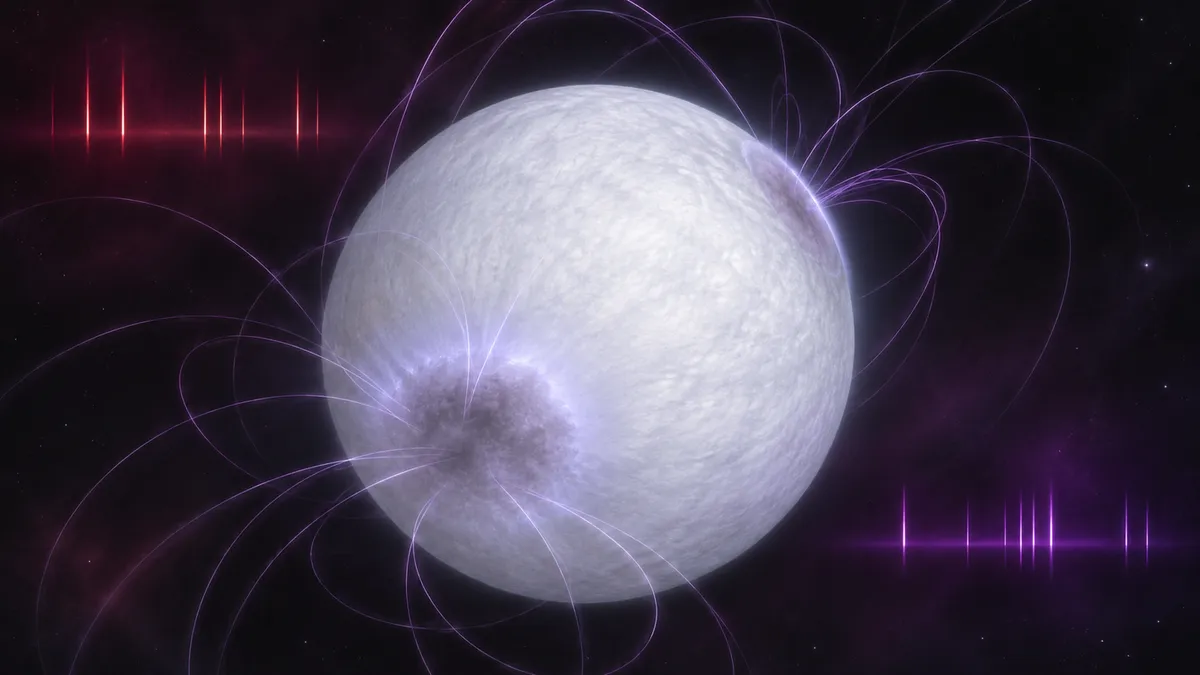
How can a star’s darker patches sit beneath glowing gas? On the white dwarf LP 705-64, changing hydrogen emission and magnetic signatures suggest a close connection between surface spots, strong magnetic fields and atmospheric heating—but not a simple magnetic layout.
Every 72.63 minutes, the white dwarf LP 705-64 completes a rotation. As it turns, its hydrogen emission switches between two strikingly different magnetic signatures. The change is unusually abrupt: rather than smoothly passing through intermediate values, the observations alternate between fields of about 9.5 and 22 million gauss.
A study led by Leyla Iskandarli uses that switching to investigate where heated gas sits above the star and how its magnetic field is arranged. The work is available as an arXiv preprint, whose listing reports acceptance to Monthly Notices of the Royal Astronomical Society. This account uses the supplied PDF text extraction and figure captions; the figures themselves were unavailable, and extraction can damage equations and layout.
Reading magnetism in hydrogen light
White dwarfs are compact stellar remnants. LP 705-64 belongs to a rare group whose hydrogen spectral lines appear in emission and are split by strong magnetic fields. That emission points to heated gas in an upper atmospheric layer, or chromosphere.
The researchers observed the star with two instruments on the Very Large Telescope in Chile during October and November 2022. X-shooter collected spectra across several rotations, with measurements roughly every 3.6 minutes. FORS2 measured both the spectrum and circular polarization: the imbalance between light with opposite senses of rotation of its electric field.
These measurements provide complementary clues. Magnetic fields split hydrogen lines into components through the Zeeman effect, allowing field strengths to be estimated from their wavelength separations. Circular polarization helps reveal the field’s orientation along our line of sight.
The hydrogen-alpha line showed two distinct splitting patterns. The weaker-field signature was visible for about 60 percent of a rotation and stayed close to 9.5 million gauss. During the remaining phases, the stronger signature changed modestly, from roughly 20 to 22 million gauss. The polarization reversed sign between the two patterns, supporting an association with regions of opposite magnetic polarity.
Darker below, heated above
The team also compared hydrogen emission with previously published brightness measurements. The star has two unequal dips in brightness during each rotation, previously modelled as two dark surface spots.
The emission-line equivalent widths generally peaked near those brightness minima. Equivalent width measures a line’s strength relative to the surrounding continuum, rather than directly measuring its absolute luminosity. The timing nevertheless supports a connection between the darker surface regions and the heated gas above them. The authors interpret the observations as consistent with magnetic regions, spots and chromospheric emission occupying corresponding locations.
That is not a resolved photograph of the surface. The arrangement is inferred from how the signals change as rotation carries different regions into view.
Why the sharp transitions matter
An offset dipole—a two-pole magnetic field displaced from the star’s centre—can produce unequal field strengths at opposite poles. But the authors find that this relatively simple geometry does not explain the abrupt transitions.
Among 118 X-shooter hydrogen-alpha spectra, only six contained both splitting patterns. Even in those exposures, the two sets of σ± components remained distinct rather than spreading through intermediate wavelengths. The authors interpret these mixed spectra as observations spanning a rapid change in visibility.
To estimate a region’s size, they used the transition duration, including a heuristic curve shaped like a planetary transit. This was a mathematical timing tool, not evidence for a planet. Their estimate suggests that at least one magnetic emission region has an angular radius no larger than about 10 degrees, compared with at least 20 degrees for the dark spots in earlier modelling.
Those sizes depend on geometric assumptions and limited time resolution. They should not be read as precise boundaries, or as proof that both magnetic regions are equally small.
A heating mechanism still to test
The findings support heating intrinsic to the white dwarf rather than supplied by an orbiting companion. One proposed mechanism involves neon-22 separating within the cooling interior, driving motions that generate magnetic fields and electrical currents. Dissipation of those currents could heat the upper atmosphere near magnetic poles. The present observations are compatible with that model, not a direct detection of the internal process.
Important uncertainties remain. Polarization measurements averaged over roughly 16 minutes, blurring changes on this rapidly rotating star. The authors estimate realistic field-strength uncertainties of a few percent and line-of-sight field uncertainties of at least 10–15 percent, larger than some formal fitting errors.
Faster observations are needed to distinguish localized magnetic structures from a more extensive global field. For now, LP 705-64 offers evidence that its atmospheric heating and magnetism are spatially connected—and that their geometry is more complicated than a simple pair of unequal poles.
- white dwarfs
- LP 705-64
- stellar magnetic fields
- chromospheres
- Zeeman effect
- spectropolarimetry
- stellar rotation
Related reading
Automatically matched by shared topic keywords. These links do not imply that the sources agree or establish a consensus.
A nearby star system emits low-frequency radio waves—but what powers them?
Source published
Shared keywords: stellar magnetic fields
Did two stars become one? Clues from the heaviest white dwarfs
Source published
Shared keywords: white dwarfs
Close companions are unlikely to explain most slow-spinning stars in open clusters
Source published
Shared keywords: stellar rotation
A nearby supernova may reveal how quickly white dwarfs can explode
Source published
Shared keywords: white dwarfs
Radio surveys reveal a faint signal from IX Velorum
Source published
Shared keywords: white dwarfs