TRANSMISSION // 2611.08742v1
When gravity changes the effect of neutrino flavour near a black hole
Source published
A theoretical preprint finds that the locations where different neutrino flavours emerge can determine whether gravity and flavour conversion may be calculated separately. In one idealised configuration, including curved spacetime reverses conversion’s effect on the energy deposited above an accretion disc.
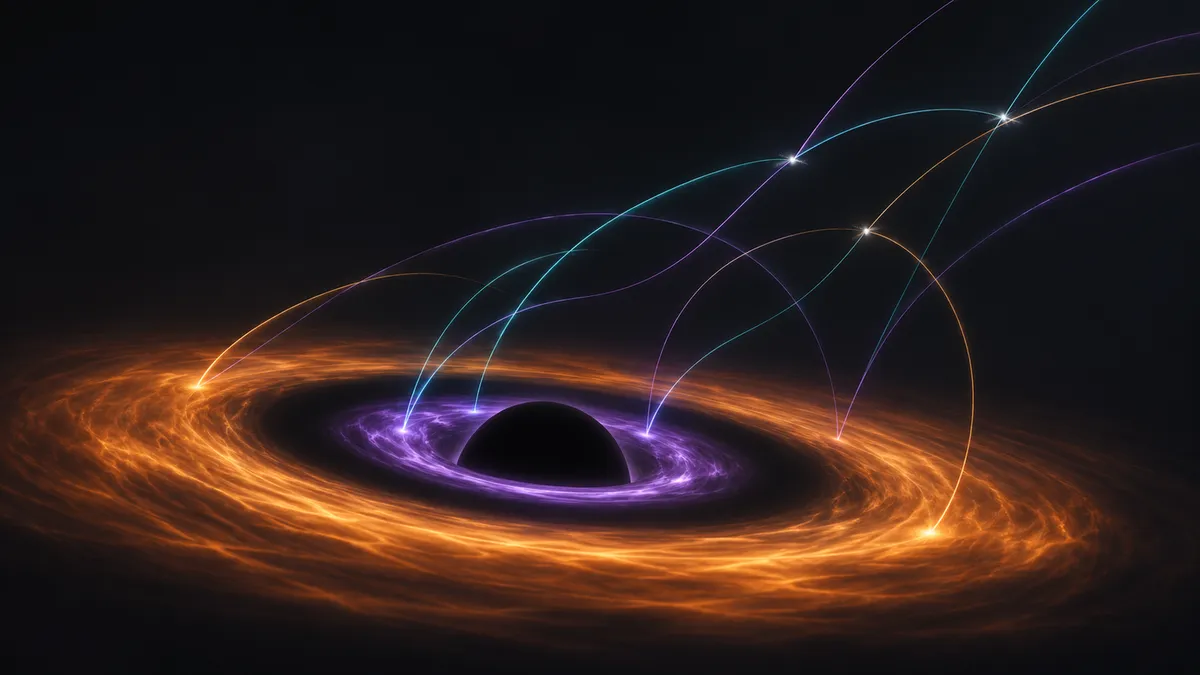
Near a black hole, neutrinos can collide with antineutrinos and create electrons and positrons. Calculating the energy supplied by these encounters requires tracking both curved trajectories and changing neutrino flavours. A new study asks when those two complications can safely be separated.
Can changing a neutrino’s flavour reduce energy deposition in one calculation but increase it in another? A theoretical study finds that it can—when the second calculation includes gravity and different flavours emerge from different parts of a black hole’s surrounding disc.
The result appears in an arXiv preprint by Rafael C. R. de Lima, Luciano de Oliveira Junior and Pedro Martins Bailer, submitted on 5 November 2026. Its landing page lists submission to the Journal of High Energy Astrophysics, not acceptance. The findings concern idealised transport calculations, not an observed black hole or a demonstrated explanation for a gamma-ray burst.
Two effects that may not stay separate
Hot accretion discs can emit neutrinos and their antiparticles, antineutrinos. A small fraction annihilate into electron–positron pairs, supplying energy to the surrounding plasma. This is one proposed contribution to the outflows associated with gamma-ray bursts.
Neutrinos come in three flavours: electron, muon and tau. The latter two are grouped here as heavy-lepton flavours. Flavour conversion redistributes neutrinos among these categories. That matters because electron-flavour neutrino–antineutrino pairs have an annihilation coupling about 4.7 times that of either heavy-lepton pair.
Gravity changes the calculation too. It bends trajectories, alters collision angles and shifts particle energies. Disc motion adds Doppler shifts. The question is whether researchers can calculate a flavour-conversion correction without gravity, then multiply it into a relativistic energy estimate—or whether gravity changes the correction itself.
Following particles backwards
The authors trace possible neutrino paths backwards from points above thin discs, using the spacetime descriptions for nonspinning and spinning black holes. Each path identifies an emitting region and the energy shift between emission and arrival.
They also simplify the annihilation calculation. Instead of explicitly comparing every sampled arrival direction with every other direction, they combine angular moments: weighted summaries of the arriving radiation’s directional distribution. The annihilation formula permits this rearrangement exactly, without an additional approximation relating higher moments to lower ones.
This makes the angular calculation scale linearly rather than quadratically with the number of sampled directions. It does not eliminate expensive ray tracing. The authors report checks against an analytic spherical solution, published disc calculations and finer numerical resolutions. These support the numerical method within its assumptions; they do not establish that the assumed discs describe real systems.
For the gravity comparison, the flat-space discs retain the same local orbital speeds and emission temperatures. That helps distinguish gravitational effects from differences caused simply by changing the emitters’ motion.
Where the approximation works—and fails
There is an exact simplifying limit. If heavy-lepton emission is absent and conversion is uniform across positions and directions, the conversion factor is independent of spacetime and emitting geometry. Every contribution inherits the same geometric weighting, which cancels in the ratio.
When emitting regions overlap, that cancellation remains approximately useful. For uniform conversion, gravity changed the conversion factor by no more than about 6% across most tested temperature profiles and emission ratios, although a flatter temperature profile reached 13%. Meanwhile, gravity increased the deposited energy itself by roughly 1.4–5 times. Allowing conversion to vary with emission location or direction produced deviations up to 22% in the overlapping configurations tested.
A different regime appears when heavy-lepton neutrinos emerge from an inner ring, spatially separated from the electron-flavour emitting regions. Gravity then preferentially amplifies annihilations involving particles from that ring.
In one rapidly spinning black-hole configuration, equal redistribution among the three flavours reduced deposition by 54% in flat space but increased it by 11% in curved spacetime, each relative to its own no-conversion baseline. Conversion creates electron-flavour particles from the inner-ring population, enabling more strongly coupled annihilations with partners from the outer disc. Gravity gives those cross-region encounters enough extra weight to reverse the balance.
An energy budget, not a jet prediction
The calculated quantity is deposited energy expressed in the accounting appropriate to a distant observer, called Killing energy. It is not necessarily energy that escapes: pairs can fall into the hole, and the plasma’s subsequent motion is not simulated.
Crucially, conversion is prescribed rather than dynamically calculated. Converted neutrinos stream freely even through material that might absorb them after their flavour changes. The authors explicitly caution that the sign reversal needs testing with conversion outside opaque regions before being interpreted as a prediction for real discs.
This account uses the supplied PDF text extraction; figures were unavailable, and equations and layout may be damaged. The supported conclusion is therefore conditional: in these models, emission locations help determine whether gravity and flavour conversion can be treated separately.
- neutrinos
- flavour conversion
- black holes
- accretion discs
- general relativity
- neutrino annihilation
Related reading
Automatically matched by shared topic keywords. These links do not imply that the sources agree or establish a consensus.
Falling merger debris could fuel—and frustrate—a second cosmic jet
Source published
Shared keywords: black holes
Can a simpler star simulation recover tides in gravitational waves?
Source published
Shared keywords: general relativity
AI trained on physics equations speeds up models of spinning neutron stars
Source published
Shared keywords: general relativity
Neutron star binaries may get their chance after a cluster’s black holes leave
Source published
Shared keywords: black holes
Webb maps gas and stars moving differently around faint active black holes
Source published
Shared keywords: black holes