TRANSMISSION // 2611.08736v1
Did two stars become one? Clues from the heaviest white dwarfs
Source published
A survey identifies merger signatures in roughly half of 60 white dwarfs estimated to contain at least 1.3 solar masses. Its most massive candidate weighs about 1.33–1.35 Suns, depending on its unknown interior composition—but neither result establishes a universal limit.
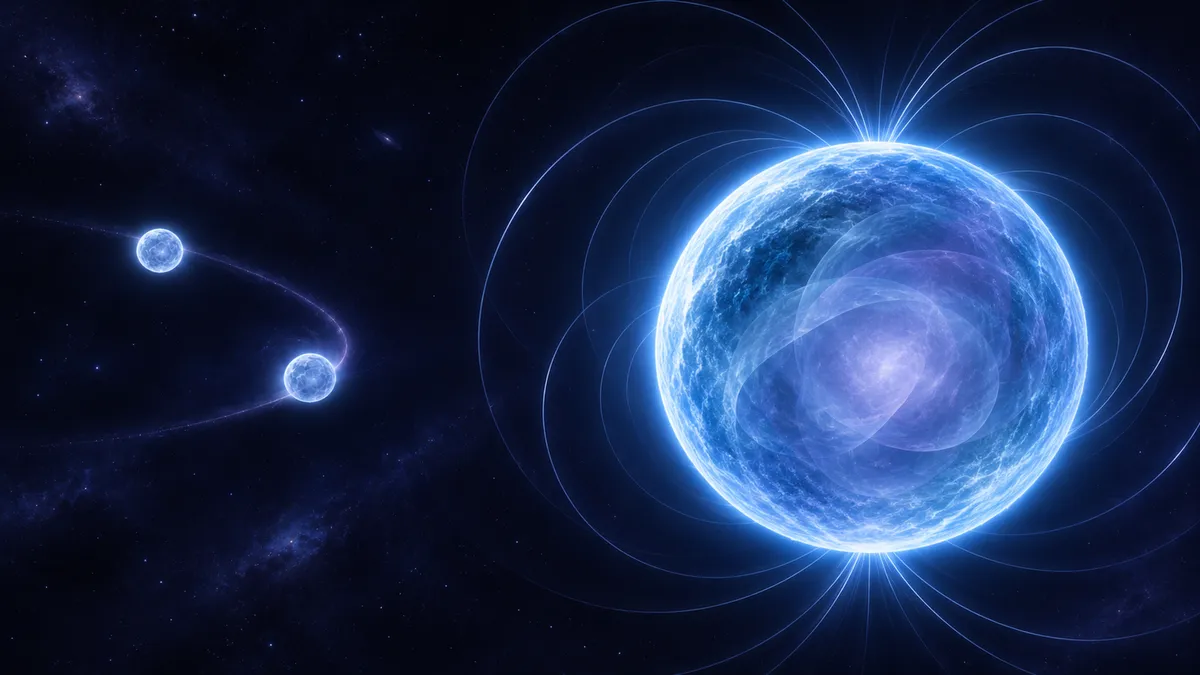
A white dwarf can look like a single stellar remnant while carrying clues to a two-star past. Astronomers have surveyed some of the heaviest candidates, using their light, magnetism, motion and rotation to investigate how they formed—and how massive these compact objects can become.
How can astronomers tell whether one stellar remnant began as two stars? For ultramassive white dwarfs, the answer comes from combining clues rather than finding a single decisive signature.
A study led by Gracyn Jewett reports that roughly half of its highest-mass white dwarfs show evidence consistent with past stellar mergers. It also identifies an exceptionally compact object whose estimated mass depends on what lies inside it. The work is available as arXiv:2611.08736v1; its landing page states that it has been accepted for publication in The Astrophysical Journal.
From candidates to measured stars
White dwarfs are the compact remnants left by most stars. Their resistance to gravitational collapse comes from electron degeneracy pressure, a quantum effect. Near their upper mass range, understanding their interiors becomes especially important for estimating their masses and eventual fates.
The researchers began with 293 candidates from a Gaia-based catalogue. Initial estimates, assuming pure hydrogen atmospheres, placed them at or above 1.3 times the Sun’s mass and at temperatures of at least 11,000 kelvin. That temperature threshold helps make atmospheric elements identifiable through spectral lines—the features different atoms leave in a star’s light.
Spectroscopic coverage reached 97% of the initial sample. But follow-up revealed why a candidate list is not a final census: some stars had different atmospheric compositions, uncertain distances or revised temperatures and masses. After exclusions, the analysis retained 208 hot, massive white dwarfs, with masses starting at 0.9 solar masses. Sixty remained in the highest bin, at or above 1.3 solar masses.
To estimate physical properties, the team compared brightness measurements across several wavelength bands with model atmospheres. Distance estimates based on Gaia helped translate apparent brightness into stellar radius; evolutionary models then connected radius and temperature to mass. Spectra constrained atmospheric composition and provided checks on the solutions. These are model-dependent mass estimates, not direct weighings.
What counts as a merger clue?
The team searched for strong magnetism, unusual atmospheric composition, rapid rotation and unusually fast motion across the sky. A merger can leave rapid rotation and generate a magnetic field. Other clues can indicate a mismatch between an apparently young, hot remnant and a much older stellar history.
The authors classified a star as a likely merger product if it showed at least one signature. In the highest-mass bin, 32 of 60 met that criterion: 53%, with quoted binomial uncertainties of minus six and plus seven percentage points. Twenty-seven of those 60 were classified as magnetic.
That does not mean astronomers witnessed 32 mergers. Nor does the result identify exclusively mergers between two white dwarfs: the classification includes possible mergers at earlier stages of stellar evolution.
The statistical error bars also do not capture every uncertainty. Rotation measurements are incomplete, and some merger remnants may show none of the detectable clues. Conversely, magnetic fields might emerge through mechanisms unrelated to mergers, making the assumption that magnetic stars are merger remnants too generous.
Cooling introduces another bias. Some white dwarfs can linger at particular brightnesses because processes involving neon-22 delay their cooling. Such stars become overrepresented in a temperature-selected snapshot. The authors discuss this as a likely contributor to the especially high inferred merger fraction at 1.1–1.2 solar masses. The observed fractions therefore cannot simply be read as the fractions originally born through mergers.
A heavyweight, not a universal ceiling
The study’s most massive well-constrained candidate is the magnetic white dwarf J0318+7923. Models including general relativity give it 1.349 solar masses if its core contains carbon and oxygen, or 1.329 solar masses for an oxygen–neon core. Each estimate carries a quoted uncertainty of 0.006 solar masses, but the difference between core assumptions illustrates an additional uncertainty.
Its inferred radius is about 2,073 kilometres, roughly 20% larger than the Moon’s. These measurements constrain the high-mass end of the surveyed population; they do not prove that no heavier white dwarf exists or replace the theoretical stability limit.
Pulsations could help resolve the interior question. The survey identifies candidates near the temperature range where some hydrogen-atmosphere white dwarfs pulsate. Measuring those oscillations may constrain core composition and crystallized interiors, but candidate status is not a detection of pulsations.
This account uses the supplied PDF text extraction, not just the abstract. Figures were unavailable, and equations and table layout may be damaged. The findings are therefore reported from the authors’ written analysis, without independently inspecting plotted evidence or reanalysing observations.
- white dwarfs
- stellar mergers
- Gaia
- ultramassive white dwarfs
- stellar magnetism
- asteroseismology
Related reading
Automatically matched by shared topic keywords. These links do not imply that the sources agree or establish a consensus.
Radio surveys reveal a faint signal from IX Velorum
Source published
Shared keywords: white dwarfs
A nearby supernova may reveal how quickly white dwarfs can explode
Source published
Shared keywords: white dwarfs
A white dwarf’s abrupt magnetic switch hints at compact atmospheric regions
Source published
Shared keywords: white dwarfs