TRANSMISSION // 2611.08719v1
A nearby star system emits low-frequency radio waves—but what powers them?
Source published
LOFAR observations reveal strongly polarized radio emission near 45 MHz associated with GJ 725A, a nearby star with a known planet. The signal favors a magnetic emission process, but stellar activity, star–planet interaction and an undiscovered giant planet remain competing explanations.
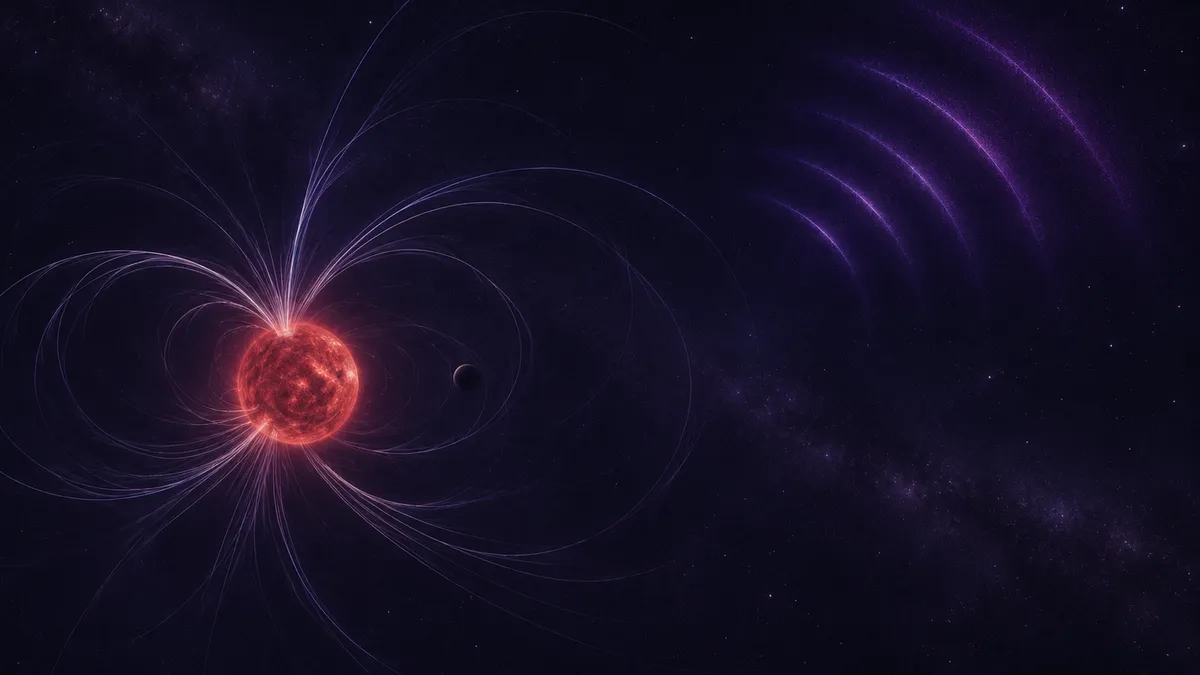
A radio signal can reveal a magnetic environment without identifying the object that powers it. Around GJ 725A, astronomers have found a striking example: emission detected during one hour of archival observations, with clues to its mechanism but no settled explanation for its origin.
What produces a strong radio signal around an otherwise quiet star? Astronomers studying GJ 725A, about 3.5 parsecs from Earth, have identified emission near 45 megahertz that could arise from stellar activity, an interaction with its known planet, or an undiscovered giant planet. The observation does not establish a planetary radio detection.
H. W. Edler and colleagues report the result in an arXiv preprint whose landing page lists it as accepted for publication in Astronomy & Astrophysics. They describe it as the lowest-frequency confirmed radio detection of a stellar system. That claim concerns the detection and its association with the system—not confirmation of its power source.
One detection in the archives
The team found the source through an untargeted survey of circularly polarized radio emission using LOFAR’s low-band antennas. Circular polarization describes a wave whose electric-field direction rotates as it travels; a high polarization fraction helps distinguish certain magnetic emission processes.
An initial image combined three hour-long observations. Examining the observations separately revealed that the signal came from the session on 11 December 2020. Further processing isolated emission between 42 and 50 MHz, with a peak brightness of 135 ± 17 millijanskys per telescope beam and a statistical significance of 7.9 sigma in total intensity. Its circular polarization fraction was 74 ± 16%.
Time-resolved analysis suggested that the emission persisted across at least the observed hour, rather than coming from one brief flash, although individual time-frequency measurements were mostly only marginally significant. No other archival LOFAR observation examined by the team yielded a detection, including one three days later with sufficient sensitivity to show a decline.
The researchers also checked which member of the GJ 725 binary was responsible. They compared radio positions with stellar positions corrected for the stars’ motion, and assessed positional errors using 42 reference sources. The resulting localization supported GJ 725A rather than its companion, GJ 725B. It did not resolve the star from any nearby planet.
A magnetic clue, not a thermometer
During the detection, the source was absent between 50 and 66 MHz, with a three-sigma upper limit of 48 millijanskys per beam. The contrast indicates a sharp spectral feature or cutoff near 50 MHz. Consequently, a nondetection at a higher frequency need not mean that the source has switched off.
Assuming an emitting region no larger in projected area than the stellar disk, the team inferred a brightness temperature of at least roughly 140 trillion kelvin. This is a measure of radio intensity relative to apparent source size, not a measurement of matter heated to that temperature.
Together with the strong polarization, that brightness favors coherent emission: radiation produced collectively by charged particles. The authors favor the electron cyclotron maser instability, the mechanism behind planetary auroral radio emission in our Solar System. Their modeled alternative, plasma emission, could not reproduce the observed properties.
If the signal is fundamental cyclotron-maser emission and the spectral edge marks its maximum frequency, it implies a magnetic field of about 18 gauss in the emitting region. This is conditional on the mechanism and spectral interpretation; it is not a direct measurement of the known planet’s field.
Three explanations, each with obstacles
An undiscovered giant planet: The known planet, GJ 725Ab, has an approximately 11.2-day orbit and a minimum mass of 2.8 Earth masses. Dynamo scaling laws suggest its field would be too weak to generate the observed frequency directly. A wider-orbit giant could have a suitable field, but existing planet searches restrict its possible orbit. The authors’ model also finds that the stellar wind at wide separations would provide far too little power. An internal driver involving rapid rotation and plasma supplied by a moon remains speculative.
An interaction with the known planet: GJ 725Ab could instead power emission in the star’s magnetic environment. This requires conditions that let magnetic disturbances travel back toward the star, plus enough transferred energy. Under assumed planetary properties and 5% radio-conversion efficiency, the model requires a large-scale stellar surface field above roughly 80 gauss, with stronger fields needed for denser winds. The detection’s orbital phase is compatible with an example geometry, but one event cannot demonstrate orbital repetition.
Stellar activity: A rare magnetic event remains possible despite the star’s slow, approximately 103-day rotation and low activity. Optical monitoring did not cover the radio detection itself, so it cannot exclude a simultaneous flare.
Repeated low-frequency observations could test for orbital or rotational repetition. Simultaneous optical, ultraviolet and X-ray measurements could check for stellar activity, while improved planet searches could constrain a giant companion.
This account uses the supplied paper-text extraction and landing-page metadata. Figures were unavailable for inspection, and extraction can damage equations and layout. The central distinction remains: the radio source is associated with GJ 725A, but what powers it is unresolved.
- GJ 725A
- LOFAR
- low-frequency radio astronomy
- electron cyclotron maser
- stellar magnetic fields
- star–planet interaction
- exoplanet aurorae
Related reading
Automatically matched by shared topic keywords. These links do not imply that the sources agree or establish a consensus.