TRANSMISSION // 2611.08700v1
A new Titan climate model connects fast upper winds with methane weather below
Source published
TitanMPAS simulates strong stratospheric winds alongside terrain and an active methane cycle, reproducing several Cassini and Huygens measurements. The preprint also exposes unresolved wind patterns and limits on local weather predictions.
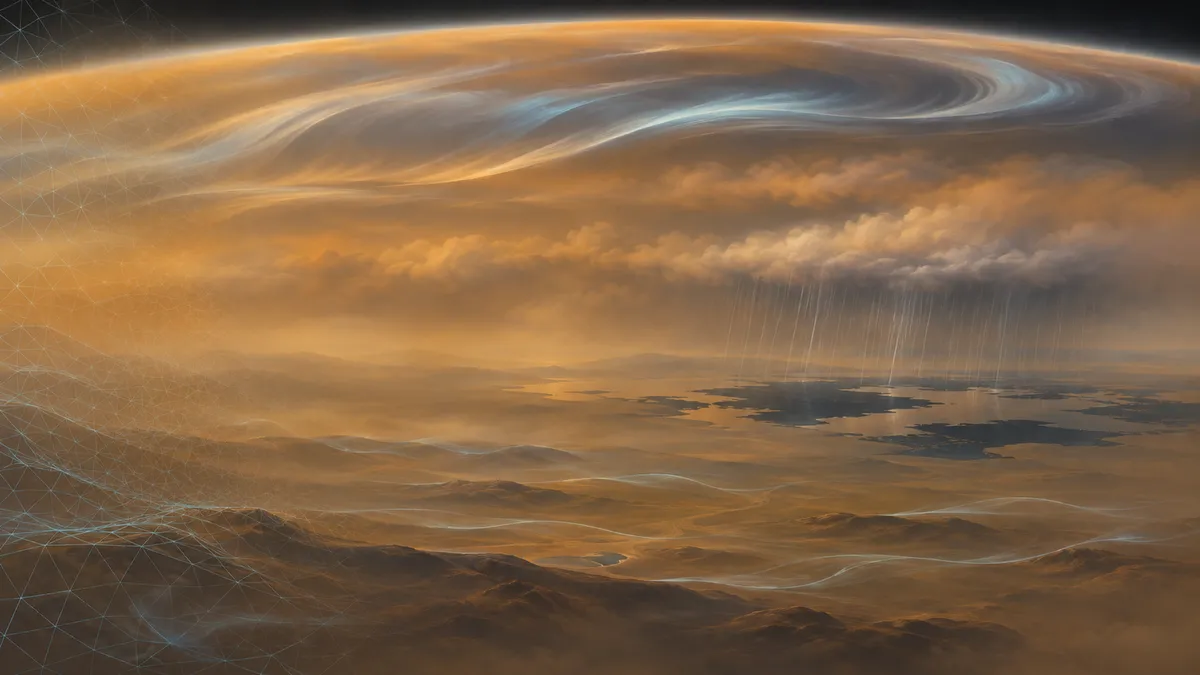
Can one model reproduce Titan’s racing upper atmosphere and its much gentler methane weather near the ground? TitanMPAS brings both into a global simulation with realistic terrain, while leaving important observational puzzles unsolved.
Can a climate model reproduce Titan’s fast upper winds without sacrificing the terrain and methane weather below? That is the central test of TitanMPAS, a new atmospheric model developed by Yuan Lian and colleagues. Their results reproduce several observed features together, but also show where the simulated moon still differs from the real one.
The study is an arXiv preprint submitted on 5 November 2026 and listed as submitted to The Planetary Science Journal. That status does not establish completed peer review. This first paper presents global simulations; detailed regional modeling and further analysis of the driving mechanisms are reserved for later papers.
Modeling a thick atmosphere
Titan, Saturn’s largest moon, has a nitrogen-rich atmosphere and an active methane cycle involving evaporation, rain and lakes. Its stratosphere, above the lower weather-producing troposphere, exhibits superrotation: winds moving in the direction of rotation much faster than the surface beneath them. Near the ground, winds are far weaker.
TitanMPAS combines the Model for Prediction Across Scales atmospheric engine with physical schemes inherited and adapted from TitanWRF. These schemes approximate processes that the grid cannot resolve individually, including turbulent mixing and moist convection—the movement of buoyant air associated with methane condensation.
The model incorporates observation-based maps of terrain, surface reflectivity, heat-storage properties and lakes. Its prescribed lake reservoirs are assumed to have infinite depth, an important simplification of methane availability. The researchers also correct gravity and geometric acceleration terms for altitude, rather than treating Titan’s atmosphere as thin compared with the moon’s radius.
The global grid has 60 vertical layers reaching about 550 kilometers. Simulations begin with a motionless atmosphere on a four-degree horizontal grid, then use that evolving state to initialize finer two-degree and one-degree grids. Runs extend beyond 100 Titan years, allowing the circulation to approach a repeating seasonal state. One-degree spacing corresponds to roughly 45 kilometers.
Strong winds, with significant mismatches
At the finest resolution, simulated equatorial stratospheric winds typically exceed 120 meters per second, while maximum east–west speeds exceed 170 meters per second. Producing strong superrotation alongside terrain and an active methane cycle is a central achievement reported by the authors.
Simulated stratospheric temperatures broadly match measurements from Cassini’s Composite Infrared Spectrometer, including seasonal polar warming. Near the equator, the model places the tropopause—the boundary between troposphere and stratosphere—near 100 millibars and about 70 kelvin. This improves on the colder, lower-altitude tropopause in the earlier TitanWRF configuration discussed in the paper.
Comparisons near the Huygens probe’s landing site also show good agreement in lower-atmosphere wind, temperature and methane abundance. But the model misses the observed wind minimum near 75 kilometers. It also fails to reproduce the equatorial wind-speed peaks reported from ALMA telescope observations. Matching broad circulation patterns therefore does not mean the acceleration mechanisms are fully captured.
The model’s upper boundary introduces another caution. Reflected waves create artificial temperature oscillations, and simulated temperatures at pressures below roughly 0.001 millibar are about 10 kelvin warmer than the Cassini comparison data. Numerical damping near the model top affects that region.
Methane seasons are not a cloud forecast
Simulated rainfall generally favors the summer hemisphere, with longer-lasting northern high-latitude precipitation and a shorter southern season. Several patterns resemble observed cloud activity. A notable mismatch occurs during late southern summer and early northern spring, when observations show northern polar clouds but the model produces little precipitation there.
The comparison has limits: TitanMPAS does not retain atmospheric cloud particles in its convection scheme. Real clouds can move away from where they formed, and the modeled precipitation does not represent every cloud-forming process.
The model also reproduces a methane-poor layer near the tropopause followed by greater abundance higher in the stratosphere, resembling a reanalysis of Cassini infrared observations. Large-scale circulation transports more methane than smaller-scale atmospheric disturbances in the reported diagnostics. However, methane is also subject to an imposed stratospheric relaxation intended to prevent unrealistic accumulation near the model top, so its distribution is not determined by transport alone.
Finer grids change the answer
Higher resolution produces stronger stratospheric and near-surface winds. It also changes the north–south pattern of surface methane accumulation. The authors caution that this cannot be attributed to better-resolved terrain alone: refining the grid changes the wider circulation too.
Near Huygens and Selk crater, the global model predicts daily cycles in pressure, temperature, wind and methane despite weak sunlight. Winds are usually below one meter per second at the lowest atmospheric level, around 150 meters above the surface. These are not crater-scale forecasts: a 45-kilometer grid cannot adequately resolve Selk’s narrow terrain features.
This account uses the supplied full-paper PDF text extraction. Figures were not available for visual inspection, and extraction can damage equations, tables and layout. The results support a more integrated model of Titan’s climate, not a settled explanation of its winds or lake distribution.
- Titan
- TitanMPAS
- atmospheric circulation
- methane cycle
- superrotation
- Cassini
- Huygens
- climate modeling