TRANSMISSION // 2611.08676v1
Measuring the stars behind JWST’s planet spectra
Source published
An infrared study measures carbon and oxygen in six cool planet-hosting stars, supplying reference abundances for interpreting their planets. Five stars also show lower carbon-12-to-carbon-13 ratios than the Sun, although weak spectral features and uncertain stellar ages limit the interpretation.
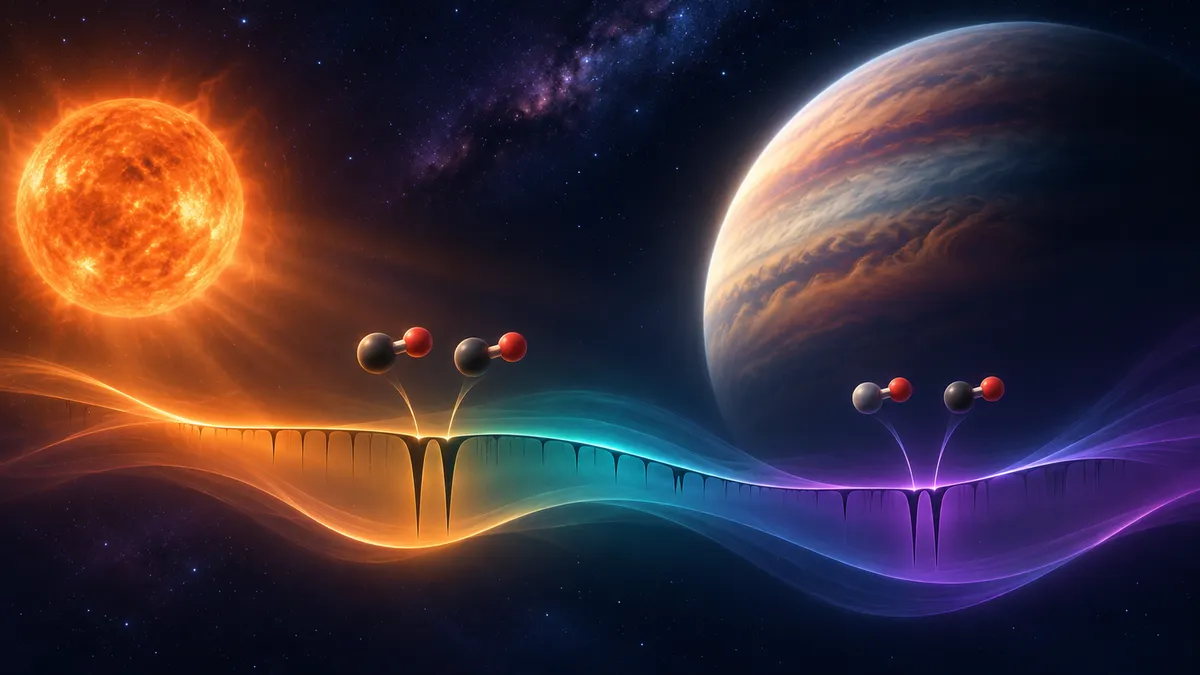
How can astronomers tell whether a planet’s atmosphere differs chemically from the material it formed from? Measuring its host star provides a starting point, but cool K dwarfs have crowded spectra that make those measurements difficult.
How can astronomers interpret carbon and oxygen in a distant planet’s atmosphere when they do not know those elements’ abundances in its star? A study led by David R. Coria addresses that missing reference for six cool stars hosting planets targeted by the James Webb Space Telescope, or JWST.
The paper measures stellar chemistry, not new planetary atmospheric compositions. Its contribution is a set of comparison points: stars and planets form from the same protoplanetary material, but subsequent processes can leave their compositions different. The work is available as arXiv preprint version 2611.08676v1, submitted on November 5, 2026. Its landing-page metadata reports acceptance for publication in The Astrophysical Journal on November 3.
Why these stars are difficult to measure
The targets are K2-141, NGTS-10, WASP-43, WASP-69, WASP-80 and HATS-72. They are K dwarfs: main-sequence stars cooler than the Sun, with adopted effective temperatures of roughly 4,100–4,750 kelvin. Their planetary systems include giant planets and the intensely irradiated rocky world K2-141 b.
At these stellar temperatures, molecular absorption produces a dense collection of features in visible-light spectra. Those features overlap and obscure the atomic lines traditionally used to measure chemical abundances. Near-infrared observations offer another route, although molecular blending remains a challenge there too.
The researchers used existing observations from IGRINS, a high-resolution infrared spectrograph, obtained at Gemini South and Lowell Observatory. The spectra cover approximately 1.45–2.45 micrometres. Their resolving power of about 45,000 allows closely spaced spectral features to be distinguished.
Comparing molecular absorption with models
An absorption line is a dip in a spectrum where atoms or molecules absorb particular wavelengths. The team used carbon monoxide, or CO, features to constrain carbon and hydroxyl, or OH, features to constrain oxygen.
They generated synthetic spectra using MARCS stellar-atmosphere models and the TurboSpectrum code, adopting each star’s temperature, surface gravity and metallicity. Here, metallicity describes its abundance of elements heavier than helium relative to the Sun. The calculations used one-dimensional atmospheres and assumed local thermodynamic equilibrium, which sets atomic and molecular populations from local physical conditions.
The authors compared observed features with models containing different abundances and selected the best-fitting values line by line. They rejected features affected by poor modeling, bad pixels or fitting problems, then combined the retained measurements. Establishing the reference brightness around each feature was particularly important because crowded spectra can conceal the true continuum.
Different stellar carbon-to-oxygen baselines
The resulting carbon-to-oxygen ratios, expressed as numbers of carbon atoms per oxygen atom, range from 0.48 to 0.87. Examples include 0.48 ± 0.13 for WASP-69, 0.79 ± 0.20 for WASP-43 and 0.87 ± 0.23 for WASP-80. These uncertainties matter: differences between individual central values should not automatically be treated as significant.
According to the paper’s literature assessment, NGTS-10, WASP-80 and HATS-72 previously lacked published carbon and oxygen abundance measurements. The new results therefore supply previously missing stellar reference values.
Those references do not uniquely reveal where a planet formed. The paper emphasizes that delivery of solids and gas, evolving disk chemistry and later atmospheric processes complicate any attempt to reconstruct formation from atmospheric carbon-to-oxygen ratios alone.
Carbon isotopes provide another measurement
The team also examined isotopes, forms of an element with different numbers of neutrons. Carbon-12 and carbon-13 produce slightly different CO absorption features.
Five stars yielded carbon-12-to-carbon-13 ratios between 38 and 52, with reported uncertainties of about 10–16. These are below the solar reference of 91.4 ± 1.3, indicating more carbon-13 relative to carbon-12 than in the Sun. WASP-80’s spectrum did not support a reliable measurement.
The weaker features containing oxygen-18 could not provide reliable oxygen isotope ratios for any target. Even the carbon isotope measurements were sensitive to noise, continuum placement and adopted stellar parameters; the authors included an additional systematic uncertainty.
Ages limit the wider interpretation
The researchers estimated stellar ages from rotation, a technique called gyrochronology, to compare their measurements with models of the Galaxy’s changing chemistry. But close-in planets can alter stellar rotation, and conflicting rotation measurements make WASP-80 especially uncertain. Separate evolutionary-model fits pushed five targets toward the imposed 14-billion-year upper age boundary, illustrating the difficulty of dating these stars.
With only five carbon isotope measurements and little coverage of stars aged 4–10 billion years, proposed abundance–age trends remain tentative. The firmer result is the expanded inventory of stellar chemistry, not a demonstrated formation history for the planets.
This article uses the supplied full-paper PDF text extraction. Figures were not visually inspected, and extraction can damage equations, tables and layout.
- K dwarf stars
- stellar abundances
- exoplanet atmospheres
- carbon-to-oxygen ratio
- carbon isotopes
- infrared spectroscopy
- JWST
- gyrochronology
Related reading
Automatically matched by shared topic keywords. These links do not imply that the sources agree or establish a consensus.
Reading the Ingredients of Planets in M-Dwarf Starlight
Source published
Shared keywords: infrared spectroscopy, stellar abundances
Faster noise modelling could sharpen studies of exoplanet atmospheres
Source published
Shared keywords: exoplanet atmospheres
Low-resolution starlight reveals 133 candidate chemical families in the Milky Way
Source published
Shared keywords: stellar abundances
Could nova explosions explain the chemistry of phosphorus-rich stars?
Source published
Shared keywords: stellar abundances