TRANSMISSION // 2611.08648v1
Red giant stars refine the distances to Andromeda’s dwarf companions
Source published
A preprint combines distance estimates for 20 dwarf galaxies around Andromeda using the brightness cutoff of red giant stars. The results help locate possible companions of Andromeda and the Triangulum Galaxy, but stellar crowding and incomplete uncertainty estimates limit conclusions about membership.
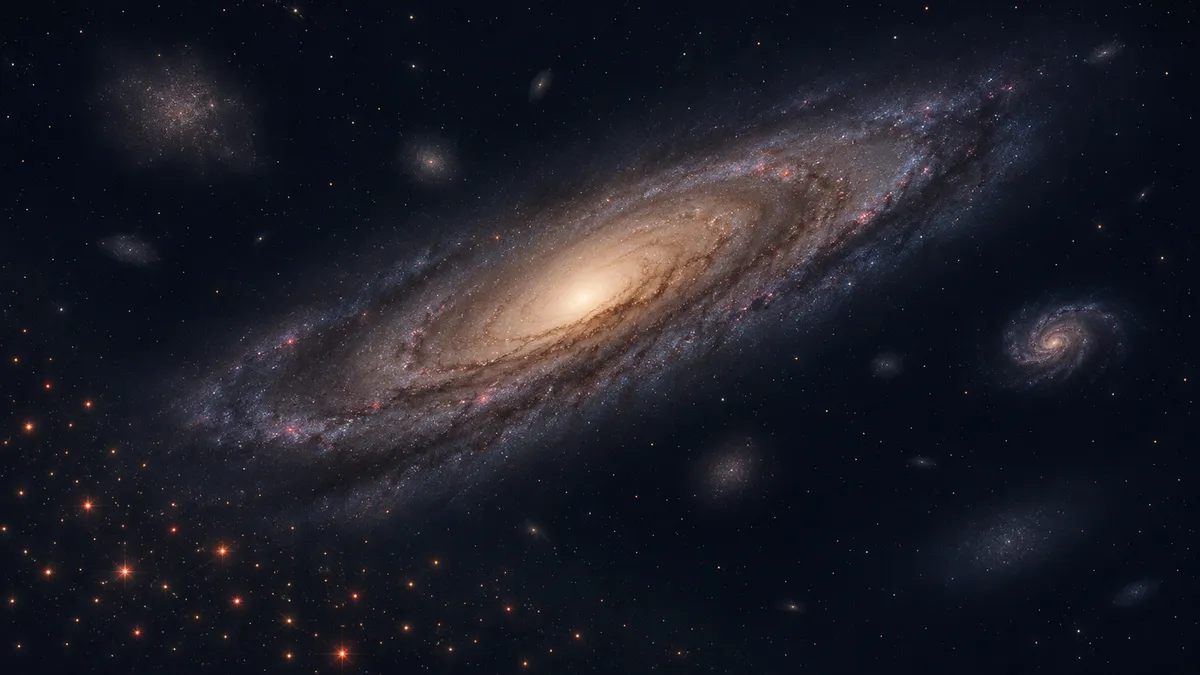
Which small galaxies really belong to Andromeda, and which only appear nearby on the sky? Measurements of red giant stars help resolve their positions in depth, while leaving some important associations uncertain.
Which dwarf galaxies near Andromeda actually sit close to it in space? Their positions across the sky are measured precisely, but their distances along our line of sight are harder to establish. That missing depth matters: the paper notes that a difference of 0.3 magnitudes in a distance estimate near Andromeda corresponds to roughly 110 kiloparsecs.
In a preprint, Hedieh Abdollahi measures distances to 17 dwarf galaxies using observations from the Isaac Newton Telescope, then adds three previously published distances from the same survey. The resulting sample of 20 provides a more uniform basis for comparing these galaxies, without settling which larger galaxy each belongs to.
A brightness cutoff that reveals distance
The method uses the tip of the red giant branch, or TRGB. This marks the onset of helium burning in the cores of low-mass red giant stars. For old populations with relatively few elements heavier than helium, the tip’s intrinsic brightness changes only weakly with age and chemical composition in suitable red optical bands.
Astronomers therefore compare its observed brightness with a calibrated intrinsic brightness to estimate distance, correcting for dimming by foreground dust. The challenge is identifying the tip reliably among a galaxy’s stars.
A luminosity function counts stars in brightness intervals. At the tip, the counts rise abruptly toward fainter stars. An edge-detection filter searches for that jump; it does not measure a physical edge of the galaxy.
One survey, a consistent procedure
The observations came from the 2.5-metre Isaac Newton Telescope on La Palma between June 2015 and February 2018. Although the monitoring survey was designed to find long-period variable stars, its images also resolve red giant populations.
For each galaxy, the analysis selected stars within twice its half-light radius—the radius enclosing half its light—and within a colour range around the red giant branch. It grouped their Sloan i-band brightnesses into 0.05-magnitude intervals and applied a Sobel filter, which compares neighbouring intervals to detect changes in counts. A broader filter was used for the noisiest cases, and competing peaks were checked before selecting the tip.
Artificial-star tests indicated that the measurements recovered about 90–95 percent of stars at i-band magnitude 22. That threshold is fainter than the measured tip in every target except And XVIII. Faint systems remain difficult because only a few stars may populate the crucial brightness range.
Most distances agree with some earlier work
The estimated distances from the observer range from approximately 474 kiloparsecs for And XVI to 1,177 kiloparsecs for And XVIII. Fifteen of the 20 galaxies fall between 650 and 850 kiloparsecs, around Andromeda’s distance of roughly 780 kiloparsecs.
Most estimates agree with at least one published value. But agreement is not universal. Compared with Conn and colleagues’ 2012 study, the measured tip is brighter in 12 of the 18 galaxies shared by the analyses, by as much as 0.39 magnitudes. Ten of those 12 differences fall within twice the quoted comparison uncertainty.
Crowding offers one possible explanation: two unresolved stars can blend into a source brighter than either star alone, shifting the apparent cutoff. Differences between the earlier Bayesian fitting method and this study’s edge detection may also contribute. The comparison does not establish the cause.
Three galaxies with consequential positions
And XII is estimated to lie at 844 kiloparsecs, with quoted uncertainties of about 40 kiloparsecs. That places it roughly 60 kiloparsecs behind Andromeda, but the offset is only about 1.5 times the reported uncertainty. It remains consistent with an earlier interpretation that it is entering the Local Group for the first time, without adding strong new support.
And XXII is placed at approximately 753 kiloparsecs, closer than earlier estimates. Adopting a distance of 794 kiloparsecs for M33, the Triangulum Galaxy, gives a three-dimensional separation of about 59 kiloparsecs. This is consistent with an association, but depends on the adopted M33 distance and cannot establish membership alone.
And XVIII remains roughly 400 kiloparsecs behind Andromeda despite its revised, smaller distance. Its association with Andromeda is consequently uncertain.
The uncertainties extend beyond the error bars
The reported distance-modulus uncertainties include only the tip measurement, not systematic uncertainty in its intrinsic-brightness calibration or the dust correction. Sparse stars, blending and filter choices introduce further concerns. Membership requires motion measurements as well as positions.
This article uses the supplied full-paper PDF text extraction, which omits figures and may damage equations and tables. The source is arXiv version 1, submitted on 5 November 2026 and listed as conference proceedings submitted to Communications of the Byurakan Astrophysical Observatory; that metadata does not establish completed peer review.
- Andromeda
- dwarf galaxies
- tip of the red giant branch
- galaxy distances
- Isaac Newton Telescope
- Triangulum Galaxy
- stellar crowding
Related reading
Automatically matched by shared topic keywords. These links do not imply that the sources agree or establish a consensus.
How Red Giant Measurements Shift the Inferred Expansion Rate
Source published
Shared keywords: tip of the red giant branch
GetGaia 2.0 sorts distant stellar systems from the Milky Way foreground
Source published
Shared keywords: dwarf galaxies
Why missing radio signals do not rule out black holes in dwarf galaxies
Source published
Shared keywords: dwarf galaxies