TRANSMISSION // 2611.08642v1
Can a simpler star simulation recover tides in gravitational waves?
Source published
A preprint tests whether Newtonian particle simulations can estimate the small tidal contribution to gravitational-wave amplitudes. For one idealized neutron-star binary, a rescaling brings results into the same range as a relativity-calibrated model at selected separations—but does not validate a complete inspiral waveform.
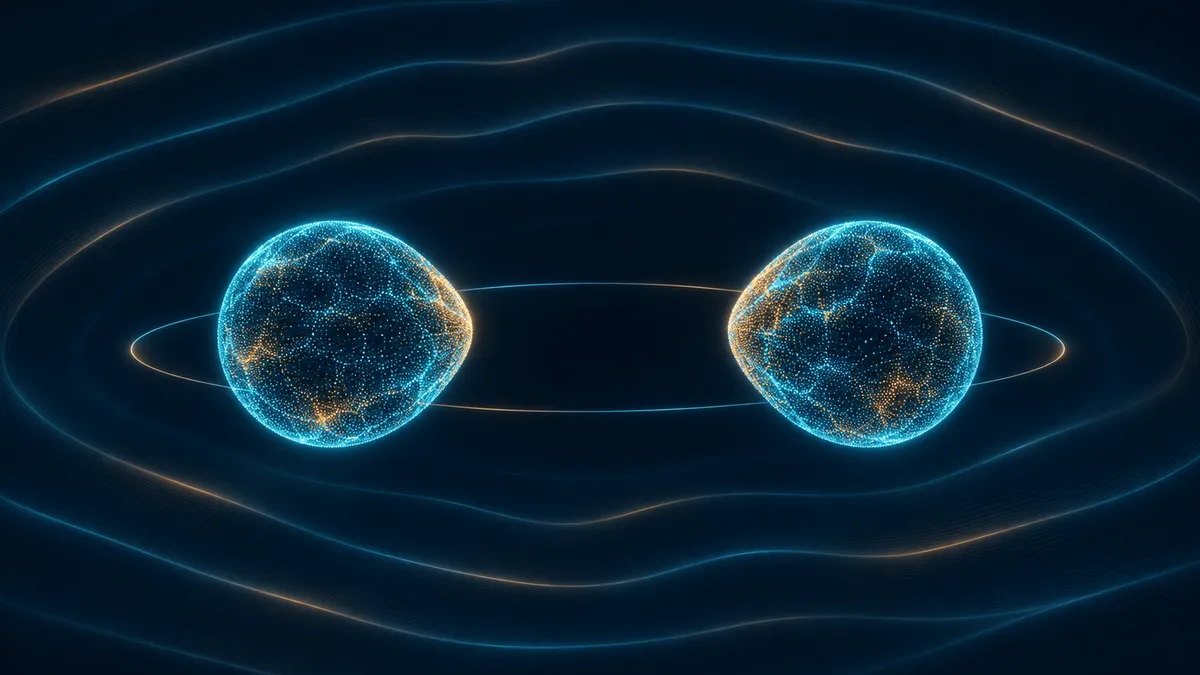
How much does a neutron star’s changing shape alter the gravitational waves from its orbit? A new modeling study finds that a relatively modest particle simulation can estimate part of that effect, within a narrow and carefully qualified comparison.
How much does the stretching of two orbiting neutron stars change their gravitational-wave signal—and can a simpler simulation estimate that change without solving the full equations of general relativity?
Marat Sh. Potashov, Sergei I. Blinnikov and Aleksandra V. Mishakina investigate this question in an arXiv preprint submitted on November 5, 2026. Their result concerns a limited task: estimating the tidal contribution to wave amplitude for selected configurations of an idealized binary. It is not a demonstration of a complete, accurate merger waveform or an operational early-warning system.
Separating stellar shape from orbital motion
A point-mass model treats each star as having mass but no physical extent. Real stars deform under a companion’s gravity. These tides change the distribution of matter and therefore the gravitational waves emitted by the binary.
The researchers use PHANTOM, a smoothed particle hydrodynamics code. This method represents a fluid with computational particles whose collective behavior describes the star. Here, gravity follows Newton’s theory rather than a self-consistent evolution of matter and spacetime under general relativity.
Their main example contains two neutron stars, each with 1.5 times the Sun’s mass and a radius of 12 kilometers. Both use the same simplified prescription relating pressure and density. Each star contains 10,000 computational particles. The models assume nearly circular orbits and synchronized rotation: each star spins once per orbit.
Before measuring the signal, the team lets the configurations settle. Their halted-pendulum relaxation procedure repeatedly removes residual particle motion in the rotating frame, suppressing unwanted oscillations. Without this preparation, the authors report that numerical noise overwhelms the gravitational-wave signal.
Measuring snapshots, not an entire inspiral
From each relaxed configuration, the researchers calculate the changing mass quadrupole—a measure of how matter is distributed asymmetrically—and use its second time derivative to estimate gravitational-wave strain. Strain describes the fractional stretching and squeezing associated with the wave.
Each configuration stays at a fixed separation. Because the Newtonian calculation omits the orbital shrinkage driven by gravitational-wave emission, its signal is periodic with constant amplitude. A sequence of these snapshots samples amplitude at different separations; it does not simulate the complete inspiral.
The comparison includes Newtonian point masses, a relativistic sixth-order post-Newtonian point-mass model, and Rising Tides, an analytical tidal model calibrated against numerical-relativity simulations. Post-Newtonian methods add successive relativistic corrections to a Newtonian description.
To isolate tides, the authors subtract each calculation’s appropriate point-mass baseline. This matters because a difference between two full wave amplitudes can contain both relativistic and finite-size effects.
A correction brings the estimates closer
Newtonian and relativistic stars do not have the same tidal response, even at the adopted mass and radius. The researchers account for this using a Love number, which measures how readily a star develops a deformation under an external tidal field.
For their model, the Newtonian Love number is about 0.260, compared with a relativistic value of about 0.052. They therefore multiply the Newtonian tidal excess by approximately 0.20. This is a leading-order correction for linear tidal response, not a conversion of the entire simulation into general relativity.
At roughly 60 kilometers separation, the rescaled SPH tidal addition is 0.040%, with temporal scatter of 0.0020 percentage points, compared with 0.048% from Rising Tides. At roughly 70 kilometers, the corresponding values are 0.018%, with scatter of 0.0034 percentage points, and 0.016%. These percentages use each model’s own point-mass baseline. The authors describe agreement in scale, not exact agreement.
Near 80 kilometers, the rescaled contribution approaches their adopted numerical noise band. At about 100 kilometers, the estimated addition is smaller than its temporal scatter and is unresolved. At smaller separations, the simple rescaling departs from Rising Tides.
Where the approach stops working
Several limits prevent a broader conclusion. The waveform curves start with deliberately aligned phases, so their initial agreement is not an independent validation. The study explicitly does not validate the proposed hybrid model’s full orbital phase evolution.
The spin comparison is also imperfect: PHANTOM uses synchronized stars, while Rising Tides was calibrated with nonspinning binaries. The authors estimate a small rotational correction under stated assumptions, but do not measure its coefficient or establish a strict upper bound. Their error bars represent fluctuations after relaxation, not statistical confidence intervals.
An exploratory white-dwarf–neutron-star calculation presents another obstacle. Internal oscillations, mass transfer and departures from point-mass orbital motion contribute effects of comparable size, frustrating a simple isolated tidal correction.
The useful finding is therefore narrow: relaxed Newtonian particle models can estimate tidal amplitudes in part of this idealized neutron-star comparison. This account uses the supplied full-paper PDF text extraction, which omits figures and may damage equations, tables and layout; it does not independently inspect the plotted graphics. The source is a preprint, and the comparison should not be read as established validation of a general waveform method.
- gravitational waves
- neutron stars
- tidal deformation
- smoothed particle hydrodynamics
- PHANTOM
- waveform modeling
- general relativity
Related reading
Automatically matched by shared topic keywords. These links do not imply that the sources agree or establish a consensus.
Phentax adapts black hole waveform calculations for LISA’s crowded signals
Source published
Shared keywords: gravitational waves, waveform modeling
AI trained on physics equations speeds up models of spinning neutron stars
Source published
Shared keywords: general relativity, neutron stars
Separating black hole signals from glitches in simulated LISA data
Source published
Shared keywords: gravitational waves
Can One Modified Gravity Rule Work Across a Star’s Different Matter Phases?
Source published
Shared keywords: neutron stars
Even powerful birth kicks struggle to reverse black hole binary orbits
Source published
Shared keywords: gravitational waves