TRANSMISSION // 2611.08630v1
VENUS maps 60 galaxy clusters that magnify the distant universe
Source published
A preprint presents mass models for 60 strongly lensing galaxy clusters, using about 4,500 multiple images of background sources. The authors identify especially powerful natural telescopes and find that the sample’s largest Einstein radii are compatible with their standard cosmological model predictions.
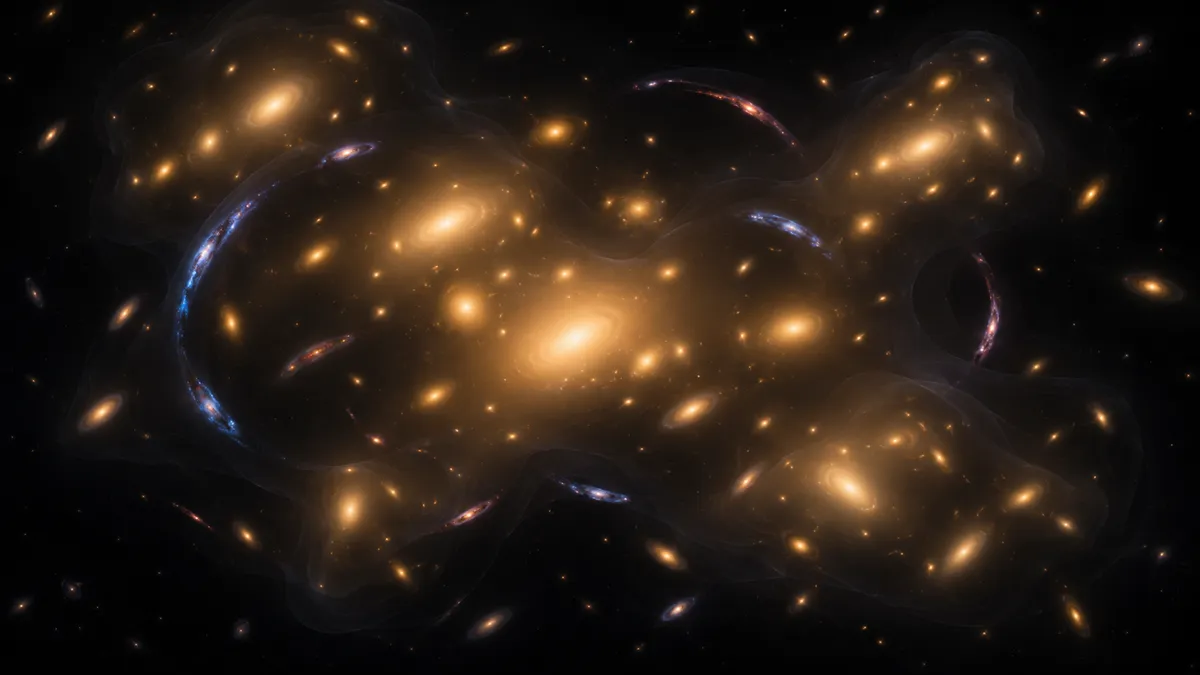
Galaxy clusters can bend light from more distant galaxies into magnified arcs and repeated images. The VENUS team has used those patterns to refine models of 60 clusters, assessing both their usefulness for studying distant objects and whether their strongest lensing effects fit cosmological expectations.
Reading mass through distorted light
A galaxy cluster can act as a natural telescope: its gravity bends light from background galaxies, producing magnified views and sometimes several images of the same source. Understanding those images requires a model of the cluster’s mass distribution, including its dark matter and member galaxies.
In a preprint, Masamune Oguri and colleagues present strong gravitational lensing models for 60 clusters targeted by Vast Exploration for Nascent, Unexplored Sources, or VENUS. This James Webb Space Telescope program is designed to obtain imaging through ten NIRCam filters. The models are intended to support studies of distant galaxies and other magnified sources.
The sample was deliberately selected for high lensing strength and the availability of existing strong-lensing models. Its powerful lenses therefore should not be taken as representative of galaxy clusters generally.
About 4,500 images, not 4,500 galaxies
The researchers fitted the positions of approximately 4,500 multiple images, about 1,150 of them newly identified in this work. These are not all separate background galaxies: one galaxy can produce several images. A typical cluster contributed about 50 images, while roughly a quarter of the clusters had more than 100.
Starting with previously identified systems, the team searched for additional matches using image shapes, estimates of redshift from multiband photometry, and consistency with the developing lens model. They then refined the model and repeated the search, retaining systems they considered high confidence.
Using the glafic software, the authors represented each cluster with parameterized components for dark matter halos, member galaxies and additional perturbations where needed to improve the fit. Spectroscopic redshifts were fixed when available; otherwise, source redshifts could be fitted, with photometric constraints included when sufficiently accurate.
JWST imaging was available for 57 clusters, not all 60. RXC J0949.8+1707, Abell 1835 and RXC J1347.5−1145 had not yet received their VENUS NIRCam observations. Their models instead used existing Hubble Space Telescope imaging, and the authors plan updates after the JWST observations.
Which clusters make the strongest telescopes?
The study measures lensing strength in two related ways. One is the area of sky over which a background source would be magnified beyond a chosen threshold. The other is an effective Einstein radius: the radius of a circle with the same area as the largest contiguous region enclosed by the cluster’s tangential critical curve.
Both depend on the background source’s redshift. For a source at redshift nine, the sample’s median Einstein radius is about 30 arcseconds. The three largest belong to MACS J0717.5+3745, MACS J0600.1−2008 and PLCK G287.0+32.9, at approximately 65, 63 and 58 arcseconds, respectively.
Those same three clusters have the largest areas with magnification greater than ten. But rankings change when the threshold is lowered to three: the Bullet cluster joins MACS J0600.1−2008 and PLCK G287.0+32.9 among the leading systems.
That distinction reflects cluster structure. Separate mass clumps can enlarge the total magnified area without greatly changing the Einstein radius as defined here, which tracks the largest contiguous critical region. Some clusters also require more than one NIRCam pointing to cover their lensing regions.
Checking predictions and recognizing limits
The models typically reproduce image positions with a root-mean-square discrepancy of about half an arcsecond. A close fit alone, however, does not establish predictive accuracy. The authors therefore used a jackknife check: remove one multiply imaged source system, refit the model and test predictions for the omitted images.
They report no sign of overfitting for most clusters, particularly those with many image constraints. A few models show likely overfitting; Abell 1835, still lacking VENUS JWST imaging, has the strongest such indication. The paper also finds a weak increase in positional discrepancies for higher-redshift sources, which the authors associate with less-constrained outer lensing regions.
Finally, the team compared the sample’s largest Einstein radii with predictions from 800 mock all-sky cluster realizations within the standard Lambda cold dark matter framework. The observed maxima fall within the reported 95% prediction limit.
The result is compatibility with that calculation, not a comprehensive validation of cosmology. The authors stress that VENUS is not a complete census of strong lenses: other clusters could have larger Einstein radii. The immediate contribution is a consistently modeled set of powerful lenses, with lens maps and image catalogs planned for the program’s first data release.
- VENUS
- gravitational lensing
- galaxy clusters
- James Webb Space Telescope
- Einstein radius
- dark matter
- cosmology
- preprint
Related reading
Automatically matched by shared topic keywords. These links do not imply that the sources agree or establish a consensus.
Early Galaxies Narrow a Search for Neutrino Interactions
Source published
Shared keywords: james webb space telescope
How Decaying Dark Matter Could Puff Up a Galactic Halo
Source published
Shared keywords: dark matter
Can brightness gradients reveal subtle distortions in distant galaxies?
Source published
Shared keywords: gravitational lensing
Webb spots a faint oxygen line in a distant galaxy’s core
Source published
Shared keywords: gravitational lensing, james webb space telescope
Modified gravity still leaves galaxy clusters with missing mass
Source published
Shared keywords: galaxy clusters