TRANSMISSION // 2611.08604v1
Even powerful birth kicks struggle to reverse black hole binary orbits
Source published
Three-dimensional simulations suggest that a strong recoil at a black hole’s birth does not reliably reverse its binary orbit. Falling stellar debris can weaken the kick, and sustained reversals in the modeled binaries required unusually energetic explosions and a precisely chosen kick direction.
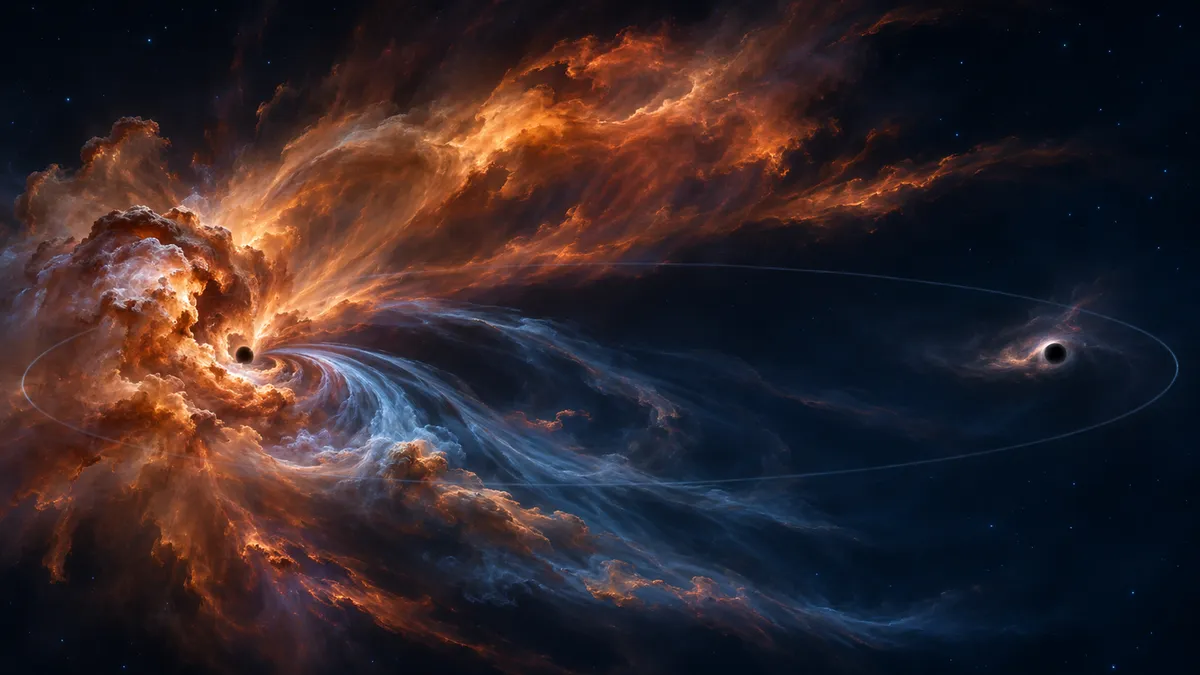
A black hole can receive a recoil as it forms inside an asymmetrically exploding star. But can that shove reverse a binary’s orbit, changing how its spins appear in gravitational waves? A new preprint finds that even an initial kick of 1,000 kilometers per second often loses that contest as stellar material falls back.
Gravitational waves carry clues not only to the masses of merging black holes, but also to how their spins line up with their shared orbit. One useful measure, called effective spin, combines the two black holes’ spin components along the orbital angular momentum, weighted by their masses. A negative value means that this weighted combination points against the orbit.
That distinction matters for reconstructing a binary’s history. Two stars evolving together in isolation are generally expected to produce black holes with spins aligned with their orbit. Black holes brought together through encounters in a dense stellar environment need not share that alignment. But a sufficiently strong birth kick could complicate this picture: reversing the orbital motion could make initially aligned spins point against the new orbit.
In a preprint submitted to arXiv on November 5, Edwin Santiago-Leandro, Clarissa Avilés-Niebla and Aldo Batta investigate whether asymmetric stellar explosions can deliver and preserve such kicks. Their results come from computer simulations, not observations of black holes being born.
Following the falling debris
The researchers modeled four rotating, hydrogen-stripped helium stars with pre-explosion masses of 13, 21, 28 and 34 times the Sun’s mass. Each simulation began with a nonrotating black hole of three solar masses already formed at the center. This simplified starting point bypassed the preceding neutron-star stage and its complicated accretion physics.
Using three-dimensional smoothed particle hydrodynamics, the team represented the surrounding stellar material with moving particles. They injected kinetic energy asymmetrically into the innermost solar mass of gas around the black hole. The prescribed explosions had energies between 20% and 90% of the surrounding envelope’s gravitational binding energy, the energy needed to overcome its gravitational binding.
The isolated-star calculations explored initial kicks from 200 to 1,500 kilometers per second, although not every combination was achievable for the lightest star. The authors describe 1,500 kilometers per second as an extreme, physically unlikely limiting case. Most calculations used one million particles; simulations including a companion black hole used eight million.
The central issue was fallback: material initially pushed outward could remain gravitationally bound and subsequently fall into the black hole. That returning gas adds both mass and momentum, changing the recoil left after the explosion.
A stronger kick than expected—not necessarily a stronger original kick
If fallback were symmetric, adding mass would dilute the black hole’s initial kick in a straightforward way. Asymmetric fallback made the outcome more complicated. Some simulations produced final speeds approaching twice that symmetric-fallback prediction. Others reduced the speed below it, especially for the weakest explosions.
This enhancement is relative to the reduced speed expected after symmetric accretion, not necessarily an acceleration beyond the original birth kick. Explosion energy and the star’s internal structure helped determine the outcome. More energetic explosions generally expelled more material, leaving less to fall back.
To assess the consequences for binaries, the researchers first combined isolated-star results with an analytical approximation treating mass loss and recoil as instantaneous. They then simulated explosions with the companion black hole explicitly present.
The kicks were deliberately aimed within the orbital plane, exactly opposite the exploding star’s orbital motion—a favorable arrangement for reversing the orbit. Even then, the companion-inclusive calculations showed that a 1,000-kilometer-per-second initial kick did not reliably preserve a reversal. Fallback often restored the original direction of orbital motion.
Negative effective spin persisted at the highest tested explosion energy, 90% of the envelope’s binding energy, across the four stellar models. At 80%, it persisted only for the 13-solar-mass model.
Limits of the experiment
The instantaneous approximation often reproduced orbital separations well, particularly for energetic explosions. Eccentricity—the degree to which an orbit departs from a circle—could differ substantially. Because merger-time estimates become especially sensitive to eccentricity near extremely elongated orbits, apparently modest orbital differences could produce large differences in predicted merger times.
These results do not rule out birth kicks as a route to negative effective spin. The study used one prescribed asymmetry width, initially circular compact binaries and a selected companion spin. It did not calculate the explosion mechanism from first principles. The authors also identify initially wider binaries as a possibility requiring further study.
The narrower conclusion is that kick strength alone is insufficient. In these models, direction, explosion energy and the momentum carried back by falling debris jointly determined whether a binary kept its reversed orbit.
- black hole binaries
- natal kicks
- stellar fallback
- asymmetric supernovae
- gravitational waves
- effective spin
- hydrodynamic simulations
Related reading
Automatically matched by shared topic keywords. These links do not imply that the sources agree or establish a consensus.
Phentax adapts black hole waveform calculations for LISA’s crowded signals
Source published
Shared keywords: black hole binaries, gravitational waves
Separating black hole signals from glitches in simulated LISA data
Source published
Shared keywords: gravitational waves
A Possible Polarization Swing Near the Black Hole in Cygnus X-1
Source published
Shared keywords: black hole binaries
Can a simpler star simulation recover tides in gravitational waves?
Source published
Shared keywords: gravitational waves
Fading X-rays connect merger-driven gamma-ray bursts to their opening flash
Source published
Shared keywords: gravitational waves