TRANSMISSION // 2611.08599v1
Black hole spin alone may not keep massive galaxies from making stars
Source published
A new galaxy-formation model finds that disordered feeding can slow supermassive black holes and weaken their spin-powered jets. Within the model, additional mechanical outflows restore enough heating to reproduce the observed abundance of massive galaxies.
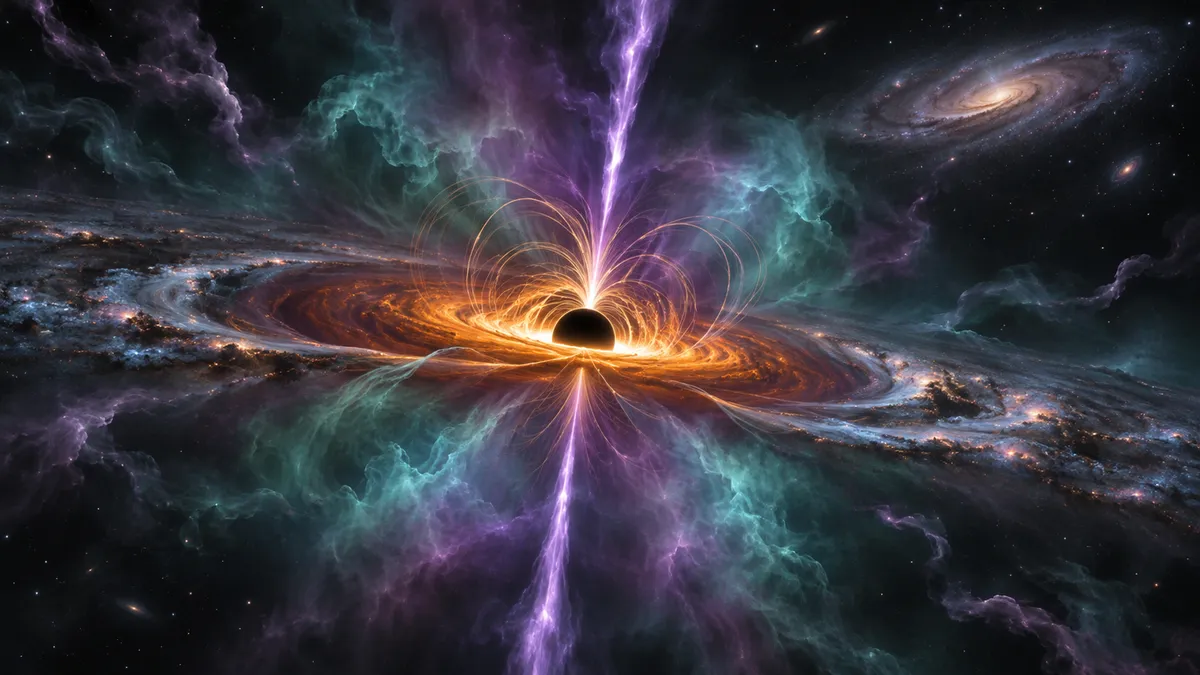
A black hole can gain mass while losing the rotation that helps power its jets. A new preprint explores how that competition affects entire galaxies—and finds that jets drawing on black hole spin may need help from other outflows to suppress star formation.
Supermassive black holes influence their host galaxies by releasing energy as they feed. Jets can heat the surrounding gas, limiting how much cools into the material from which stars form. But the strength of that feedback depends on more than how much gas reaches the black hole: its rotation and magnetic environment also matter.
In a preprint submitted to arXiv on November 5, 2026, Antonio J. Porras-Valverde and colleagues introduce Mad Sage, a galaxy-formation model that follows black hole mass, spin and feedback together. Their central finding is conditional but consequential: when disordered feeding slows massive black holes, spin-powered jets alone do not adequately suppress the growth of massive galaxies in their model.
Connecting black holes to galaxies
Mad Sage builds on the existing Dark Sage framework. It is a semi-analytic model: rather than directly simulating every movement of gas, it uses physical prescriptions to track processes such as cooling, star formation, black hole feeding and feedback within the assembly histories of dark matter halos.
The researchers run it on merger histories from a dark-matter-only IllustrisTNG simulation covering a box 110.7 comoving megaparsecs across. To describe conditions close to black holes, they incorporate fitting formulas calibrated against relativistic simulations of magnetized accretion flows, alongside a prescription for the spins left by black hole mergers.
The key assumption is magnetically arrested accretion. In this state, magnetic flux accumulates near a black hole strongly enough to impede the inflow. Organized magnetic fields can extract rotational energy through the Blandford–Znajek mechanism, powering jets while also slowing the black hole.
Gas feeding supplies a competing influence. Cold material flowing inward through an unstable galactic disk is treated as coherent, with angular momentum consistently aligned with the black hole. Hot halo feeding is treated as incoherent, with randomly assigned prograde or retrograde orientations. These are modelling choices, not observations of individual feeding events.
When jets need another source of heating
The team compares four variants: a fixed-efficiency reference without spin tracking; an entirely coherent feeding model; a model combining coherent disk feeding, incoherent halo feeding and merger-driven spin changes; and that mixed model with an additional mechanical-feedback prescription.
In the mixed model without the correction, incoherent feeding and electromagnetic extraction push massive black holes toward low spins. Their jet efficiency falls, and the model produces too many galaxies with stellar masses above roughly 100 billion Suns. The authors report that adjusting their two galaxy-formation calibration parameters could not resolve this high-mass excess.
Allowing exclusively coherent feeding gives a better match, through changes in both radiative and jet feedback. Alternatively, the mixed model improves when the researchers impose a minimum effective mechanical power equal to 2% of the incoming gas’s rest-mass energy rate, whenever the calculated jet power is lower.
That floor represents outflows beyond the spin-powered jet, motivated by simulations of hot, radiatively inefficient flows around non-spinning black holes. It is a phenomenological prescription—not a direct calculation of those winds throughout the galaxy population.
The result is also not simply that the model releasing the most energy suppresses the most stars. Black hole growth, feeding rates and feedback efficiency change together. Moreover, the variants are calibrated independently, so their quantitative differences cannot all be attributed to spin physics alone.
Predictions with unresolved tensions
The models broadly reproduce observed black hole–galaxy mass relations and disk surface-density profiles. Their predicted abundance of active galactic nuclei also agrees reasonably with observational constraints at redshifts around two to six. At low redshift, however, the spin-tracking models produce too few faint active nuclei.
Their spin predictions offer another test. At redshifts below about three, more massive black holes generally rotate more slowly; earlier in cosmic history, that mass dependence weakens. Predicted spin distributions peak around 0.5–0.7 on the dimensionless spin scale, below the near-maximal values favoured by existing X-ray reflection measurements. The authors emphasize that those measurements carry substantial modelling uncertainties and selection effects.
For massive, weakly accreting black holes targeted by future horizon-scale facilities such as the next-generation Event Horizon Telescope and Black Hole Explorer, the models predict bimodal spin distributions. Forecast merger-detection rates for LISA are nearly identical across the spin variants, largely because they share the same halo merger histories and black hole seeding prescription.
The largest caveat is the assumed magnetically arrested state across accretion conditions. Its applicability throughout the model population remains uncertain. The work therefore identifies a tension within a specified physical framework, not proof that real galaxies universally require a 2% feedback floor.
- supermassive black holes
- black hole spin
- galaxy formation
- AGN feedback
- magnetically arrested disks
- Mad Sage
- accretion
- astrophysics preprint
Related reading
Automatically matched by shared topic keywords. These links do not imply that the sources agree or establish a consensus.
Could displaced black holes give cosmic rays an extra boost?
Source published
Shared keywords: supermassive black holes
How a Black Hole’s Jets Could Disrupt Its Own Fuel Supply
Source published
Shared keywords: supermassive black holes
Galactic Gas May Preserve Traces of Fading Black Hole Activity
Source published
Shared keywords: supermassive black holes
CosmicGrain follows dust histories through a simulated galaxy
Source published
Shared keywords: astrophysics preprint
Hyperion’s Densest Regions Show More X-ray-Active Black Holes
Source published
Shared keywords: supermassive black holes