TRANSMISSION // 2611.08589v1
What Galaxy Triangles Could Reveal About Cosmic Flows
Source published
A theoretical preprint models how a galaxy’s motion relates to the distribution of galaxies at two other locations. Its predictions reveal a dominant directional pattern and geometry-dependent echoes of ancient sound waves, while outlining the work needed before this statistic can deliver reliable cosmological measurements.
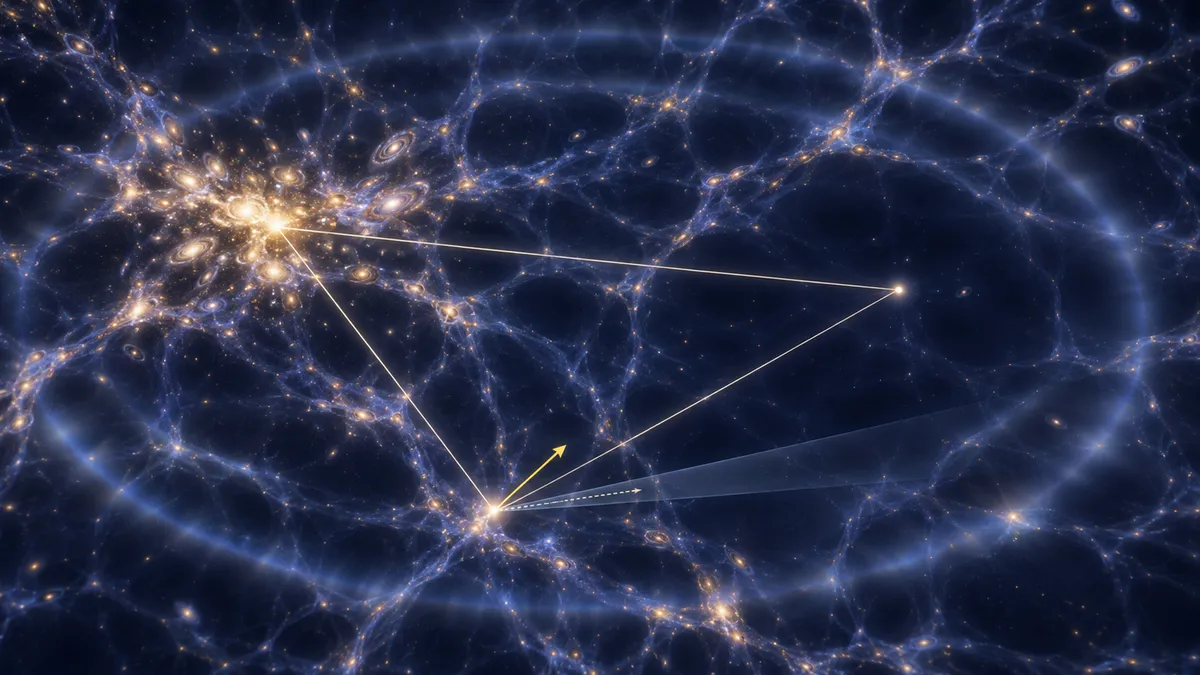
Galaxies do more than follow the expansion of the universe: gravity also draws them toward concentrations of matter. Those additional motions offer a complementary view of cosmic structure. A new preprint by M. Guidi, A. Farina, A. Nusser and E. Branchini develops a framework for connecting these flows to galaxy clustering through triangles, rather than pairs.
Mapping where galaxies gather is a powerful way to study the universe, but galaxies are imperfect markers of its matter. Their abundance depends on how they form and on their surroundings, a relationship cosmologists call galaxy bias. Large-scale motions offer a complementary probe: under the equivalence principle, galaxies and dark matter respond to the same gravitational acceleration. Their coherent flows can therefore help disentangle the growth of structure from the way galaxies trace it.
The new preprint studies a three-point statistic involving one peculiar velocity—the motion beyond cosmic expansion—and galaxy density at two other locations. Only the velocity component toward or away from the observer is used. Repeating this comparison over triangles of different sizes, shapes and orientations describes how flows couple to the surrounding galaxy distribution. Unlike a two-point statistic, it captures a leading signature of nonlinear evolution: for jointly Gaussian fields with zero mean, this three-point correlation vanishes.
The authors construct a theoretical model, not a measurement from a galaxy survey. They use tree-level perturbation theory, the lowest order that produces the signal for Gaussian initial conditions. Their calculation includes linear galaxy bias, a quadratic response to local density, and tidal bias, which describes sensitivity to the surrounding gravitational environment. It also accounts for redshift-space distortions: galaxy motions alter the redshifts used to infer positions, making observed clustering depend on viewing direction.
The calculation begins with velocity divergence, a scalar describing how flows converge or spread out. The researchers then convert it into a projected velocity. That conversion couples the angular patterns associated with the two density locations, complicating the mathematics. Spherical harmonics separate these patterns into multipoles, or angular components. The team derives predictions both in Fourier space, which describes structure through waves, and in configuration space, which describes separations between locations. Reusable geometric calculations and numerical transforms make the configuration-space predictions practical.
For an illustrative model at redshift 0.9, the simplest odd directional pattern—the line-of-sight dipole sector—dominates. It contains about 94% of the calculated squared amplitude in Fourier space and 95% in configuration space over the authors’ chosen ranges. These percentages describe the distribution of model amplitude, not measurement precision or cosmological information. Several angular components are still needed to represent triangle shape, especially in configuration space.
The weaker components could nevertheless matter. Changing the rate at which structure grows mostly changes the overall signal strength, but also shifts some amplitude into more complicated directional patterns. Changing quadratic or tidal bias alters the dependence on triangle shape. These differences suggest possible ways to distinguish physical effects that otherwise resemble one another. However, the predicted responses remain substantially degenerate. The paper does not establish how well observations could separate them, because that requires a covariance calculation describing uncertainties and correlations between measurements.
The model also follows baryon acoustic oscillations, the fossil imprint of sound waves in the early universe. In Fourier space, these appear as oscillations; in configuration space, they produce a feature near the acoustic separation, approximately 105 h⁻¹ Mpc, or 105/h megaparsecs, in the examples. Here h is the dimensionless Hubble parameter, defined as h = H₀ / (100 km s⁻¹ Mpc⁻¹), where H₀ is the present expansion rate. For individual triangles, the feature depends on which side reaches that separation and on the velocity projection. The velocity vertex has a distinct role, so the three sides are not interchangeable as they are in galaxy-density-only statistics. The authors include the smoothing of the acoustic feature by large-scale bulk motions.
Connecting this theory to observations requires another distinction. A peculiar-velocity catalogue samples motions at galaxy positions, rather than uniformly throughout space. It therefore measures a density-weighted velocity, often called momentum. At the order considered, its three-point statistic equals the desired velocity-density-density correlation plus two products of two-point correlations. The authors derive this relationship and propose estimators for observable angular components, with those extra contributions subtracted using measurements from the same catalogues.
Important limitations remain. The model assumes Gaussian initial conditions, irrotational velocities, no velocity bias at the retained order, and a common line of sight. Its Fourier calculation is checked against an exact expression within the model, while configuration-space predictions undergo numerical convergence tests. Angular reconstruction becomes difficult near certain equal-side configurations. These checks do not establish physical accuracy on strongly nonlinear scales. Simulations must determine usable scales, and future work must address velocity errors, survey geometry, sampling, shot noise, wide-angle effects and covariance. The preprint supplies a framework for those investigations—not a demonstrated improvement in cosmological constraints.
- peculiar velocities
- galaxy clustering
- three-point correlation
- bispectrum
- cosmic structure
- galaxy bias
- baryon acoustic oscillations
- redshift-space distortions
- cosmology preprint
Related reading
Automatically matched by shared topic keywords. These links do not imply that the sources agree or establish a consensus.
Galaxy Motions Help Untangle Models of Dynamical Dark Energy
Source published
Shared keywords: redshift space distortions
A Census of Nearby Galaxies Finds Concentrated Stellar Mass and an Unusual Dwarf
Source published
Shared keywords: peculiar velocities
How Decaying Dark Matter Could Puff Up a Galactic Halo
Source published
Shared keywords: cosmology preprint
An AI-Built Dark Matter Registry Points to Missing Tools, Not Just Missing Theory
Source published
Shared keywords: cosmic structure