TRANSMISSION // 2611.08585v1
Can Ripples in the Universe’s Oldest Light Reveal When New Physics Acted?
Source published
A preprint finds that two types of inflationary signals generally leave patterns in the cosmic microwave background distinguishable from those produced by the energy-injection and early-dark-energy models tested. Planck data support that separation, but provide no significant detection of the proposed new physics.
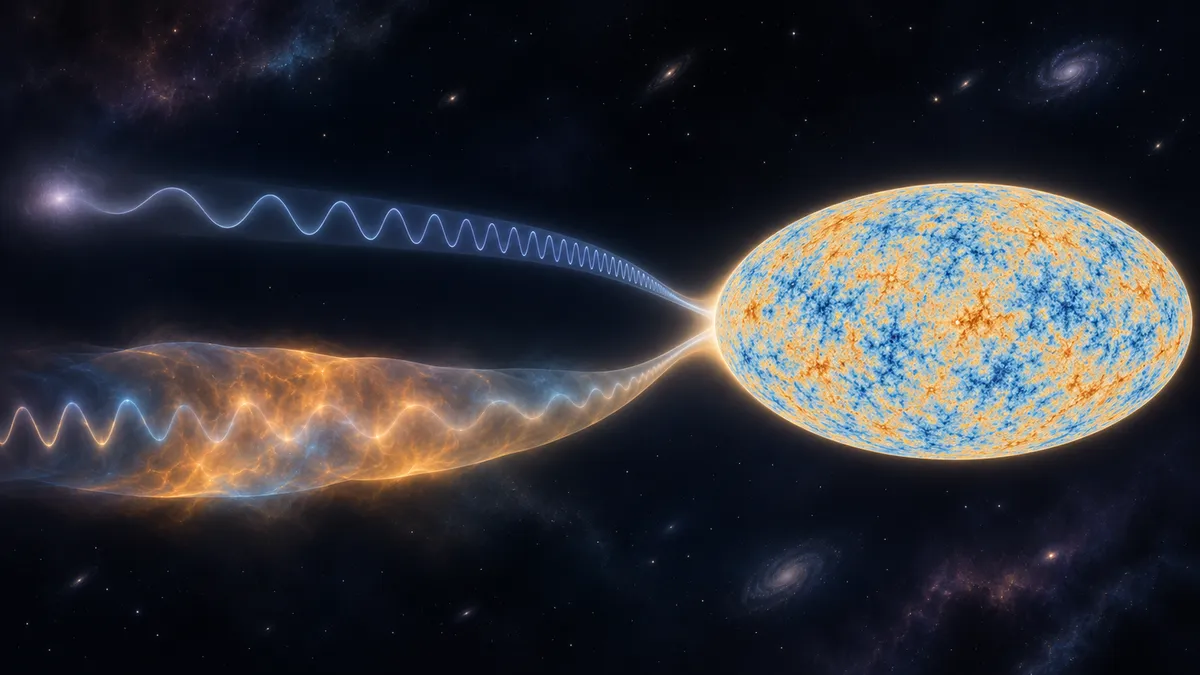
An unusual pattern in ancient cosmic light could reflect events during inflation—or changes that happened much later. A new study asks whether cosmologists could tell those histories apart, rather than mistake one for the other.
The cosmic microwave background, or CMB, is often described as a baby picture of the universe. But that picture contains more than one layer of history. Its temperature and polarization patterns reflect both the initial cosmic fluctuations and the processes that subsequently shaped them. If an unexpected ripple appears, identifying when it originated is essential to understanding what caused it.
In a November 2026 preprint, Matteo Braglia, Wenzer Qin, Xingang Chen and Tracy R. Slatyer investigate that identification problem. They compare two kinds of signals associated with inflation—the proposed early episode of accelerated expansion—with two examples of physics operating afterward. Their conclusion is encouraging but limited: the particular classes they test generally produce distinguishable patterns. The work is a preprint, not an established detection of new physics.
The standard cosmological model, known as Lambda-CDM, already describes the CMB remarkably well. Some differences between its predictions and observations have attracted attention, including a shortage of temperature variation on very large angular scales. However, such residuals are not compelling evidence for an alternative model. They could arise from statistical fluctuations or unidentified systematic effects. This study asks how competing explanations could be separated, rather than claiming that those anomalies require new physics.
The primordial possibilities concern departures from inflation’s simplest, smoothly evolving behavior. A brief disturbance can generate a “sharp feature”: an oscillatory correction to the initial fluctuation spectrum, with peaks spaced regularly in wavenumber, a measure inversely related to physical wavelength. A repeating disturbance can instead generate a “resonant feature,” whose oscillations are regularly spaced in the logarithm of wavenumber. These different spacing rules describe how the oscillation’s phase changes across scales—not a fluctuation occurring in time in today’s sky.
For the later-universe alternatives, the researchers first consider spatially uniform injections of energy into cosmic gas. Processes such as dark matter decay or annihilation motivate this possibility, although the study uses simplified bursts rather than a detailed particle model. Extra ionization near recombination, when neutral atoms formed and light could travel freely, can delay that transition and shift the CMB’s acoustic peaks. Later injections mainly increase scattering and suppress existing anisotropies.
The second alternative is a transient early-dark-energy component, represented by a simplified fluid that briefly changes the expansion history before rapidly fading. It also affects gravitational perturbations. Its main oscillatory signature comes from shifting existing acoustic peaks, rather than introducing an independently adjustable oscillation frequency. Those acoustic peaks originate in sound waves in the early mixture of photons and ordinary matter.
The team calculated the predicted temperature, polarization and temperature–polarization spectra using a modified version of ExoCLASS, a cosmological evolution code. They then used principal component analysis to identify combinations of model changes that observations could constrain most strongly. Crucially, they allowed the ordinary cosmological parameters to vary: otherwise, changes that a standard-model adjustment could absorb might misleadingly appear to be distinctive new signals.
That analysis found little substantial overlap between the dominant primordial and post-inflationary signatures. The key distinction is their pattern across scales. Primordial oscillations can have a freely chosen characteristic frequency, while the tested later processes mainly damp existing structure or leave residual oscillations tied to the established acoustic pattern. Some partial similarities remain, particularly when primordial oscillations resemble that acoustic scale. Even then, the evolution translating initial fluctuations into observed CMB patterns can help separate them.
A second test fitted actual Planck temperature and polarization observations, including the CamSpec likelihood based on PR4 NPIPE maps. The researchers used nested sampling, which can explore multiple separate regions of good fit associated with different oscillation frequencies. Adding a later-universe model alongside a primordial one barely changed the inferred parameter distributions or amplitude constraints. That stability supports the conclusion that neither class readily disguises itself as the other in these analyses.
Better fits did not amount to discoveries. The sharp and resonant models improved the best-fit chi-squared statistic by about 6.9 and 7.9 respectively, but Bayesian model comparisons favored Lambda-CDM after accounting for the additional parameter space. The study also reports a 95% upper bound of 0.0387 on the early-dark-energy fraction at its transition, within the specific fluid model tested.
The limitations matter. The primordial templates omit detailed amplitude envelopes, the energy injections are idealized, and the early-dark-energy prescription is phenomenological. The statistical compression also involves approximations. The full data analysis uses Planck rather than adding newer ground-based measurements, and it excludes CMB lensing data. Other changes to gravity, recombination or dark-sector interactions remain untested. The result is therefore a method and a promising demonstration—not proof that every possible primordial signal can be distinguished from every later process. Future CMB observations and galaxy surveys could make that distinction much more powerful.
- cosmic microwave background
- inflation
- primordial features
- early dark energy
- dark matter
- Planck
- principal component analysis
- cosmology
Related reading
Automatically matched by shared topic keywords. These links do not imply that the sources agree or establish a consensus.
Early Galaxies Narrow a Search for Neutrino Interactions
Source published
Shared keywords: cosmic microwave background
A Python tool traces possible signals from the early universe
Source published
Shared keywords: dark matter
Planck reanalysis finds a modest hint of inflation-era particle signatures
Source published
Shared keywords: cosmic microwave background
How Decaying Dark Matter Could Puff Up a Galactic Halo
Source published
Shared keywords: dark matter
VENUS maps 60 galaxy clusters that magnify the distant universe
Source published
Shared keywords: dark matter