TRANSMISSION // 2611.08563v1
Webb survey links stronger early-galaxy emission to bursts of star formation
Source published
Combining two James Webb Space Telescope surveys, researchers find that oxygen and hydrogen emission becomes stronger relative to starlight in earlier galaxies. Their preprint links the trend to increasingly variable star formation, while highlighting uncertainties from galaxy models and sample selection.
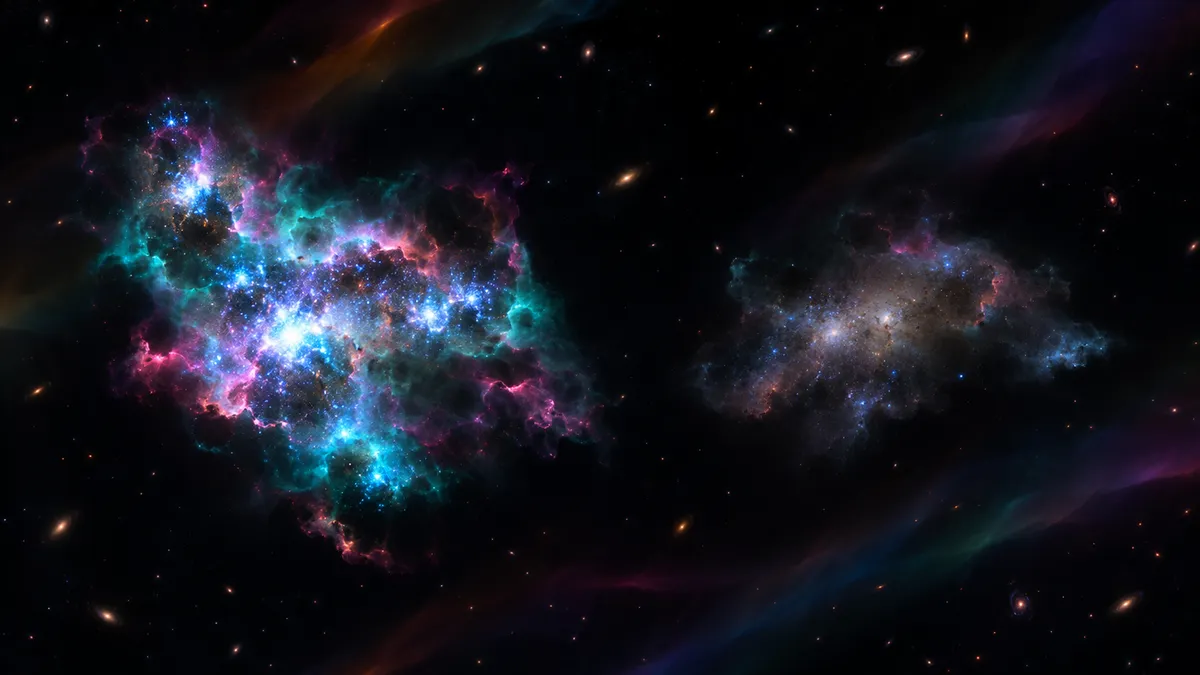
The youngest galaxies often announce themselves through bright emission from gas surrounding newly formed stars. A new analysis of nearly 2,000 galaxies uses Webb’s infrared filters to investigate how that signal changed across cosmic history—and why strong emitters became more common toward earlier times.
Galaxies do not necessarily form stars at a steady pace. Short episodes of intense activity can illuminate their gas, followed by quieter intervals as the most massive stars die. A preprint by Isaac J. B. Holst and colleagues finds evidence consistent with this increasingly stop-start pattern in the early universe. Submitted to Monthly Notices of the Royal Astronomical Society, the study examines galaxies across redshifts of about 3 to 8.5; higher redshift means their light comes from an earlier cosmic era.
The team combined James Webb Space Telescope imaging from the PRIMER and MINERVA surveys in the UDS survey field, alongside Hubble observations. Together, these provide measurements through 19 filters. Broad filters collect light across wide wavelength ranges, while medium-width filters help distinguish emission from glowing gas from the smoother background light of stars. As cosmic expansion shifts a galaxy’s light toward longer wavelengths, different filters capture the same emission features at different redshifts.
The researchers focused on a group of optical emission lines called [O III]+Hβ, produced by doubly ionized oxygen and hydrogen. Their key measurement, equivalent width, compares the total line emission with the adjacent continuum brightness. Although expressed in angstroms, it is not the physical width of a galaxy or a measure of gas speed. A larger equivalent width means the lines stand out more strongly against the underlying light.
This comparison probes recent star formation. Massive, short-lived stars supply radiation that powers nebular emission, making the lines sensitive to activity over roughly the preceding 10 million years. The optical continuum also includes longer-lived stars. A sudden increase in star formation can therefore boost the lines faster than the background continuum builds up.
Adding MINERVA’s medium-band imaging improved the estimated redshifts. For the reported performance down to an F444W magnitude limit of 28, Table 2 gives a large-error rate of 8.12% for PRIMER alone, validated against 2,599 galaxies with spectroscopic redshifts, and 4.71% for PRIMER+MINERVA, validated against 3,145 galaxies. The authors report a 42% relative reduction, but these totals are not a matched-sample comparison. Photometric redshifts are estimates from multicolour imaging, rather than direct spectral measurements for every object.
To infer equivalent widths and stellar properties, the team fitted models of galaxy light using the bagpipes software. They tested different stellar-population models and star-formation histories against 115 galaxies with suitable Webb NIRSpec spectra. The preferred setup used BPASS stellar models and a flexible history allowing star formation to vary between time intervals. Photometric and spectroscopic equivalent widths agreed closely on average, although individual measurements showed substantial scatter, around 337 angstroms. The researchers applied a small calibration correction.
The final sample contained 1,964 galaxies selected above a common ultraviolet-luminosity threshold, divided into five redshift intervals. Median equivalent width increased in every successive interval: from approximately 350 angstroms at redshift 3.2 to about 1,120 angstroms at redshift 8.3. The distribution also became more asymmetric, developing a longer tail toward weak emission even as its typical value increased.
Extreme emission-line galaxies, defined here by equivalent widths of at least 1,000 angstroms, became substantially more common. Within a narrower ultraviolet-luminosity range used for this comparison, their fraction rose from 14% ± 2 percentage points at redshift 3.2 to 50% ± 10 percentage points at redshift 8.3. Model fits associated the extreme emitters with young stellar populations and high recent star-formation rates relative to their stellar masses. Together, these findings support the authors’ interpretation that early galaxies experienced increasingly variable star formation.
The study also estimated the abundance of galaxies with luminous [O III]+Hβ emission around redshift 7.3. Its bright-end measurements broadly agree with earlier work, although the sample cannot independently constrain the faint end. One reported parameter contains an internal inconsistency: the source abstract and Section 3.4 give log10 L* = −43.4 for the characteristic luminosity, whereas conclusion (iii) gives +43.4, consistent with Figure 3’s luminosity range. The negative value appears to be a source error, not a reliable physical result.
Important limitations remain. The highest-redshift bin contains only 49 galaxies, and all observations come from one survey field. Detection requirements could favour stronger emitters, although comparisons between brighter and fainter ultraviolet subsamples suggest no strong bias within the tested range. Model assumptions matter too: changing the star-formation prescription shifted the inferred median equivalent width at redshift 7.2 substantially.
Finally, weak emission does not uniquely identify a galaxy resting after a burst. Gas composition, high densities and escaping ionizing radiation can also affect line strengths. Nor does this snapshot survey watch individual galaxies cycle through bursts. The preprint establishes a population trend consistent with burstier star formation; deeper spectroscopy is needed to distinguish competing explanations for particular galaxies.
- James Webb Space Telescope
- PRIMER
- MINERVA
- galaxy evolution
- early universe
- star formation
- extreme emission-line galaxies
- equivalent width
- photometric redshifts
Related reading
Automatically matched by shared topic keywords. These links do not imply that the sources agree or establish a consensus.
How JWST Could Trace the Seeds of the First Massive Black Holes
Source published
Shared keywords: early universe, galaxy evolution, james webb space telescope
Why Astronomers Want a Bigger JWST Survey of the First Galaxies
Source published
Shared keywords: james webb space telescope
A third hydrogen line helps reveal how dust dims distant galaxies
Source published
Shared keywords: galaxy evolution, star formation
Early Galaxies Narrow a Search for Neutrino Interactions
Source published
Shared keywords: james webb space telescope
Stellar motions support an excess of small stars in massive galaxy cores
Source published
Shared keywords: galaxy evolution, james webb space telescope