TRANSMISSION // 2611.08497v1
How a Black Hole’s Jets Could Disrupt Its Own Fuel Supply
Source published
A theoretical preprint proposes that powerful radio jets can reduce the gas reaching a supermassive black hole without emptying its galaxy’s cold-gas reservoir. Estimates place the proposed fueling bottleneck within roughly a light-year of the black hole, potentially explaining a change in accretion state over a few million years.
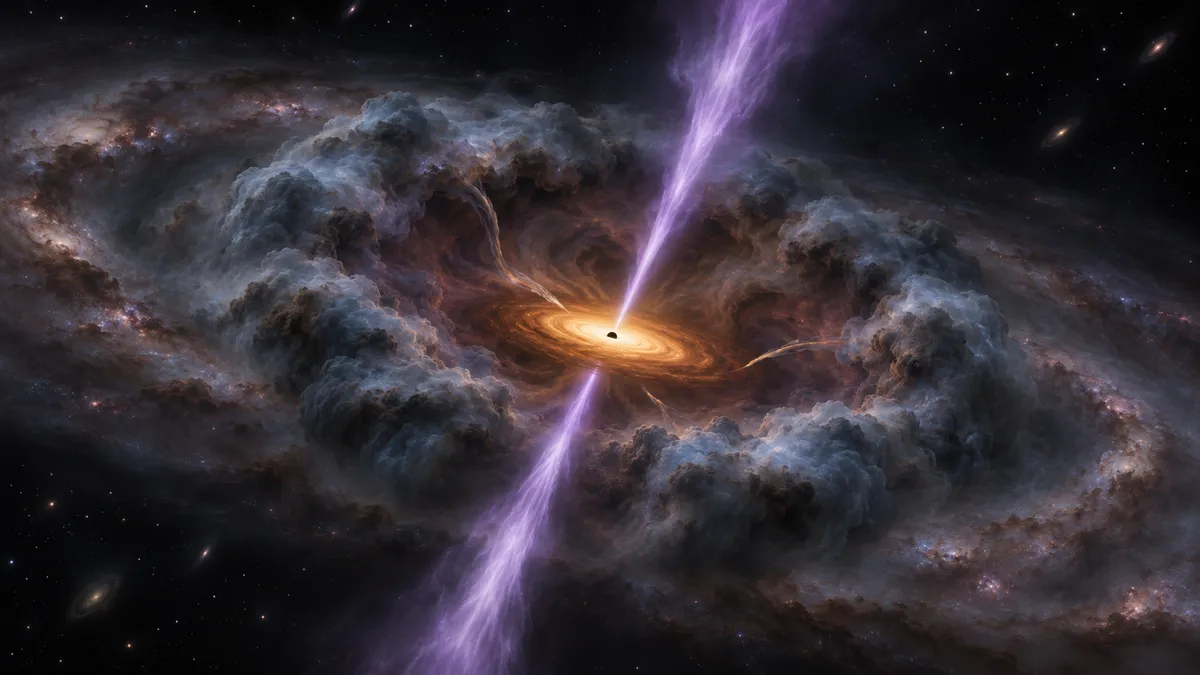
A galaxy can hold plenty of gas while its central black hole struggles to feed. David Garofalo’s preprint explores how a black hole’s own jets might create that mismatch, changing the way its surrounding gas shines while leaving its large radio structures intact.
Supermassive black holes power active galactic nuclei by drawing in surrounding gas. Before crossing the black hole’s boundary, that material can release enormous amounts of energy. Some systems also launch powerful jets, producing radio-emitting structures far beyond the galaxy’s center. But a prominent radio source does not always accompany a brightly radiating accretion disk. Understanding how these properties become disconnected is a central problem in explaining radio galaxies.
In a theoretical preprint, David Garofalo of Kennesaw State University examines one possible evolutionary pathway: a high-excitation radio galaxy becoming a low-excitation radio galaxy while retaining its large-scale radio shape. These excitation labels describe differences in spectral emission lines and are associated with different modes of accretion. High-excitation systems generally have disks that radiate efficiently; low-excitation systems are associated with flows that release less of their available energy as radiation.
The particular radio shape considered is Fanaroff–Riley type II, or FRII, characterized by prominent outer radio structures. Within the evolutionary framework adopted by the paper, an FRII galaxy can change its accretion state without immediately losing that morphology. The question is whether its fuel supply can decline on the roughly four-million-year timescale required by that framework. This is rapid in the context of galaxy evolution, not an observable change over a human lifetime.
Garofalo approaches the problem through physical estimates rather than new telescope observations or a detailed numerical simulation. The main calculation concerns the viscous timescale: the time over which gas redistributes angular momentum and moves inward. Orbiting gas cannot simply fall straight toward a black hole. It must transfer angular momentum, and the efficiency of that process helps determine how quickly a change in the outer supply reaches the inner disk.
Using an effective viscosity parameter of about 0.1 and a disk thickness about one-hundredth of its radius, the paper associates a few-million-year response with fueling at sub-parsec distances. It identifies characteristic radii of approximately 0.1–0.3 parsecs, or roughly 0.3–1 light-year, for black holes with masses of 100 million to one billion Suns. These are model-dependent estimates, not measured locations of a fueling bottleneck. The proposed region overlaps the broad-line region, containing fast-moving gas, and the inner dusty structure surrounding the nucleus.
The mechanism that restricts the supply is feedback from the jets themselves. In the proposed picture, jets heat and disturb the surrounding interstellar gas, making inward transport less effective. The paper considers a characteristic jet power of about 10^46 ergs per second sustained for around four million years. Its energetic argument is that even a modest transfer of jet energy to surrounding gas could substantially interfere with feeding. That establishes plausibility, rather than demonstrating precisely how the energy reaches and alters the relevant gas.
Crucially, this scenario does not require the jets to expel every cold cloud. A galaxy may retain a substantial molecular-gas reservoir while only a small fraction reaches the central accretion flow. The preprint cites existing molecular-gas observations with ALMA as compatible with that distinction. Such reservoirs therefore need not contradict reduced black-hole fueling. Their presence alone, however, does not establish that jet-driven suppression caused a particular galaxy’s accretion state.
Once the declining supply crosses a critical accretion threshold, quoted as about 0.01 in the paper’s normalized notation, the inner disk is proposed to become an advection-dominated accretion flow. In this state, much of the released energy is carried inward rather than radiated away. The inner adjustment is much faster than the outer fueling response, so the longer clock would be set by transport near the proposed bottleneck, not by the final rearrangement close to the black hole.
The result is a possible explanation, not a demonstrated universal sequence. The inferred timescale depends strongly on assumed disk thickness, transport efficiency and black-hole mass. Applying a simplified viscous estimate to a clumpy region containing gas in different physical phases also leaves substantial uncertainty. The note does not directly track a galaxy through the transition or calculate the full jet–gas interaction. It predicts that weaker feedback should produce slower evolution or prolong efficient accretion. Its central contribution is to identify a compact fueling region where the proposed transition could be timed, while distinguishing the amount of gas a galaxy possesses from the amount its black hole can actually receive.
- supermassive black holes
- active galactic nuclei
- radio galaxies
- accretion disks
- jet feedback
- FRII
- molecular gas
- advection-dominated accretion flow
Related reading
Automatically matched by shared topic keywords. These links do not imply that the sources agree or establish a consensus.
Could displaced black holes give cosmic rays an extra boost?
Source published
Shared keywords: accretion disks, active galactic nuclei, supermassive black holes
Black hole spin alone may not keep massive galaxies from making stars
Source published
Shared keywords: supermassive black holes
Galactic Gas May Preserve Traces of Fading Black Hole Activity
Source published
Shared keywords: active galactic nuclei, supermassive black holes
Hyperion’s Densest Regions Show More X-ray-Active Black Holes
Source published
Shared keywords: active galactic nuclei, supermassive black holes
Glowing gas offers clues to Mrk 1018’s changing nucleus
Source published
Shared keywords: supermassive black holes