TRANSMISSION // 2611.08310v5
How recovery-gate choices shape quantum noise tomography
Source published
A preprint exhaustively studies recovery gates in repetition-code tomography. Its results depend on a fixed measurement basis, a specified noise model and, for precision comparisons, sampled parameter points.
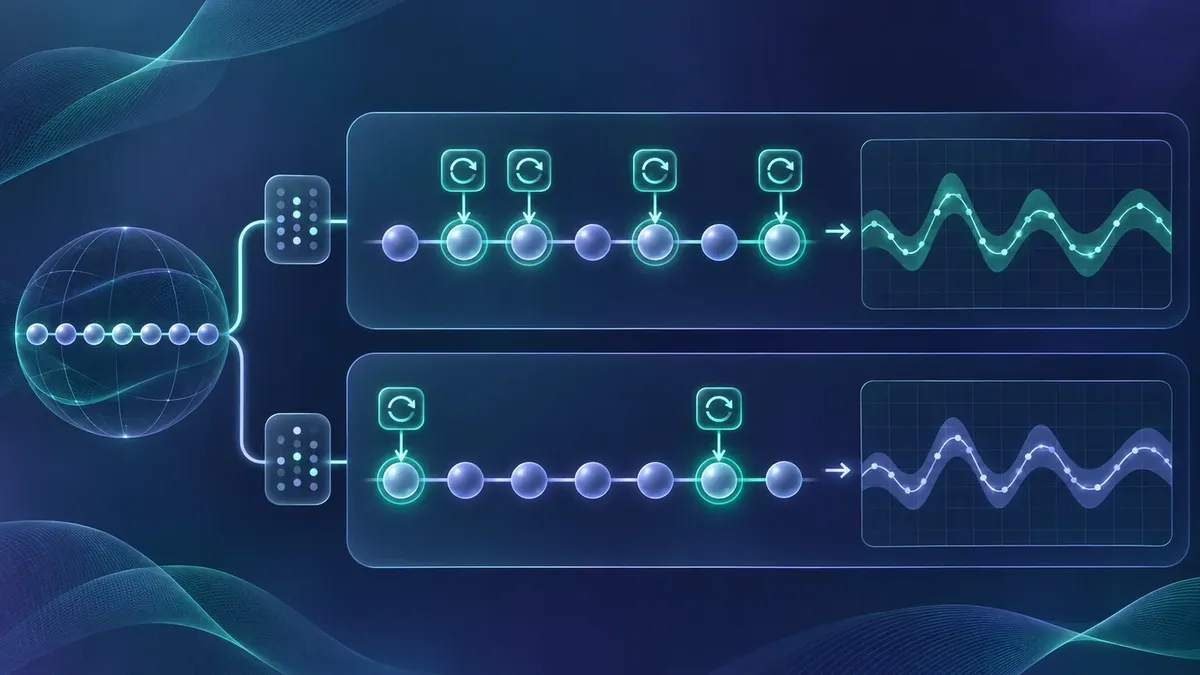
A decoder is usually chosen to correct errors as well as possible. But when a quantum code is used to measure noise, correction can also affect which clues remain visible. Long Huang’s preprint examines that trade-off for repetition codes of three, five and seven qubits—and carefully limits what its gate counts and precision estimates establish.
Quantum error correction is meant to protect information. The same codes can also help researchers characterize noise: they compare the logical channel produced by a code with a reference channel, then use measurements to infer properties of the underlying system.
In that setting, a decoder has two possible jobs. It can remove errors, or it can leave the measurement data informative about what those errors were. Long Huang’s arXiv preprint asks how many recovery gates are needed for the second purpose, and whether correcting more errors necessarily makes noise easier to identify.
What is being counted?
The study considers repetition codes arranged in chains of three, five and seven qubits. Its recovery designs apply single-qubit Pauli gates according to the measured error syndrome. The gate count is meaningful only under a particular condition: the measurement basis stays fixed across syndromes. If the basis could instead be changed for each syndrome, some corrections could be represented as measurement choices rather than physical gates, and the count would no longer measure the same resource.
Within this fixed-basis setup, the author exhaustively enumerates a defined family of recovery designs. Each chooses which sites to correct and the maximum error weight to correct. The analysis uses a specified small-angle noise model with 11, 19 or 27 parameters, depending on code size. To test whether measurements distinguish all those parameters locally, it examines the rank of a matrix describing how measured quantities change when parameters change. Exact arithmetic certifies key rank results at selected parameter points, avoiding misleading conclusions from floating-point rounding.
Precision is a separate question from identifiability. The paper estimates it using generalized least squares under a stated measurement-noise model, including a calibration-error floor. That floor represents systematic uncertainty that does not disappear just by collecting more measurements.
Gate counts and information are not the same thing
Within the chosen design family, the minimum gate budgets that achieve full local rank at the certified points are zero, one and five for three, five and seven qubits. For comparison, first-order decoding uses six, ten and fourteen gates, while full minimum-weight decoding uses six, fifty and 308. These are not universal minima across all possible decoders: they apply to the paper’s recovery family and fixed-basis premise.
The count depends on how many sites are corrected, not which ones. But placement can affect whether parameters are identifiable and how precisely they can be estimated. The two repetition-code orientations can also need different placements.
At seven qubits, the paper certifies that a five-gate design has full rank at specified parameter points. At one such point, full decoding has rank 24 of 27. These are point-specific results, not claims that either rank holds everywhere in parameter space. The paper reports a second-point check, but says the exact certificates do not establish rank across the entire domain.
For three qubits, the precision curve has a U-shaped form, with its reported minimum at three gates. Across 40 sampled working points, the reported comparison chooses the best three-gate placement separately at each point. On that point-by-point basis, it is more precise than the standard six-gate decoder at all 40 points, by factors ranging from 1.8 to 88. That is not the result for a single placement fixed in advance: one preselected placement has a smaller median advantage and loses to full decoding at two sampled points. Another preselected placement is reported as never worse across those 40 points, but has a smaller median gain. These comparisons depend on the study’s assumptions and samples; they are not guarantees for other devices or conditions.
The distinction matters at five qubits, too. One gate suffices for full rank at the certified point, but the paper’s precision analysis finds that this minimum-budget design estimates parameters poorly. At seven qubits, the precision scan does not locate a turning point, so it does not identify the best gate budget for precision.
Limits and open questions
The paper also considers measuring a reference channel at every site. In the analyzed setup, this requires no recovery gates and uses fewer settings than the original measurement scheme. But its rank results are certified at selected points, not throughout parameter space. Its seven-qubit precision floor remains three orders of magnitude above the stated target, and this extension does not remove the mirror ambiguity described in the paper. The findings therefore do not amount to a general claim that extra reference measurements solve the problem.
The precision estimates rely on modeled noise and a calibration floor, with representative hardware parameters rather than measurements from a specific device. Precision varies substantially with the working point, and the cost accounting does not include every practical constraint, such as circuit depth and leakage. The results concern a restricted decoder family and do not establish scalability or optimality beyond seven qubits.
This is an arXiv preprint, not a peer-reviewed publication. Its exact-arithmetic certificates strengthen particular local rank claims; they do not turn sampled precision comparisons into universal predictions. The central takeaway is qualified: under a fixed measurement basis, carefully chosen recoveries can preserve useful information with fewer gates in the studied models, while more extensive correction does not automatically improve tomography.
- quantum tomography
- repetition codes
- quantum error correction
- quantum noise
- recovery gates
Reviewed cross-references
These connections were reviewed by a model, not independently fact-checked by a human. Similarity does not imply agreement; consult the original papers and the evidence below.
Choosing a quantum-noise model depends on how the experiment is designed
Shared method: Both papers use the repetition-code fingerprint, recovery-design algebra and rank machinery. The origin paper studies gate counts and parameter identifiability for three-, five- and seven-qubit codes; the target applies the shared approach to model-family detection and precision in three-qubit designs. This is a methodological connection, not independent confirmation of the origin paper’s results.
Model review: · openai-codex/gpt-6-luna
Evidence and provenance
Selected excerpts, not complete papers. PDF extraction can omit figures or damage equations, tables and reading order; sources may be preprints.
2611.08310v5 — Original paper
Excerpt reference:
static/papers/2611.08310v5.md:157-202
Basis: Paper text
Source SHA-256:2e20fc5c052e962297c1bedbfeb64ef28fd3e82aa887f17eddaaa8d2e838863d2611.11748v1 — Original paper
Excerpt reference:
static/papers/2611.11748v1.md:124-195
Basis: Paper text
Source SHA-256:0c2b909cadb14d0040aca9ce31cf4a3fa8caf8e9a2305d13ca6f20a8452ddbf4
Related reading
Automatically matched by shared topic keywords. These links do not imply that the sources agree or establish a consensus.
Choosing a quantum-noise model depends on how the experiment is designed
Source published
Shared keywords: recovery gates
When quantum memory becomes undecidable
Source published
Shared keywords: quantum error correction, quantum noise
A Fourier neural network tries to recover Shor’s signal from quantum noise
Source published
Shared keywords: quantum noise
How researchers reconstruct the states in twisted light
Source published
Shared keywords: quantum tomography
Estimating Distance Between Quantum States
Source published
Shared keywords: quantum tomography