TRANSMISSION // 2611.07824v1
GradFlex reads galaxy brightness gradients to measure subtle lensing distortions
Source published
An unreviewed preprint introduces a gradient-based method for measuring gravitational lensing flexion. Simulations show close agreement with input signals under weak distortions and limited additional noise bias with a carefully chosen measurement region, but stronger lensing produces systematic errors that remain unresolved.
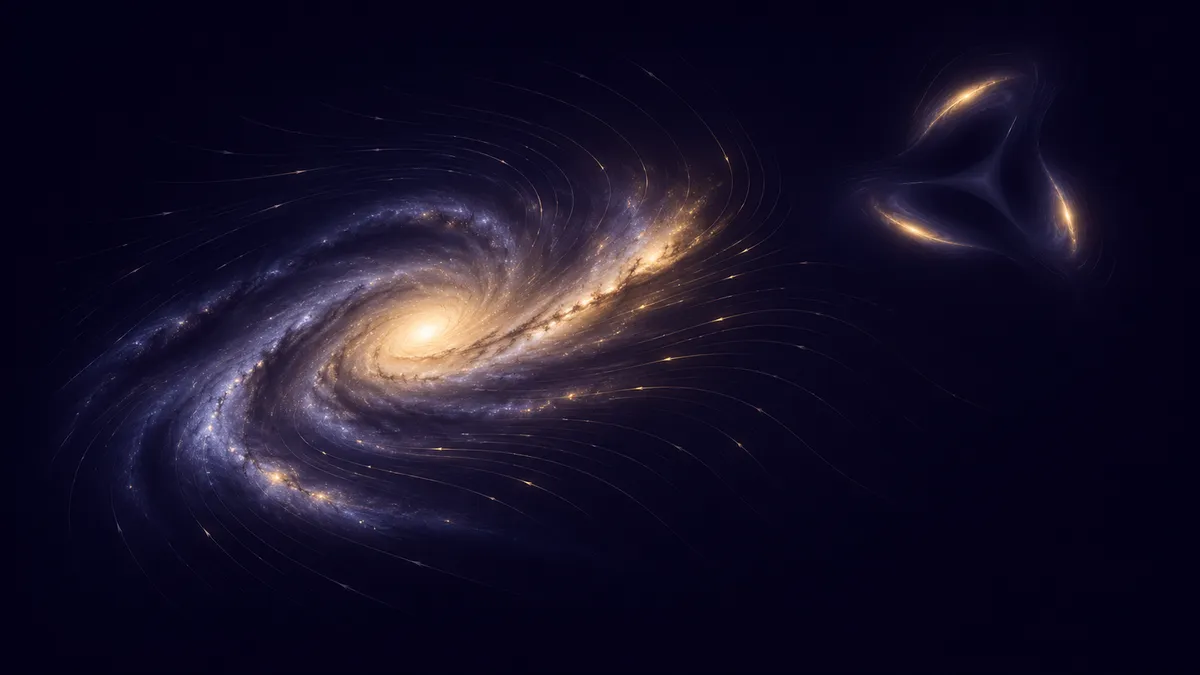
A galaxy’s uneven light can conceal the subtle distortions imposed by gravitational lensing. GradFlex seeks to separate those effects using patterns in brightness gradients, with simulation results that demonstrate both the method’s promise and its current limits.
Gravitational lensing changes the apparent shapes of background galaxies. Shear describes directional stretching; flexion captures the next order of distortion, associated with spatial changes in the lensing fields across an image. Measuring it is difficult because galaxies already have irregular structures, while instrumental blurring and image noise further complicate the signal.
In an unreviewed preprint, Jiarui Sun, Jun Zhang and Toshifumi Futamase introduce GradFlex, a method that estimates flexion from gradients of galaxy surface brightness. Their simulations support its accuracy in the weak-distortion regime. They also expose an important boundary: stronger lensing produces systematic errors that the present formulation does not correct.
Reading changes in brightness
A brightness gradient describes how quickly light intensity changes across an image and in which direction. GradFlex combines these directional quantities to isolate two characteristic patterns. First flexion produces a skewed light distribution and is associated with the spatial gradient of convergence. Second flexion describes a threefold distortion.
The method constructs mathematical combinations of gradients with matching rotational properties, called spin-1 and spin-3. Integrating across images and averaging over statistically isotropic intrinsic galaxy orientations removes contributions with incompatible rotational patterns. Response factors then normalize the remaining statistics to estimate flexion.
This averaging is central to the method: intrinsic galaxy structure is not assumed to disappear from an arbitrary individual image. The authors discuss individual measurements for idealized, centrosymmetric galaxies, but the general construction relies on ensemble statistics.
Instrumental blurring is treated in Fourier space. The procedure divides by the Fourier transform of the point-spread function, or PSF, and applies Gaussian smoothing. Brightness derivatives are then calculated through Fourier operations. Although GradFlex does not require a particular parametric PSF shape or galaxy light profile, it still uses the instrumental PSF in processing the image.
What the simulations tested
The authors generated regular galaxies with Sérsic light profiles and irregular galaxies built from two-dimensional random walks. The regular models varied in size and radial concentration and had an intrinsic ellipticity of 0.2. Lensing came from a simulated galaxy-cluster halo, with different distances from its center providing different distortion strengths.
Images were blurred with a Moffat PSF and represented on 128-by-128-pixel stamps. Noiseless tests used 12 rotated copies of each galaxy to suppress intrinsic shape contributions. Each noisy measurement combined 2.4 million randomly oriented simulated galaxies. The reported noisy results therefore describe large ensembles, not the precision obtainable from one faint galaxy.
In tests without shear, the estimators recovered reduced flexion: flexion divided by one minus convergence. The authors consequently interpret their measured signals as reduced flexion when comparing them with simulation inputs.
At small input distortions, recovered values closely matched the inputs across the tested morphologies. Closer to the halo center, discrepancies increased. Those errors also depended on galaxy morphology, including size and radial profile, making a single straightforward correction more difficult.
Noise agreement is not zero bias
The noisy tests require careful interpretation. At a fixed distance of 45 arcseconds from the halo center, all four measured reduced-flexion components agreed with the corresponding noiseless reference within three estimated standard errors over the displayed signal-to-noise range. Tests at two other distances gave consistent conclusions.
That agreement does not mean the estimates were unbiased relative to the input truth. The noiseless reference already contained systematic errors from the method’s approximations. The noise experiment tested whether adding noise introduced a further detectable shift.
The measurement region mattered. A Friends-of-Friends algorithm identified connected pixels above a background-noise threshold. Restricting measurements to that region caused first-flexion estimates to depart increasingly from the noiseless reference as signal-to-noise declined. A circular region extending to the most distant identified pixel avoided a comparable detected trend. Retaining faint surrounding galaxy light helped, although including more background increased statistical uncertainty.
Where the evidence stops
GradFlex retains only first-order terms in its derivation. Its approximations omit higher-order contributions, including shear–flexion coupling, that become important under stronger lensing. The response calculation also substitutes observed brightness derivatives for unknown intrinsic ones, introducing higher-order differences.
Centering and source identification remain practical conditions. The procedures were stable in the authors’ tests above a signal-to-noise ratio of 20, but noise peaks can misidentify the galaxy at lower values. Contamination from neighboring and foreground objects, along with weighting samples of differing signal-to-noise, remains unassessed here.
The result is a simulation-tested estimator with demonstrated weak-distortion performance, not a completed observational validation. Its handling of noise is encouraging within the tested setup; stronger-lensing calibration remains a substantive unresolved limitation.
- gravitational lensing
- flexion
- GradFlex
- brightness gradients
- galaxy morphology
- point-spread function
- numerical simulations
Related reading
Automatically matched by shared topic keywords. These links do not imply that the sources agree or establish a consensus.
Galaxy Images Offer Clues to Billions of Years of Star Formation
Source published
Shared keywords: galaxy morphology
Tracing cosmic arcs: HLA-Net uses geometry to shortlist gravitational lens candidates
Source published
Shared keywords: gravitational lensing
Radio galaxies masquerade as tiny gravitational lenses
Source published
Shared keywords: gravitational lensing
Dust in Quiet Galaxies May Reveal How Their Star Formation Shut Down
Source published
Shared keywords: gravitational lensing
Webb finds a faint oxygen signal inside a nearly pristine galaxy
Source published
Shared keywords: gravitational lensing