TRANSMISSION // 2611.07794v1
A Calibration Gap Challenges a Supernova-Based Hubble Constant Claim
Source published
An unreviewed comment argues that a recent Hubble constant estimate combines ZTF supernova observations with SH0ES calibrators without establishing a shared brightness scale. The authors identify missing calibration products and detector corrections, while distinguishing these concerns from ZTF-only studies that do not require an absolute brightness reference.
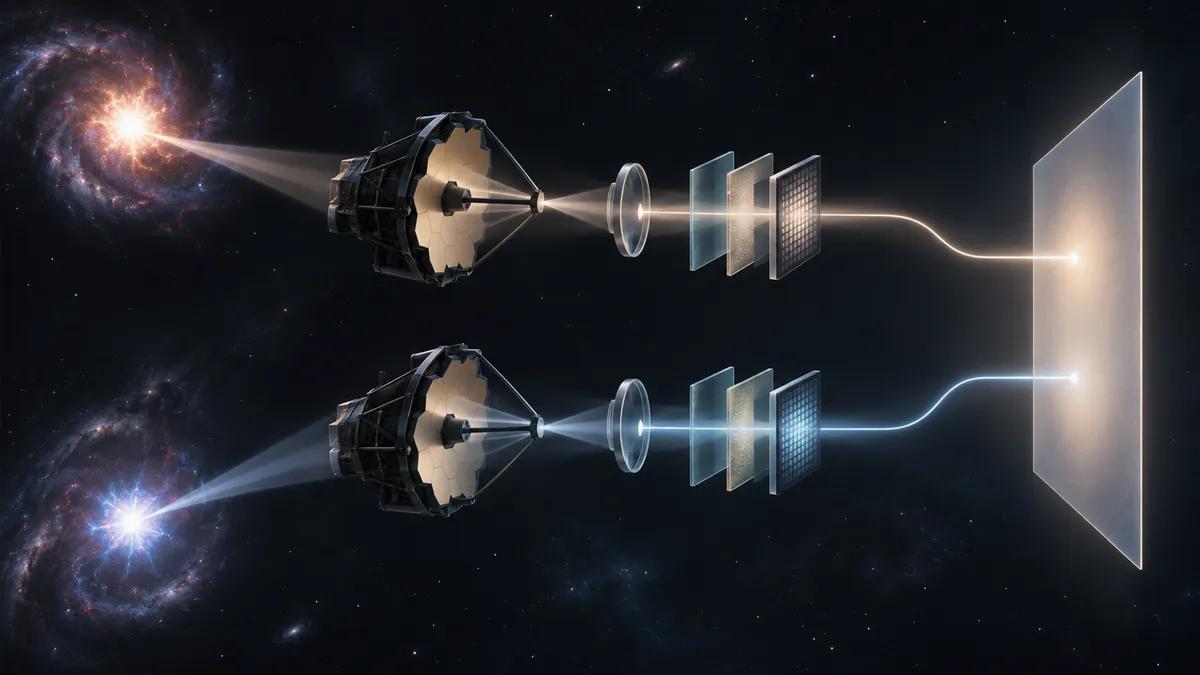
Thousands of supernovae cannot compensate for an unknown offset between two brightness scales. That is the central argument of a new, unreviewed preprint challenging a recent measurement of the universe’s expansion rate using the Zwicky Transient Facility’s second Type Ia supernova data release.
The missing connection between two samples
Measuring the Hubble constant, H₀, with Type Ia supernovae requires more than a large collection of stellar explosions. It requires a reliable connection between their measured brightnesses. In an unreviewed comment, Mickael Rigault and colleagues argue that this connection has not been established for a recent analysis combining Zwicky Transient Facility observations with SH0ES supernova calibrators.
Their criticism concerns a measurement reported by Karchev and colleagues. According to the comment, that analysis combines the ZTF second data release, containing roughly 3,000 Type Ia supernovae, with nearby supernovae whose distances are independently established. The comment’s authors argue that an unknown brightness offset between these samples prevents the combination from supporting the reported H₀ value and uncertainty.
This is a calibration critique, not a new measurement of the expansion rate. Its central distinction is between having many observations and knowing how their brightness scale connects to an external reference.
Why a shared brightness scale matters
Type Ia supernovae have peak luminosities that can be standardized. Nearby calibrator supernovae, with independently known distances, establish that luminosity scale. More distant supernovae tracing cosmic expansion then allow astronomers to infer H₀ by comparing brightness and redshift.
But the comparison requires both groups to use a consistent brightness scale. A photometric “zeropoint” defines the reference that converts a measured signal into a magnitude. An unaccounted-for difference between two samples shifts their inferred relative distances and therefore shifts H₀.
The authors describe the unknown relative zeropoint as fully degenerate with H₀: within this comparison, a brightness-scale offset can mimic a change in the expansion rate. The supernova measurements alone cannot distinguish the two. Consequently, corrections to other aspects of the observations do not establish the missing global calibration.
Three parts of the calibration problem
The comment examines the chain connecting reference stars, supernova brightness measurements and detector behavior.
First, the surveys need a common stellar reference. The SH0ES calibrator compilation is anchored to the Pan-STARRS photometric system. ZTF’s image-processing pipeline also uses Pan-STARRS, but the authors argue that this nominal connection does not establish sufficiently accurate calibration for the released supernova light curves. They report that some catalog-level corrections were not applied to the underlying science images.
The ZTF supernova release also lacks the field-star magnitudes needed for the cross-survey comparison described in the comment. Updated measurements of the telescope’s filter transmission profiles remain unavailable publicly, the authors say. Those measurements indicate differences of a few nanometers from the published profiles, as well as substantial variation across the camera’s focal plane.
Second, measuring a supernova requires separating its light from its host galaxy. The released ZTF light curves use forced photometry on images from which a reference image has been subtracted. An alternative, scene-modeling photometry, models the scene to extract the supernova signal.
The authors report that a comparison between these approaches found an offset initially quoted as 90 millimagnitudes and subsequently revised to approximately 60 millimagnitudes. They associate the processing difference with an H₀ shift of about 1.7 kilometers per second per megaparsec. Crucially, correcting this difference would not establish the separate ZTF–SH0ES zeropoint, and its uncertainties are not yet well understood.
Third, detector response complicates the connection between stellar and supernova measurements. A flux-dependent bias called the “pocket effect” changes the point-spread function—the image profile of a point source—and varies among detectors and with survey conditions. The authors argue that the retrospective correction used by Karchev and colleagues cannot capture these dependencies. They also identify additional detector nonlinearities affecting flux calibration at the few-percent level.
What the criticism establishes—and what it does not
Taken together, the authors argue, these issues leave the relative calibration unknown. They say the offset could be as large as 0.1 magnitude, corresponding to an H₀ systematic shift of about 3.5 kilometers per second per megaparsec. That is a possible offset discussed in the comment, not a measured correction.
On this basis, they contest the other analysis’s reported 2.7-sigma tension with Planck and its claim of independently confirming the Hubble tension. Their argument does not establish a replacement H₀ value or resolve that broader disagreement.
The authors also distinguish cross-survey calibration from internally consistent ZTF studies that do not require the zeropoint, including supernova population studies. They identify the missing ingredients for a calibrated release: reference-star magnitudes, corrected photometry, complete filter profiles and updated scene-modeling light curves. The immediate conclusion is therefore specific: the claimed cross-survey measurement requires calibration information that, according to this unreviewed comment, the public release does not supply.
- Hubble constant
- Type Ia supernovae
- Zwicky Transient Facility
- ZTF DR2
- photometric calibration
- SH0ES
- Hubble tension
- distance ladder
Related reading
Automatically matched by shared topic keywords. These links do not imply that the sources agree or establish a consensus.