TRANSMISSION // 2611.07782v1
3C 84’s faint northern feature changes brightness without clear outward motion
Source published
An unreviewed preprint tracks the faint northern radio feature N1 in 3C 84 across 56 observing sessions from 2016 to 2021. Its brightness varies significantly, but the authors find no convincing systematic motion, leaving open whether it is a stalled hotspot or another visible feature of a partly obscured jet.
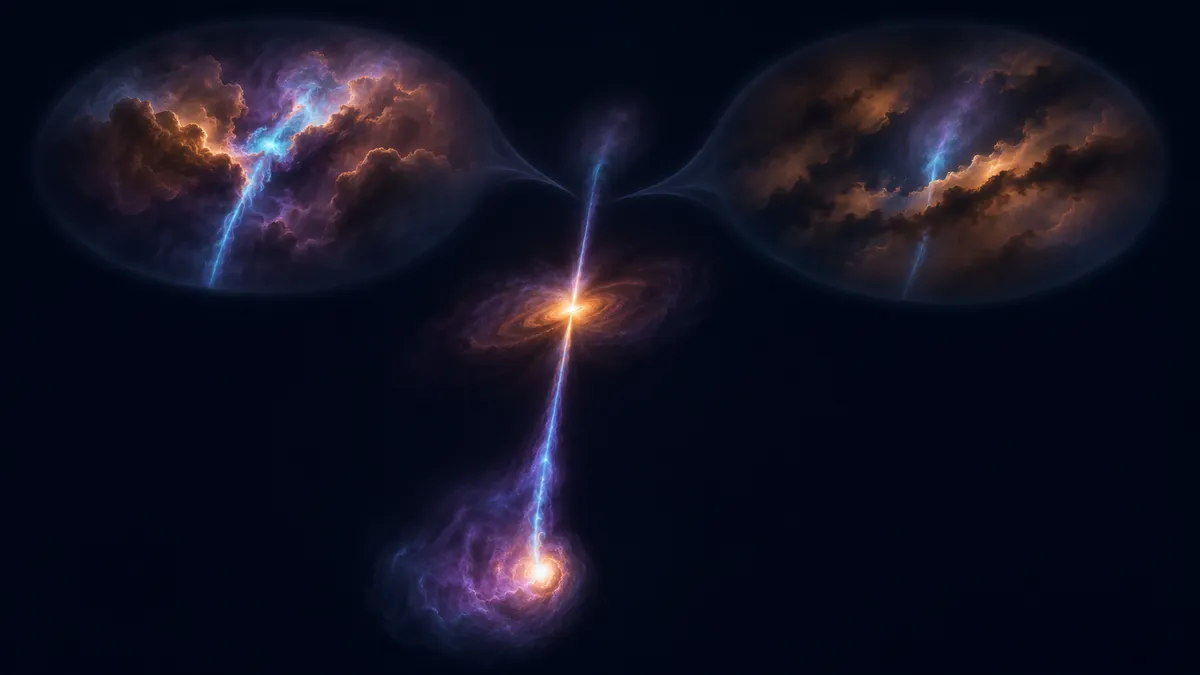
A faint patch of radio emission north of 3C 84’s central core is challenging a straightforward picture of two outward-moving hotspots. Years of monitoring show that its brightness changes more clearly than its position, while its physical identity remains unresolved.
A changing feature that barely travels
The central result of this unreviewed preprint is a contrast: the faint northern radio component N1 in 3C 84 changes brightness substantially, yet shows no statistically supported systematic motion in the authors’ analysis. That distinction matters because N1 was initially interpreted as the northern counterpart of a moving southern hotspot. The new observations leave that identification uncertain rather than settling what N1 is.
3C 84 is the compact radio source in NGC 1275, at the center of the Perseus cluster. Its central radio core is called C1, and a prominent southern hotspot is called C3. N1 was first detected in December 2015. Its roughly comparable distance from C1 initially made it a plausible counterpart to C3 on the opposite side of the core.
Making different observations comparable
Kotaro Niinuma and colleagues combined 18 observing sessions from the Korean–Japanese KaVA telescope array with 38 archival sessions from the Very Long Baseline Array. Together, these supplied 56 epochs spanning 2016–2021 at 43 gigahertz, corresponding to a wavelength of approximately seven millimeters. Very long baseline interferometry combines widely separated radio telescopes to resolve extremely small angular structures.
The team deliberately reduced the archival array’s finer spatial sampling to make it comparable with KaVA, then reconstructed all images with the same 0.6-milliarcsecond resolution. At the distance adopted in the paper, that corresponds to about 0.21 parsecs. They also excluded archival observations whose image noise exceeded their chosen threshold.
Because N1 is faint and extended, the researchers represented it with one smooth, elliptical Gaussian component rather than trying to track separate knots inside it. A fitted peak had to exceed seven times the image noise to count as a detection. N1 met that criterion in 50 of the 56 epochs.
Simulations supported this simplified treatment. For each detected epoch, the researchers generated 1,000 realizations using the actual telescope sampling and measured noise, starting from a model with two underlying components. Fitting one extended component recovered global properties more reliably than fitting two separate components. These simulations also informed the measurement uncertainties.
Brightness provides the clearer result
N1 remained approximately 2.5 milliarcseconds north of C1, with positional scatter of roughly 0.2 milliarcseconds. A straight-line fit in the north–south direction yielded a motion of 0.054 ± 0.019 milliarcseconds per year, equivalent to an apparent speed of 0.062 ± 0.021 times the speed of light.
Those fitted numbers should not be read as an established detection of outward travel. The authors emphasize that the displacement over the monitoring interval is comparable to the positional scatter, and conclude that systematic motion cannot be distinguished from jitter. This is not proof that N1 is completely motionless.
The brightness evidence is stronger. N1’s fitted peak flux density varied by about a factor of two over several months, particularly during the 2016–2018 monitoring. A test of constant brightness gave a chi-square of 160 for 49 degrees of freedom, rejecting that hypothesis at greater than 99% confidence under the adopted uncertainties. Those uncertainties include a 15% systematic contribution derived from the simulations. The authors therefore argue that measurement effects alone cannot explain the observed variability.
Two interpretations remain viable
One possibility preserves N1’s identity as the northern hotspot: a collision with a dense cloud has stalled its advance. In this interpretation, uneven ionized material changes how much radio emission reaches the observer through free-free absorption. Variations in the cloud’s density, temperature or absorbing path length could then alter the apparent brightness without requiring the hotspot to move steadily outward.
The alternative is that N1 is not C3’s counterpart. It could be part of the northern jet seen through a relatively transparent gap in otherwise absorbing foreground material. Its brightness could reflect changes within the jet or interactions with an uneven environment. The paper also considers a stationary jet feature whose brightness changes when newly ejected material reaches it.
These are explanations consistent with the observations, not directly observed mechanisms. The authors disfavor two specific alternatives within the stalled-hotspot picture: a foreground cloud moving fast enough to produce the variability, and synchrotron cooling rapid enough to explain it. Their estimates require an implausibly high cloud speed or magnetic field, respectively.
What the monitoring cannot decide
The observations cannot reliably resolve N1’s internal structure, and its position is measured relative to C1 rather than an independent fixed reference. Absorption may still matter at 43 gigahertz. The simulations quantify errors for an adopted source model; they do not identify N1’s physical nature or directly measure the proposed cloud.
The strongest conclusion is therefore observational: significant brightness variability accompanies no convincing systematic displacement. The paper proposes observations at 86 gigahertz or higher, where foreground free-free absorption is weaker, to help distinguish a stalled hotspot from a partly obscured or stationary jet feature.
- 3C 84
- NGC 1275
- N1 component
- radio jets
- very long baseline interferometry
- free-free absorption
- jet–cloud interaction
- unreviewed preprint
Related reading
Automatically matched by shared topic keywords. These links do not imply that the sources agree or establish a consensus.