TRANSMISSION // 2611.07763v1
Triangular Calibration Improves GALI’s Gamma-Ray Burst Localization in Tests
Source published
An unreviewed preprint reports that a more uniformly spaced triangular calibration mesh improves GALI’s reconstruction of gamma-ray source directions compared with a rectangular mesh. Laboratory measurements and orbital-background simulations show smaller average angular errors, although laboratory conditions, differing test boundaries and an unresolved detector-response discrepancy limit the conclusions.
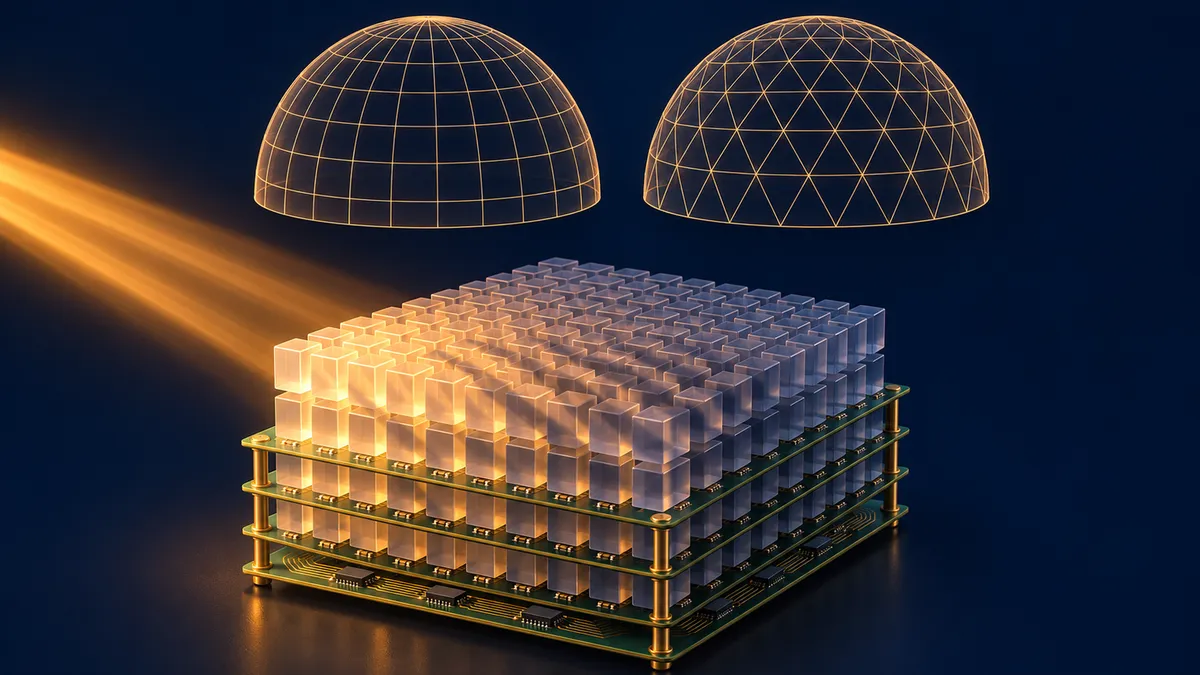
For a detector that locates gamma-ray bursts through patterns of internal shadowing, the geometry of its calibration map matters. A GALI study finds that replacing a rectangular sky mesh with an approximately uniform triangular one improves direction estimates between calibration points.
Gamma-ray burst localization is a problem of turning a brief signal into a direction that other telescopes can investigate. An unreviewed preprint by Julia Saleh-Natur and colleagues at the Technion examines one part of that process: how a detector’s calibration directions are arranged across the sky. In laboratory tests and simulations, a triangular calibration mesh produces smaller average directional errors than the rectangular mesh used previously.
The result concerns reconstruction performance, not a demonstrated observation of a celestial burst. Its strongest evidence is that the same improvement appears in both measured detector responses and simulations incorporating an expected orbital background.
Reading direction from internal shadows
GALI, the GAmma-ray burst Localizing Instrument, uses small scintillators that produce light when gamma rays interact with them. Its full-scale detector contains 362 cesium iodide cubes, each nine millimetres wide, distributed across nine circuit boards. Silicon photomultipliers read their light signals.
The cubes also partially shield one another. Gamma rays arriving from different directions therefore produce different relative count patterns throughout the array. Rather than using an external coded mask, GALI uses this internal shadowing to encode direction.
Reconstruction compares the measured pattern with calibrated responses. The algorithm uses a statistical measure called the Cash statistic, based on Poisson counting statistics, to find the best-fitting direction. It first searches the calibration mesh, then interpolates locally to estimate a position between its points.
Why the calibration geometry matters
The rectangular calibration uses five-degree steps in two angular coordinates, giving 1,297 positions. The alternative uses an icosphere-based triangular tessellation: a way of dividing a spherical surface into approximately uniform triangles. It has 1,313 positions, so the comparison uses nearly the same number of calibration directions.
The triangular arrangement samples directions more evenly and has more uniform distances between neighbouring points. Each mesh has its own interpolation scheme. The reported comparison therefore evaluates those calibration-and-interpolation approaches together, rather than geometry independently of reconstruction details.
Crucially, the tests use random “off-grid” directions, which do not coincide with calibration points. This examines the interpolation needed when an actual source arrives from an arbitrary direction.
What the laboratory tests show
The researchers placed an americium-241 source approximately 4.57 metres from the detector and analysed its 59.6 keV emission line. Calibration exposures lasted 120 seconds. At each off-grid test direction, they recorded 100 exposures lasting half a second, with roughly 3,500 photons per short exposure and negligible background relative to the source.
For each direction, they averaged the angular separation between the true and reconstructed positions over those 100 exposures. Across the tested positions, the triangular approach gave a mean of 0.86 degrees and a standard deviation of 0.14 degrees. The rectangular approach gave 1.19 degrees and 0.28 degrees, respectively.
Those standard deviations describe the spread of the position-averaged results, not uncertainty on the overall means or confidence regions for individual bursts. The sky limits also differed: rectangular off-grid tests stopped at 85 degrees from the detector’s vertical axis, while triangular tests reached 90 degrees, with calibration extending farther to provide an interpolation margin.
Simulated bursts retain the advantage
The team also reconstructed 50,000 simulated one-second bursts from random directions uniformly distributed over the hemisphere. These used a broadband burst spectrum and an expected gamma-ray background for a 600-kilometre low-Earth orbit. The background was simulated separately and subtracted before reconstruction. The abstract describes approximately 1,000 detected counts per burst.
The triangular approach produced a mean angular separation of 1.91 degrees, with a standard deviation of 1.20 degrees. The rectangular approach yielded 2.73 degrees and 2.18 degrees. Here the distribution describes individual simulated bursts, unlike the laboratory distribution of averages over repeated exposures.
The poorer simulated accuracy is not inconsistent with the laboratory result. The simulations include background, a different spectrum and fewer detected counts. The paper attributes the laboratory advantage partly to its approximately three-to-four-times higher counts.
Remaining limits
Separate simulations predict sensitivity from 10 keV to about 1 MeV, with a hemisphere-averaged effective area peaking near 130 square centimetres at 100–150 keV. However, the measured effective area at 59.6 keV is approximately 30% below the simulated value. The authors say the discrepancy remains unexplained.
Compact configurations were also simulated: a single CubeSat-unit implementation averaged 2.52 degrees of error, while two units averaged 1.49 degrees. These tests used five-second bursts, so they are not direct equivalents of the full-scale one-second simulations.
The supported conclusion is specific: triangular calibration with its associated interpolation improves off-grid reconstruction in the reported tests. These laboratory measurements and simulations do not establish in-orbit performance, and the unresolved effective-area difference remains a limitation when interpreting the modeled detector response.
- GALI
- gamma-ray bursts
- source localization
- triangular calibration mesh
- scintillator detectors
- Monte Carlo simulations
- CubeSat