TRANSMISSION // 2611.07609v1
Colours of 5,377 Star Clusters Trace the Milky Way’s Patchy Dust
Source published
An arXiv preprint uses Gaia-based stellar colours to estimate interstellar reddening for 5,377 Galactic star clusters. The results broadly agree with existing dust maps and reveal patchy conditions near the Sun, while calibration, cluster membership and unusual reddening remain important limitations.
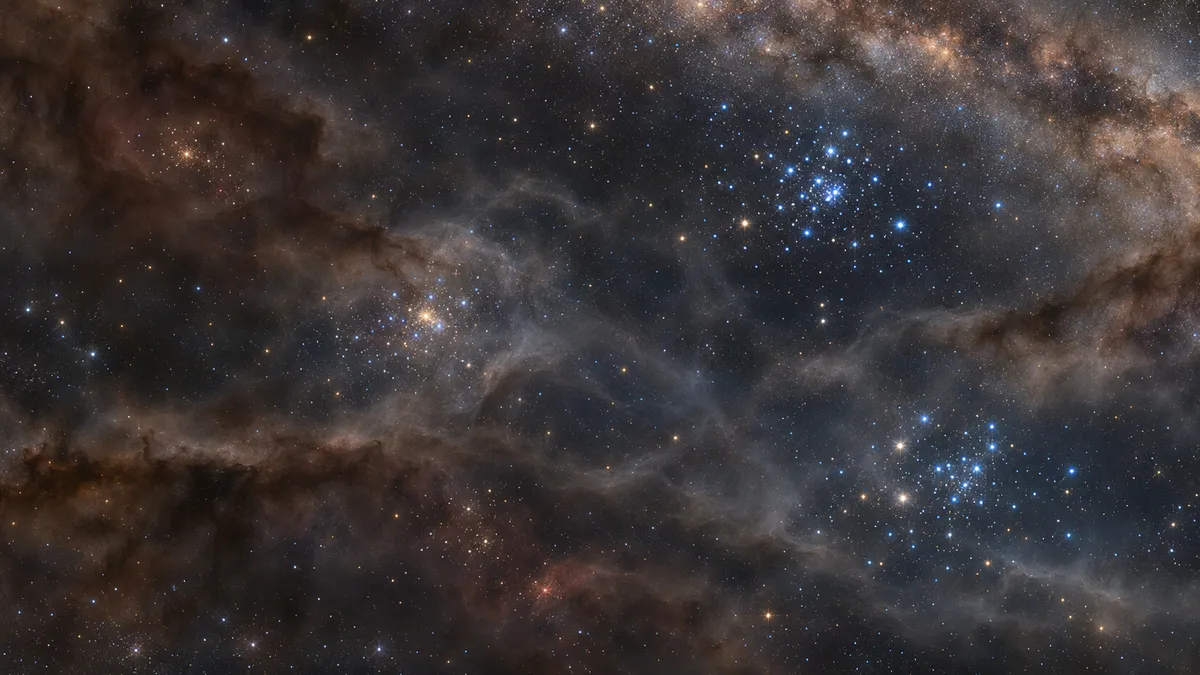
Interstellar dust changes the colours of stars, complicating measurements of their properties. Ernst Paunzen and Teja Begari use groups of stars born together to estimate this effect across thousands of Galactic clusters, providing measurements intended to support future dust maps and studies of cluster composition.
Reading dust through stellar colours
Dust between stars and observers alters the light that reaches a telescope. Because this extinction depends on wavelength, it changes measured stellar colours—an effect called interstellar reddening. Correcting for it matters when astronomers estimate the distances, ages and chemical compositions of star clusters.
In an arXiv preprint posted on November 5, 2026, Ernst Paunzen and Teja Begari report reddening estimates for 5,377 Galactic open clusters. Their sample spans distances of 2 to 20 kiloparsecs from the Galactic centre, not from the Sun. The supplied version is a preprint; the accompanying material does not establish peer-reviewed publication.
Why use clusters?
Open clusters contain stars formed together with a common chemical composition. Their collective pattern of colours offers a way to estimate reddening statistically, rather than relying on an individual star.
The authors use a classical colour–colour approach, related to the Q-method. A stellar colour is the difference between brightness measurements through two filters. Comparing different colours reveals how a cluster’s observed stellar sequence is displaced from an expected, unreddened sequence.
This also separates reddening estimation from the simultaneous fitting of distance, age and metallicity—the abundance of elements heavier than helium. Fitting all these properties together can produce ambiguous results. Unlike approaches restricted to cooler stars, the study can include hot, more massive main-sequence stars.
Reconstructing ultraviolet-sensitive measurements
The analysis combines Gaia photometry with synthetic Johnson U, B and V measurements derived from Gaia’s low-resolution spectra. The U filter is particularly useful for the colour–colour method, but the paper notes that direct observations in this band have become uncommon.
Synthetic measurements require care. The authors acknowledge a known colour-dependent calibration issue at wavelengths shorter than 400 nanometres. They compared the synthetic photometry with 30,377 measurements from an existing photometric catalogue. Mean synthetic-minus-observed offsets were −0.03 magnitudes in U, −0.01 in B and +0.02 in V, with standard deviations of 0.08, 0.06 and 0.06 magnitudes. On that basis, they applied no further corrections.
Measuring the shifts
The researchers merged membership lists from two cluster catalogues, removed duplicates and excluded objects they could not unambiguously verify. They retained candidate members with membership probabilities above 50% in at least one catalogue and required at least seven usable members per cluster.
For each cluster, they fitted reference sequences to eight combinations of colour–colour diagrams. They allowed independent shifts along both axes rather than imposing a predefined reddening direction. The resulting shifts supplied mean colour excesses and their scatter. A colour excess measures how much an observed colour differs from its unreddened value.
Membership remains a limitation. The two catalogues define membership probabilities differently. Weighting stars by those probabilities produced results within 2% of the unweighted estimates for 90% of the sample, but problematic behaviour in the remainder led the authors to adopt unweighted fits.
A patchy neighbourhood
Across the full sample, reddening measured using Gaia’s BP and RP bands strongly correlates with reddening in Johnson B and V. The fitted relation gives a Gaia BP−RP colour excess about 1.415 times the B−V excess. Some clusters depart substantially from this trend.
For a local view, the authors selected 2,051 clusters in a region extending approximately 1,500 parsecs around the Sun and within 125 parsecs of the Galactic plane. They report agreement with existing maps, including relatively dust-free directions and the Local Bubble. Reddening becomes appreciably higher beyond roughly 500 parsecs in their local sample.
Ratios between colour excesses show a patchier pattern. The authors interpret these ratios as probes of dust characteristics, rather than simply the overall amount of extinction. Consequently, regions with stronger reddening need not coincide with regions showing unusual ratios. These measurements do not directly identify individual dust compounds.
What the catalogue can support
Several qualifications remain. Very small colour excesses can make their ratios unstable. The authors regard metallicity effects on their reference sequences as small over the ranges examined, not as a measurement of each cluster’s composition. Unusual reddening laws or non-solar metallicities are suggested, but not established, explanations for outliers.
The results provide inputs for a future combined reddening map, not a completed replacement for existing maps. The authors also propose using better-constrained reddening and Gaia distances to estimate cluster metallicities. Both applications remain subsequent steps; combining existing maps will require addressing their offsets and inconsistencies.
- interstellar reddening
- Galactic open clusters
- interstellar dust
- Gaia DR3
- synthetic photometry
- colour–colour diagrams
- Local Bubble
- astronomy preprint
Related reading
Automatically matched by shared topic keywords. These links do not imply that the sources agree or establish a consensus.
Mapping M 81’s cold dust reveals spiral-arm structure—and the limits of a single temperature
Source published
Shared keywords: interstellar dust
Stellar Accelerations and Jerks Could Help Gaia Find Hidden Black Holes
Source published
Shared keywords: gaia dr3
When Cleaning the Sky Erases a Galaxy Cluster’s Faint Glow
Source published
Shared keywords: astronomy preprint
Lead-Rich Stars Offer Clues to a Hidden Heavy-Element Factory
Source published
Shared keywords: astronomy preprint