TRANSMISSION // 2611.07590v1
Viewing Angle May Help Explain Black Hole Binaries’ X-Ray Spectral Turning Points
Source published
An arXiv manuscript accepted for publication in The Astrophysical Journal examines 15 outbursts from eight black hole X-ray binaries and reports a relationship between viewing angle and the apparent luminosity at which their spectral evolution changes direction. The result depends on excluding several outbursts and supports a geometric interpretation without establishing inclination as the sole explanation.
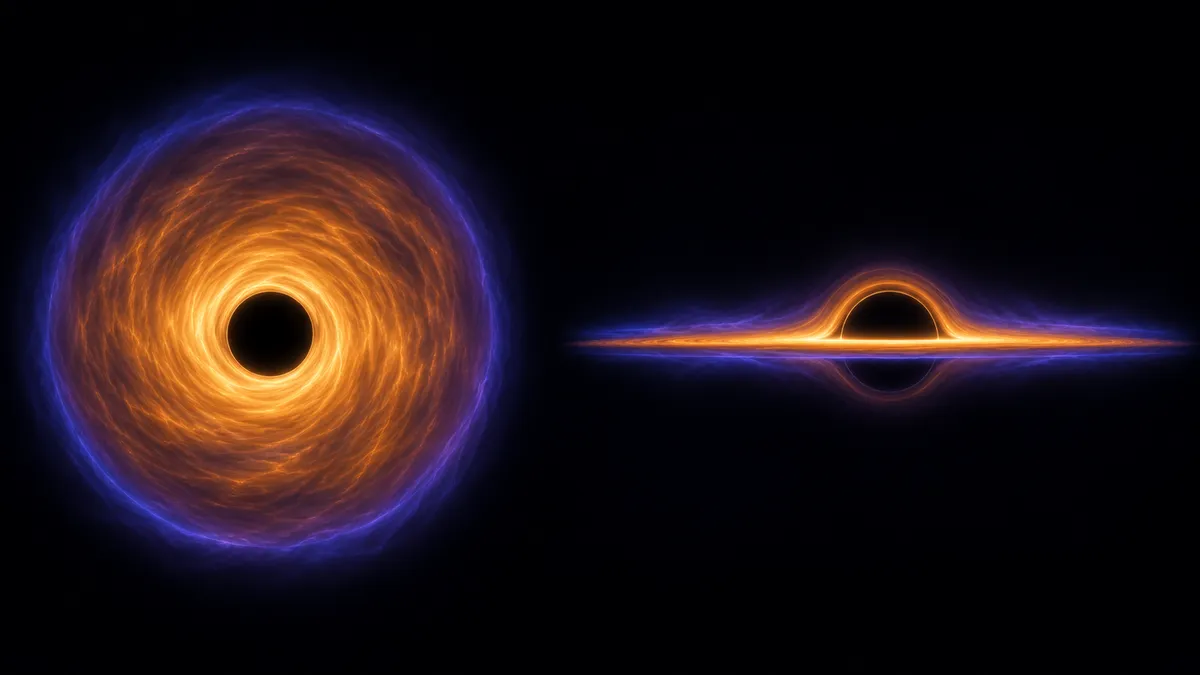
Black hole binaries can change both brightness and spectral shape as their outbursts fade. A study by Aijun Dong, Shangyao Jing and Weilong He investigates whether the angle from which we observe their accretion disks helps explain why those changes occur at different apparent luminosities.
A turning point in fading outbursts
A black hole X-ray binary contains a stellar-mass black hole drawing material from a companion star. That material forms an accretion disk, while hot plasma associated with the accretion flow contributes to the X-ray emission. During an outburst, both the brightness and the distribution of photon energies can change substantially.
A manuscript by Aijun Dong, Shangyao Jing and Weilong He, posted to arXiv on November 5, 2026, examines a particular turning point in that evolution. The arXiv landing page identifies the work as accepted for publication in The Astrophysical Journal. Its findings suggest that viewing angle contributes to differences between systems, subject to the study’s sample, fitting choices and physical assumptions.
The study follows two quantities. The photon spectral index, written as Γ, describes the shape of the power-law component of the X-ray spectrum: a larger index means a softer spectrum, with relatively fewer high-energy photons. The X-ray Eddington ratio compares luminosity in the 3–25 kiloelectronvolt energy band with the black hole’s Eddington luminosity, a mass-dependent reference scale. It is not a measurement of radiation across all energies.
At lower ratios, Γ and the X-ray Eddington ratio are anticorrelated; above a turning point, they are positively correlated. The paper asks why this crossing occurs at different apparent luminosities in different binaries.
What the researchers measured
The team analyzed archival Rossi X-ray Timing Explorer observations covering 15 outbursts from eight systems. They selected sources with published estimates of mass, distance and inclination, and concentrated on the declining portions of their outbursts.
They fitted spectra using combinations of an absorbed power law, a thermal disk component and, where included, an iron emission line. Observations with unconstrained spectral indices or a power-law contribution below 10% were excluded. Further screening removed flares, unusually large index values or uncertainties, and some early declining intervals in which the index changed little with brightness.
The remaining spectral-index versus luminosity tracks were fitted with two straight segments meeting at a crossing point. This procedure makes the reported turning points dependent on both the spectral models and the data-selection rules. Luminosities were calculated from measured fluxes and adopted distances under an assumption of isotropic emission, making the distinction between apparent luminosity and intrinsic emission important to the geometric interpretation.
Repeated outbursts of H 1743-322 produced closely grouped crossing points, supporting approximate repeatability within that source. However, the individual results for GX 339-4 and XTE J1550-564 show that such consistency is not universal.
The reported inclination relationship
The clearest reported relationship emerged after five of the 15 outbursts were excluded from the inclination fit: GX 339-4 in 2004 and 2007, GRO J1655-40 in 2005, XTE J1752-223 in 2009, and XTE J1550-564 in 1998.
For the remaining outbursts, the authors report a straight-line relationship between the logarithm of the crossing-point X-ray Eddington ratio and the cosine of inclination. The fitted slope is 0.72 ± 0.09, with an intercept of −2.81 ± 0.03. Thus, the result is not a linear relationship between inclination itself and luminosity: it involves the cosine of the angle and the logarithm of the luminosity ratio.
In this fit, systems viewed more nearly face-on have higher apparent crossing-point ratios. Combining multiple outbursts into one track for each of GX 339-4 and H 1743-322 gives a similar positive relationship, with a slope of 0.61 ± 0.07. That analysis still excludes three other outbursts.
A possible geometric explanation
The authors interpret the pattern using models in which the balance between a cold disk and a hot accretion flow changes as accretion declines. Different sources of photons cooling the hot plasma could explain the two branches of spectral evolution. Viewing geometry could then shift the apparent luminosity of the transition.
A flattened, disk-like corona would be more sensitive to viewing angle than a nearly spherical one. Projection, direction-dependent radiation and possible obscuration by the outer disk could all contribute. The authors also report that dividing the luminosity ratios by the cosine of inclination reduces the scatter between tracks.
These observations are consistent with a geometric contribution, but they do not uniquely establish the corona’s shape or isolate one physical mechanism.
Limits of the interpretation
The sample contains only eight binaries, and several outbursts depart from the preferred relationship. Proposed explanations involving additional cooling, unusual accretion conditions or jets remain interpretations rather than demonstrated causes of those departures. The geometric explanation also assumes broadly similar underlying accretion physics across sources; different coronal configurations could complicate the comparison.
The supplied manuscript contains reporting inconsistencies: its two parameter tables give different inclinations for XTE J1859+226, and its methods mention both 1% and 0.5% systematic errors. These details need clarification for reproducibility.
The central result therefore warrants broader testing. Inclination may help explain apparent differences in spectral evolution, but the study does not establish it as the only controlling factor.
- black hole X-ray binaries
- accretion disks
- inclination
- X-ray spectra
- photon spectral index
- Eddington ratio
- corona geometry
- RXTE
- The Astrophysical Journal