TRANSMISSION // 2611.07574v1
Galaxy Distortions Put Limits on Giant Primordial Black Holes
Source published
A preprint uses Dark Energy Survey galaxy-shape measurements to constrain hypothetical supermassive primordial black holes through the dark matter structures they could build. It finds no evidence for this contribution, with limits that depend on how efficiently those structures grow. Simulated Rubin Observatory data suggest substantially greater future sensitivity.
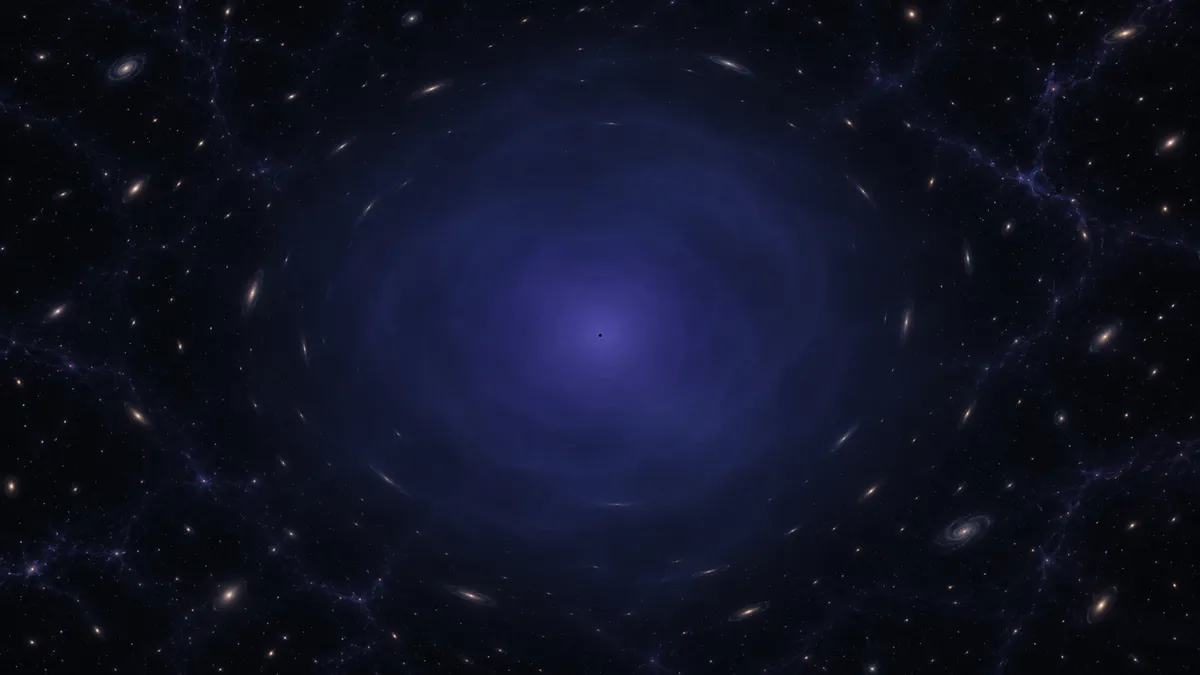
If giant primordial black holes exist, their gravitational influence could extend far beyond the holes themselves, gathering dark matter into dense surrounding halos. Lei Zu and Kazunori Kohri investigate whether the subtle distortion of distant galaxies can reveal—or constrain—these hypothetical structures.
Looking for a gravitational footprint
A black hole need not emit light to influence an astronomical survey. Its gravity, and the matter gathered around it, can change how light from more distant galaxies travels. A preprint by Lei Zu and Kazunori Kohri, posted on November 5, 2026, uses this connection to investigate whether supermassive primordial black holes could account for a small fraction of dark matter.
The authors report no evidence for the contribution predicted by their models. Instead, they calculate upper limits on how abundant these objects could be. These are preprint results, and their interpretation depends on simplified assumptions about how dark matter accumulates around the black holes.
How a black hole becomes a seed
Primordial black holes are hypothetical objects originating in the early universe. The paper considers a population in which the black holes all have the same mass and constitute only a small share of dark matter, embedded in a surrounding dark matter background.
Such objects could influence cosmic structure in two distinct ways. The first, called the Poisson effect, comes from fluctuations in the number of black holes in different regions: discrete objects do not form a perfectly smooth distribution.
The second is the seed effect, the focus of this study. An individual black hole attracts surrounding dark matter, building a dense halo or “spike.” Together, the central object and its dark matter covering form a “dressed” primordial black hole.
These compact structures would alter the matter power spectrum, a statistical description of how strongly matter clusters on different scales. The authors model an additional contribution from matter within individual dressed halos, particularly important on small scales. They also represent matter removed from the surroundings during halo growth, avoiding the double-counting that would occur if a halo were simply added to an unchanged background.
Two possibilities for halo growth
How much dark matter can a primordial black hole gather? The answer is a central uncertainty, so the researchers adopt two prescriptions.
In the optimistic model, Case 1, accretion persists longer and the surrounding halo is assigned a mass 1,000 times that of the black hole. In the conservative model, Case 2, growth stops at a redshift of 30, leaving a halo about 100 times the black hole’s mass. Both prescriptions hold the halo’s mass and density profile fixed after accretion stops.
The larger halos in Case 1 produce a stronger clustering signal. Consequently, the same observational data can place tighter limits on the number of black holes allowed in that scenario.
Reading the signal in galaxy shapes
The observational test uses cosmic shear: tiny, spatially correlated distortions in distant galaxy shapes caused by intervening matter. Because this weak gravitational lensing responds to gravity, it can probe matter that does not shine.
The authors use Dark Energy Survey Year 3 measurements covering 4,143 square degrees and containing shape measurements for more than 100 million source galaxies. They divide the sources into four redshift groups, model correlations in galaxies’ intrinsic shapes, and exclude small angular scales where uncertain effects involving ordinary matter could complicate the interpretation.
They compare predicted shear correlations with the observations while exploring cosmological and black hole parameters. Their reported 95% confidence upper limits become stronger as the assumed black hole mass increases.
Under Case 1, the analysis excludes black hole fractions above approximately 0.0001—0.01% of dark matter—for masses of roughly 10 billion solar masses or greater. Case 2 yields weaker bounds, especially below a trillion solar masses. Neither result is a detection.
Forecasts and limits
Using simulated cosmic-shear data resembling those expected from the Vera C. Rubin Observatory’s Legacy Survey of Space and Time, the authors forecast sensitivity improvements of roughly two orders of magnitude. This is a projection, not an observational result.
Important limitations remain. Real halos may overlap, merge, or lose material through tidal interactions, changing the predicted signal. The model’s representation of matter depleted from a halo’s surroundings is also approximate.
At the highest masses, black holes could be so rare that their finite number within a survey substantially affects statistical uncertainties. Correlations with ordinary cosmic structure could also undermine the assumption that the dressed-halo contribution can simply be added to the standard prediction.
The study therefore presents a conditional constraint on a hypothetical population, not proof that primordial black holes exist or a model-independent exclusion. More realistic simulations are needed to establish how robustly galaxy-shape measurements can test their proposed role as early gravitational seeds.
- primordial black holes
- dark matter
- weak gravitational lensing
- cosmic shear
- Dark Energy Survey
- large-scale structure
- Vera C. Rubin Observatory
Related reading
Automatically matched by shared topic keywords. These links do not imply that the sources agree or establish a consensus.
PrimordialPy connects inflation models to predictions of ancient black holes and cosmic ripples
Source published
Shared keywords: dark matter, primordial black holes
Rubin camera data reveal atmospheric shifts that carry clues to galaxy redshifts
Source published
Shared keywords: vera c rubin observatory
A softly broken symmetry offers a route across the phantom divide
Source published
Shared keywords: large scale structure
How Decaying Dark Matter Could Puff Up a Galactic Halo
Source published
Shared keywords: dark matter
JWST Finds Turbulent Early Disks That Depart from Today’s Galaxy Mass–Speed Relation
Source published
Shared keywords: dark matter