TRANSMISSION // 2611.07563v1
Metal-poor stars trace an offset trail behind the Magellanic Clouds
Source published
Spectroscopy identifies 12 high-confidence stellar-stream members associated with the Large and Small Magellanic Clouds. The mostly very metal-poor stars trace more than 100 degrees of sky, offset from the gaseous stream. Their motions support a connection to the Clouds, but the preprint leaves their precise origins unresolved.
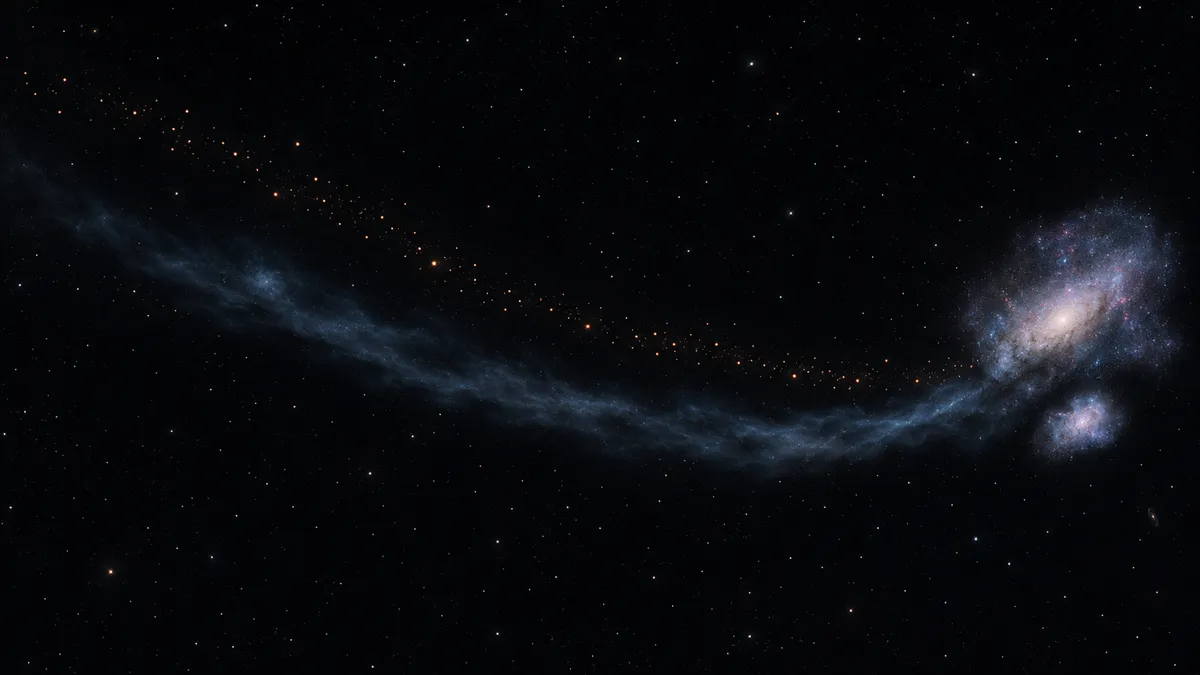
A sparse trail of stars may help reconstruct how the Milky Way’s neighbouring dwarf galaxies have shed material. New observations reveal very metal-poor red giants moving with the Magellanic Clouds—but displaced from their enormous gas stream.
The Large and Small Magellanic Clouds have left an enormous gaseous trail across the sky. A new study strengthens the evidence that their stellar debris includes a population with very little iron, spread along a different apparent path from much of the gas and more metal-rich stellar debris.
Led by Akshara Viswanathan, the researchers identify 12 high-confidence members of the Clouds’ stellar stream using spectroscopy and stellar motions. The work was posted to arXiv on November 5, 2026. It is a preprint; the supplied manuscript does not report journal acceptance.
Why look for stars beside a gas stream?
The Magellanic gas Stream extends across more than 200 degrees of sky. Understanding how it formed requires separating two processes: gravitational tides, which can pull away both stars and gas, and ram pressure, which removes gas as galaxies move through surrounding gas without directly stripping existing stars.
Stars therefore provide a complementary record of the Clouds’ interactions. Their distances, motions and chemical compositions can help reconstruct where the debris originated. But the Milky Way’s outer regions contain unrelated stars and overlapping streams, making apparent alignment insufficient evidence of membership.
Twelve stars emerge from 33 candidates
The team observed 33 candidate red giants with GHOST, a high-resolution spectrograph on the Gemini South telescope in Chile. Candidates came from the Pristine–Gaia synthetic metallicity catalogue, combined with distance estimates and motions pointing towards the Clouds.
The spectra supplied line-of-sight velocities and metallicity estimates based on three calcium absorption lines. Here, metallicity is expressed as [Fe/H], the logarithmic iron-to-hydrogen abundance relative to the Sun. A value of −2 means one-hundredth of the solar iron-to-hydrogen ratio; −3 means one-thousandth.
The researchers selected members using orbital energy and angular momentum, excluding likely contaminants from the separate Orphan–Chenab stream. Their final 12 include one star near [Fe/H] = −1.6, ten very metal-poor stars and one extremely metal-poor star near −3.0. Thus, eleven of the twelve fall below the very metal-poor threshold of −2, including the extremely metal-poor object.
Adding 15 previously reported stars brings the combined sample to 27, approximately doubling the earlier red-giant sample. Its metallicities range from about −0.5 to −4.3. The lowest-metallicity star was already known, not discovered in these observations.
A displaced stellar trail
The new stars trace more than 100 degrees along the trailing stellar stream and lie roughly 40–60 kiloparsecs from the Sun. The combined sample covers more than 130 degrees, including stars ahead of and behind the Clouds.
The very metal-poor population appears displaced by approximately 20 degrees from the neutral-hydrogen stream and previously identified, more metal-rich debris. This suggests that stellar populations with different chemical compositions may occupy different regions of the stream.
That interpretation remains tentative. The observations are not a complete census, and the new and earlier samples have different selection biases. The new survey’s brightness limit favours nearer giants, while earlier observations reached more distant, generally more metal-rich debris. These differences complicate comparisons of distance and chemistry.
Motion also matters more than alignment alone. The study finds that line-of-sight velocities overlap substantially with those of unrelated halo stars. Sideways velocities, inferred from distances and Gaia proper motions, provide a clearer distinction.
Models support a connection, not a birthplace
The researchers traced possible stellar orbits backwards through a changing Milky Way–Large Magellanic Cloud gravitational model, sampling measurement uncertainties. Many trajectories approach the Large Cloud in the distant past, supporting an association.
However, the reported encounter fractions are not membership probabilities. They depend on assumed distances, the gravitational model and an adopted encounter criterion. Four new members have no qualifying encounters when the team uses their smaller individual distance uncertainties instead of a uniform, conservative 20 percent uncertainty. Their other dynamical properties remain consistent with the selected stream population.
A separate experiment evolved massless tracer particles initially distributed around the Large Cloud. It broadly reproduced the observed debris’s positions and motions, demonstrating that such an origin is dynamically possible. But it spread particles to both sides of the stream rather than explaining the observed predominantly one-sided offset. This simplified experiment did not include the Small Cloud’s dynamical influence.
The stars could have come from extended stellar populations in either Cloud or from disrupted dwarf satellites accompanying them. The present evidence does not identify a unique birthplace or settle the Clouds’ infall history. Detailed elemental abundances, better distances and simulations including both Clouds are needed to distinguish those possibilities.
- Magellanic Clouds
- Magellanic Stellar Stream
- very metal-poor stars
- stellar tidal debris
- Pristine survey
- Gemini GHOST
- Gaia
- galaxy interactions