TRANSMISSION // 2611.07546v1
How collapsing star clusters could help build early massive black holes
Source published
An analytical preprint argues that a dense star cluster’s early collapse may create conditions favorable for massive black hole formation. Repeated cluster mergers, by contrast, generally produce larger, more extended systems. The proposed pathway depends on initial stellar structure and simplifying assumptions; the study does not demonstrate a black hole forming.
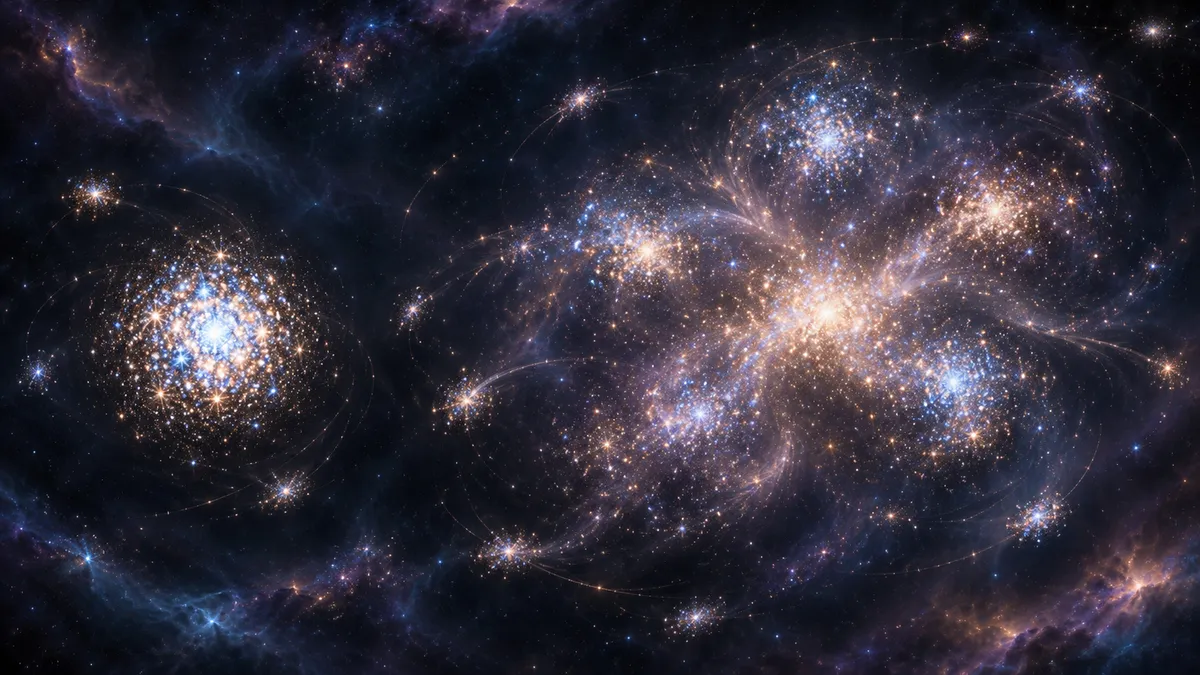
Building a bigger star cluster does not necessarily make it a better birthplace for a massive black hole. A new theoretical study suggests that the decisive step may instead be an early gravitational collapse that concentrates massive stars before repeated mergers spread the system out.
A fast route through a slow-looking system
Dense stellar systems observed in the distant Universe provide the motivation for a study by Dominik R. G. Schleicher and colleagues, posted as an arXiv preprint on November 5, 2026. Using analytical models, the authors investigate how clusters could rearrange themselves rapidly enough to create conditions favorable for massive black hole formation.
The apparent obstacle is time. In a large, smooth stellar system, the gradual exchange of orbital energy through gravitational encounters between individual stars can take billions of years. This process is called two-body relaxation. Judged by that clock alone, some early stellar systems would seem unlikely to change substantially in the available time.
But a collection of stars need not be smooth. If much of its mass resides in separate, gravitationally bound clusters, those clusters become important moving units. Their gravitational interactions can reorganize the larger system much faster than encounters between individual stars would suggest.
The authors describe this using a relaxation time based on the number of clusters rather than the number of stars. The approximation requires clusters to be small compared with the overall system and sufficiently numerous for many weak encounters to provide a useful description.
What “cold collapse” means
A second, faster mechanism operates when a newly formed cluster has too little internal motion to balance gravity. Here, “cold” means dynamically slow, not necessarily low in physical temperature.
The cluster contracts, rapidly changing its collective gravitational field. Stars respond to that changing field and redistribute their orbital energies. This process, violent relaxation, can occur within only a few crossing times—the time needed for a star to travel across the system.
Despite its name, violent relaxation does not require stars to collide physically. It is a collective gravitational process, distinct from the later stellar collisions that might help assemble a massive central object.
For a simplified cluster whose density-profile shape remains unchanged and whose mass and total energy are conserved, the authors find that an extremely cold starting configuration settles at roughly half its original scale radius. This is a conditional model result, not a universal prediction for every forming cluster.
Giving massive stars a head start
The potentially important outcome concerns clusters containing both lighter and heavier stars. Massive stars may begin more centrally concentrated, or with different motions, because of how they formed.
If violent relaxation mixes both populations completely, their spatial differences are erased. If mixing remains incomplete, however, the initial differences can survive and become more pronounced.
The authors derive a criterion for the massive-star population to dominate the central region. It compares each population’s total mass divided by the cube of its final velocity dispersion, a measure of the spread in stellar velocities. Under their assumptions, the heavy population can become a dynamically distinct central subsystem when its value exceeds that of the lighter population.
A crucial restriction is that collisionless evolution cannot generate this separation merely because some stars are heavier. The populations must already differ in their initial distributions of positions and velocities. The incomplete-mixing calculation also assumes approximately separate conservation of their energies.
Such a concentrated heavy-star core could subsequently undergo core collapse and potentially runaway stellar collisions, building a very massive central object that could lead to a massive black hole. The preprint proposes favorable conditions for that sequence; it does not calculate a complete black hole formation event.
Why more mergers can mean less compactness
Cluster mergers add mass, but the remnant’s size depends on the energy budget as well. The authors’ multiple-merger model generally produces increasingly extended systems as more clusters join together.
In their idealized model, with identical progenitors and no mass loss, the final scale radius grows directly with the number of clusters when their net orbital energy is zero. Bound starting configurations produce more compact remnants. For many progenitors and fixed model parameters, their radius instead grows approximately as the cube root of total mass, approaching a constant characteristic mean density.
Mergers involving especially compact clusters can still help build compact remnants. The conclusion is therefore not that mergers prevent black hole formation, but that repeated mergers do not automatically deliver the required density.
A pathway, not a detection
The study favors cold collapse in an already massive, dense cluster, after few mergers or none. More extended merger remnants could still contain black holes formed earlier inside their progenitors.
These conclusions remain analytical and provisional. The models simplify stellar structure, mixing and orbital energies, neglect gas, and assume no mass loss in the multiple-merger calculation. They identify a possible route toward massive black holes, rather than establish that any particular observed early system followed it.
- massive black hole formation
- star clusters
- violent relaxation
- cold collapse
- early Universe
- mass segregation
- cluster mergers
- stellar dynamics
Related reading
Automatically matched by shared topic keywords. These links do not imply that the sources agree or establish a consensus.
How JWST Could Trace the Seeds of the First Massive Black Holes
Source published
Shared keywords: early universe
Stellar Motions Put NGC 3227’s Black Hole at About 12 Million Suns
Source published
Shared keywords: stellar dynamics
Stellar motions sharpen the estimate of M87’s black hole mass
Source published
Shared keywords: stellar dynamics
Could ancient cosmic walls have left a powerful gravitational-wave background?
Source published
Shared keywords: early universe