TRANSMISSION // 2611.07533v1
Glowing gas traces a long active history for Mrk 1018’s changing nucleus
Source published
A gas stream near Mrk 1018 appears to preserve evidence of nuclear activity on a roughly 12,000-year timescale, far longer than the galaxy’s several-year changing-look transitions. The preprint supports interpreting those rapid changes as variations within a longer active episode, but cannot establish an uninterrupted history or generalize to all changing-look galaxies.
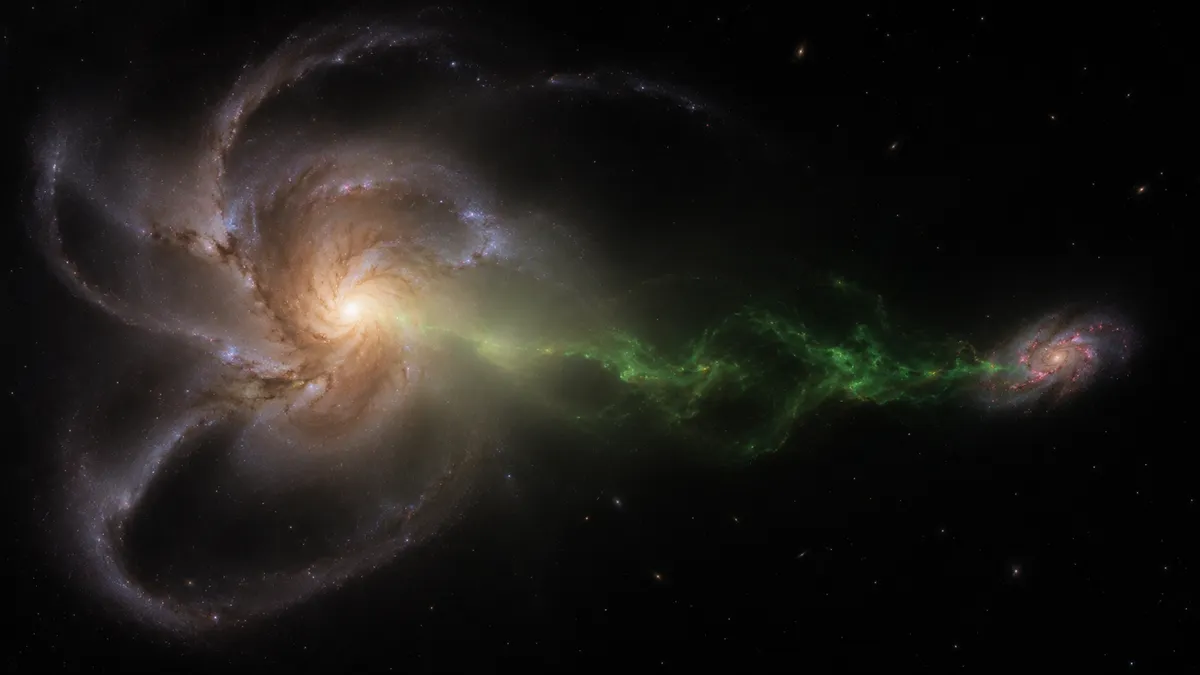
Mrk 1018’s nucleus can change its appearance over just a few years. A nearby stream of glowing gas offers a much longer perspective: radiation needs thousands of years to reach it. Researchers have used that separation, together with the gas’s spectrum and motions, to investigate how the galaxy’s rapid transformations fit into its broader history.
A longer clock outside the nucleus
An active galactic nucleus, or AGN, is a bright central region powered by gas accreting onto a supermassive black hole. In a changing-look AGN, both the brightness and characteristic features of the spectrum can change dramatically. Mrk 1018 is a well-studied example, with observed transitions unfolding over several years.
Those rapid changes raise a larger question: are astronomers witnessing the beginning or end of nuclear activity, or shorter fluctuations within a much longer episode?
Rebecca McElroy, Scott M. Croom and Thomas Dunn address that question using glowing gas outside Mrk 1018’s nucleus. Their study, posted as a preprint on November 5, 2026, argues that the galaxy’s changing-look events occur within an active phase extending back at least roughly 12,000 years. That is the authors’ interpretation of an indirect illumination record, not a continuous observation of the nucleus over that interval.
Reading the gas’s spectrum
The team analysed observations from the Multi-Unit Spectroscopic Explorer, MUSE, obtained through the Close AGN Reference Survey. These data provide spectra across the galaxy, allowing researchers to map both emission from gas and its motions.
Mrk 1018 is a merger remnant with visible tidal structures. The researchers examined three regions: the nucleus, an apparent small companion, and a region they call the stream, located between the nucleus and companion on the sky.
Different sources of energy produce different relative strengths of emission lines. The team compared these ratios using diagnostic diagrams designed to distinguish gas excited by star formation from gas associated with an AGN.
The companion’s spectrum was consistent with star formation. The stream and nucleus instead fell in the AGN region of the diagrams. Despite their apparent proximity, the stream and companion therefore seem to have different primary sources of ionisation—the process that removes electrons from atoms.
Gas motions supplied another important clue. The stream’s velocity dispersion, a measure of the spread in velocities rather than its overall travel speed, was 77 ± 1 kilometres per second. The authors argue that this is too low for the shock-ionised outflow explanation, which typically involves dispersions of hundreds of kilometres per second. Combined with the emission-line ratios, the result favours illumination by radiation from the nucleus.
Turning separation into a timescale
The stream’s measured separation from the nucleus is 4.3 ± 0.8 arcseconds, corresponding to a projected distance of 3.77 kiloparsecs. Light takes 12,300 ± 2,300 years to cross that distance.
“Projected” matters: the measurement captures separation across the sky, not the full three-dimensional distance. The true nucleus-to-stream distance could be larger. Assuming the stream lies in a plane with a previously estimated inclination gives light-travel times between 12,300 and 18,700 years. Because the geometry of this merger remnant is uncertain, the authors retain the projected value as their conservative lower limit.
They interpret the illuminated stream as evidence that nuclear activity extends back on this much longer timescale. Several-year changing-look transitions would then represent rapid variations within a longer active episode, rather than marking its overall beginning or end.
A record with limited time resolution
The gas does not respond instantly when its illumination changes. After ionising radiation declines, electrons can recombine with ions, but that takes time.
A sulfur emission-line ratio places an upper limit on the stream’s electron density. From this, the researchers estimate a recombination time of at least about 900 years, potentially longer if the gas is less dense. The stream therefore cannot track the nucleus’s several-year transitions individually. Its emission preserves a smoothed record of illumination, and a decline in nuclear output need not immediately erase that signal.
This limits what the result establishes. It supports past nuclear activity on a much longer timescale than the observed transitions, but does not reconstruct every intervening bright or faint episode or demonstrate constant output.
The study also concerns only one galaxy, and the supplied manuscript is a preprint rather than evidence of completed peer review. The authors explicitly caution against drawing conclusions about all changing-look AGN. Applying the same method to more objects could help test whether their rapid transformations commonly sit inside much longer cycles of activity.
- Mrk 1018
- changing-look active galactic nuclei
- supermassive black holes
- extended emission-line regions
- photoionisation
- MUSE
- galaxy mergers
- AGN activity timescales
Related reading
Automatically matched by shared topic keywords. These links do not imply that the sources agree or establish a consensus.
Stellar motions reveal clues to NGC 253’s merger history
Source published
Shared keywords: galaxy mergers
Molecular Gas Reveals a Hidden Nucleus Shining Unevenly
Source published
Shared keywords: galaxy mergers
Galactic Light Echoes Reveal Candidates for Fading Black Hole Activity
Source published
Shared keywords: supermassive black holes
Stellar Motions Put NGC 3227’s Black Hole at About 12 Million Suns
Source published
Shared keywords: supermassive black holes
Hyperion’s Densest Regions Show More X-ray-Active Black Holes
Source published
Shared keywords: supermassive black holes