TRANSMISSION // 2611.07524v1
Galaxy lens models identify 71 secure systems in a little-studied cosmic era
Source published
An analysis of 80 distant galaxy-scale lens candidates classifies 71 as secure gravitational lenses, with eight more judged probable or possible. The preprint expands the sample available for studying galaxy mass distributions, but sharper imaging and additional background-source redshifts are needed before it can deliver decisive tests of galaxy-evolution simulations.
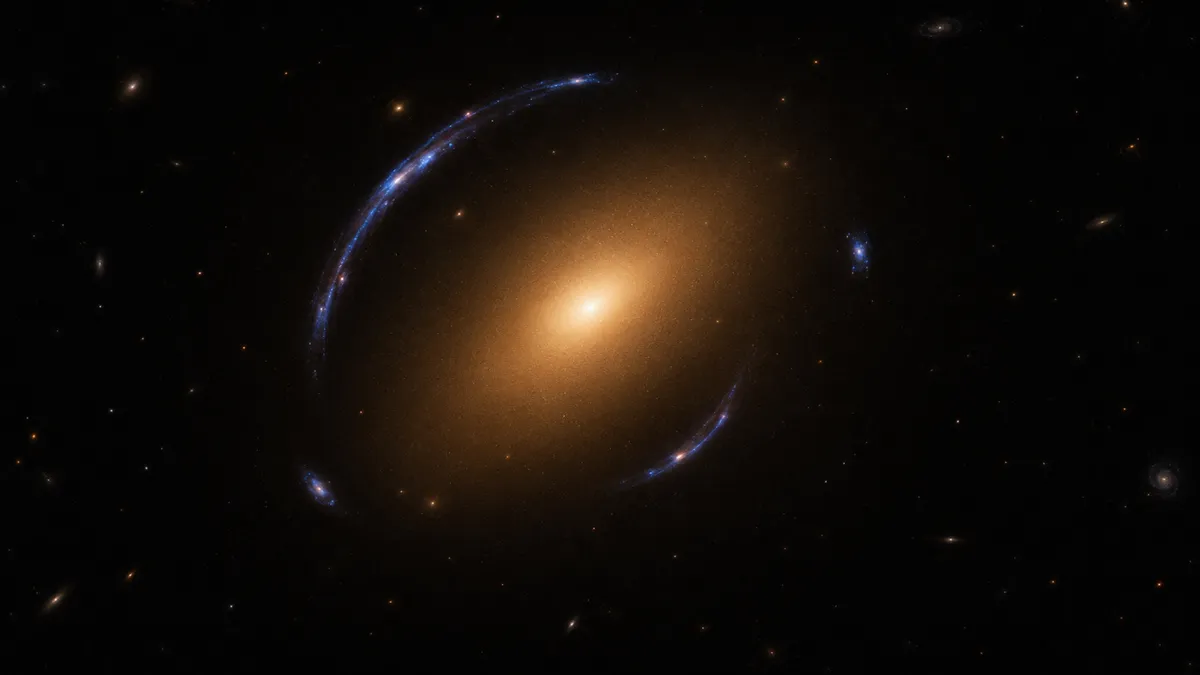
Distorted arcs around distant galaxies can reveal more than a striking alignment: they carry information about the matter bending their light. Shen Li, Yiping Shu and Lin Nie have used this effect to assess 80 strong-lens candidates whose foreground galaxies lie at redshifts above 0.8, identifying a larger sample for future studies of how galaxies assemble.
A larger sample of distant gravitational lenses
A new analysis classifies 71 of 80 distant galaxy-scale systems as secure strong gravitational lenses. Five others are rated probable lenses, three possible lenses, and one a non-lens on the evidence available. The work, by Shen Li, Yiping Shu and Lin Nie, was posted to arXiv on November 5, 2026, as a preprint; its classifications and interpretations should be read in that context.
Strong gravitational lensing occurs when a foreground galaxy bends light from a more distant source into multiple images or extended arcs. The pattern depends on the foreground galaxy’s total mass distribution, including ordinary matter and dark matter. That makes lensing useful for investigating galaxies beyond what their visible light alone can reveal.
All 80 systems have foreground, or lens, redshifts above 0.8. Redshift measures the stretching of light associated with cosmic expansion. This relatively distant regime is important because competing simulations predict increasingly different galaxy mass structures there.
Why these galaxies matter
The researchers’ broader goal is to study how sharply a galaxy’s total matter density changes with distance from its center. This structure reflects the combined effects of star formation, gas inflow, mergers, and energy released by stars and active galactic nuclei.
According to the paper, three major simulations predict closely similar average density slopes nearby, but diverge more strongly around redshift 1. Different treatments of energy feedback from active galactic nuclei are suggested as a major reason. Measurements at higher redshift could therefore help distinguish between these competing physical descriptions.
The present study does not resolve that disagreement. Its principal achievement is to assess lens candidates and characterize their foreground galaxies, creating a sample for subsequent mass-structure measurements.
Testing whether the arcs fit
An earlier paper identified 84 candidates by matching Hyper Suprime-Cam imaging candidates with Dark Energy Spectroscopic Instrument data. The new analysis excludes four systems whose apparent lensing features lie more than four arcseconds from the lens center, concentrating on the remaining 80 galaxy-scale systems.
The team jointly modeled images in five wavelength bands from the Subaru telescope’s Hyper Suprime-Cam survey. Each model represented the foreground galaxy’s light, the background source’s light, and the mass responsible for bending it. The researchers used a simplified elliptical mass profile, with an additional term accounting for tidal distortions or departures from that profile.
A secure classification required clear lensing features, including identifiable counter-images—additional images of the same background source—that the model could successfully reproduce. The probable systems had prominent features but lacked identifiable counter-images. The possible systems had more ambiguous configurations. For the rejected system, a nearby colored clump showed neither an arc-like shape nor a detectable counter-image, favoring a chance alignment.
The authors describe the resulting expansion as nearly tripling the known galaxy-scale lens sample above redshift 0.8. However, their model-based secure classifications are not equivalent to having spectroscopic redshifts for both the foreground lens and background source in every system.
Stellar motions and unusual configurations
The researchers also estimated stellar velocity dispersions, which describe the spread of stars’ line-of-sight speeds, from DESI spectra. Across the 80 systems, these estimates had a median of 232 kilometers per second and a median fractional uncertainty of 14.9%.
Five-band light measurements yielded stellar-mass estimates for 105 foreground galaxies. At a given stellar mass, the high-redshift lenses tended to be smaller than lower-redshift comparison galaxies, consistent with size-evolution trends discussed in the paper.
Several individual systems offer distinctive follow-up opportunities. One contains an apparently edge-on disk lens at redshift 0.92016, flanked by two petal-shaped arcs. Another contains two foreground galaxies with an estimated projected separation of 3.39 kiloparsecs, assuming they share the measured redshift. Five systems have orange or red lensed images, suggesting—but not establishing—that their background sources are quiescent galaxies with little ongoing star formation.
What remains uncertain
The models were designed primarily to establish whether the observed structures are consistent with lensing, not to provide a detailed account of every galaxy’s mass. Eighteen secure systems appear to contain multiple lens galaxies, although the analysis represents their lensing with a single main mass component.
Spectroscopy is another limitation. Among the 53 secure systems containing a single lens galaxy, only nine have spectroscopic background-source redshifts. The remaining 44 need such measurements, alongside improved stellar-motion estimates.
Sharper imaging is also essential. Of the full 80-system sample, 56 lie within the planned survey footprints of CSST, Euclid or the Nancy Grace Roman Space Telescope. Those observations could clarify ambiguous features and support more precise modeling. The immediate result is an expanded set of promising targets—not yet a verdict on which galaxy-evolution simulation best describes nature.
- strong gravitational lensing
- high-redshift galaxies
- galaxy evolution
- dark matter
- Hyper Suprime-Cam
- DESI spectroscopy
- galaxy mass distributions
Related reading
Automatically matched by shared topic keywords. These links do not imply that the sources agree or establish a consensus.
JWST Finds Turbulent Early Disks That Depart from Today’s Galaxy Mass–Speed Relation
Source published
Shared keywords: dark matter, galaxy evolution, high redshift galaxies
Astronomers propose a 1,000-hour JWST survey to read galaxies’ stellar histories
Source published
Shared keywords: galaxy evolution, high redshift galaxies
Hyperion’s Densest Regions Show More X-ray-Active Black Holes
Source published
Shared keywords: high redshift galaxies
Euclid simulations expose the galaxies a bright-line survey can miss
Source published
Shared keywords: galaxy evolution
When Cleaning the Sky Erases a Galaxy Cluster’s Faint Glow
Source published
Shared keywords: hyper suprime cam