TRANSMISSION // 2611.07522v1
JACKS Maps Fine-Scale Ammonia Structure in the Milky Way’s Turbulent Centre
Source published
Early images from the JACKS radio survey reveal compact and filamentary ammonia emission in the Milky Way’s Central Molecular Zone. The preprint demonstrates techniques for connecting small gas structures to their surrounding clouds, but quantitative temperature maps and an explanation for the region’s inefficient star formation remain future goals.
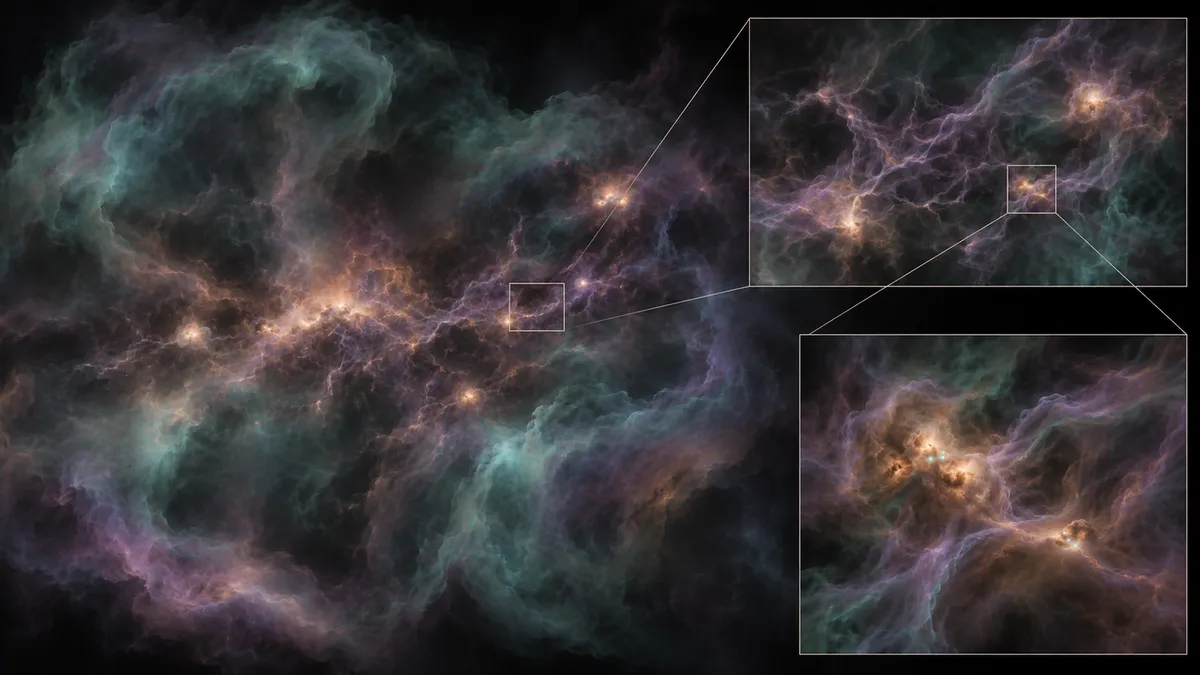
The centre of the Milky Way contains abundant dense molecular gas, yet forms fewer stars than simple estimates based on that reservoir would predict. JACKS is taking a sharper radio view of this warm, turbulent environment, using ammonia to investigate how gas conditions vary between clouds and the compact structures where stars might form.
A closer look at an unusual stellar nursery
The Milky Way’s Central Molecular Zone presents a persistent puzzle: a substantial supply of dense gas does not translate into the star-formation rate that simple dense-gas expectations suggest. Its molecular gas is also unusually warm and turbulent. The paper describes temperatures commonly around 50–100 kelvin or higher, with cloud-scale spectral line widths of roughly 10–30 kilometres per second.
Those figures are background drawn from earlier studies, not new measurements from JACKS. The new survey aims to connect that large-scale environment with the temperature and motion of compact, potentially star-forming gas.
In a preliminary preprint, Xu Zhang and colleagues present the first imaging demonstrations from the JVLA Ammonia C-configuration K-band Survey, or JACKS. The results establish observational capabilities rather than resolve why star formation is suppressed.
Why observe ammonia?
Ammonia molecules emit a set of closely spaced radio spectral lines that can constrain gas excitation conditions while tracing dense molecular material. Observing several transitions provides a route toward temperature measurements; their spectral profiles also carry information about gas velocities.
JACKS uses the Very Large Array to cover the same footprint as the ALMA Central Molecular Zone Exploration Survey, known as ACES. It comprises 31 mosaic fields, each containing 14 telescope pointings. Its nominal angular resolution is about 1.5 arcseconds, corresponding to approximately 0.06 parsec at the Galactic Centre. The ammonia observations have a velocity resolution of about 0.4 kilometres per second.
The setup includes five metastable ammonia transitions, labelled (1,1) through (5,5), plus five non-metastable transitions. It also covers the 22-gigahertz water-maser line, two hydrogen recombination lines and broad radio-continuum windows. These complementary observations are intended to probe molecular and ionized gas, excitation and embedded star formation.
What the early images show
Bright water masers provide a useful calibration reference. The team uses them for self-calibration, deriving corrections that improve the continuum and spectral-line images.
A preliminary centimetre-wavelength continuum map includes Sagittarius B1. Comparison with a lower-frequency MeerKAT image illustrates complementary structures, but the authors do not yet classify individual features by their emission mechanism. That requires observations compared at matched resolution across multiple frequencies.
Ammonia images also reveal structure beyond bright compact sources. In Field 28, an integrated-emission map contains faint extended emission, while an image selecting a narrow velocity interval isolates a filamentary feature. These are preliminary imaging results: quantitative measurements await uniform processing of the survey.
Field 30 demonstrates another way to find faint gas. Ammonia emission associated with the long filament LF3 is weak in integrated-intensity maps. However, averaging spectra over the filament’s footprint, identified independently by ACES, produces clear detections in both the (1,1) and (3,3) transitions.
Their peak velocities agree with the previously measured velocity of LF3. That agreement supports the interpretation that JACKS is detecting an extended, velocity-coherent dense-gas structure rather than an imaging artifact. It also shows how the surveys can guide one another’s analysis.
Recovering what a sharp image misses
High resolution comes with an important limitation. The VLA configuration used by JACKS filters out some emission spread over large angular scales. A sharp image alone therefore does not capture the full cloud.
The authors demonstrate a remedy using the cloud called the Brick. Combining JACKS with the lower-resolution SWAG ammonia survey restores intermediate-scale emission. Adding the single-dish HOPS survey recovers an even broader component while retaining compact structure.
The recovered spectral flux changes substantially as these larger scales are included. This matters for physical interpretation: comparing ammonia transitions with inconsistent coverage of spatial scales could distort the inferred gas properties. The paper therefore calls for temperature and column-density maps to be derived only after that coverage has been made consistent.
What remains to be measured
The next stage is uniform calibration and imaging of all 31 mosaics, followed by modelling of ammonia’s hyperfine structure and multiple transitions. Planned products include kinetic-temperature, opacity, column-density and velocity-dispersion maps, alongside catalogues of compact ammonia peaks and water masers.
These are proposed outputs, not measurements delivered in this first report. Nor does a compact ammonia peak alone establish a star-forming core. The immediate achievement is a demonstrated observing and analysis strategy for linking compact gas to its surrounding clouds; its implications for heating and star formation await the quantitative survey analysis.
- Central Molecular Zone
- JACKS
- ammonia
- Very Large Array
- star formation
- molecular clouds
- radio astronomy
- Galactic Centre
Related reading
Automatically matched by shared topic keywords. These links do not imply that the sources agree or establish a consensus.
Radio Surveys Catch IX Velorum for the First Time
Source published
Shared keywords: radio astronomy
Young stars hint at feedback-driven formation between two glowing gas regions
Source published
Shared keywords: star formation
SWARA simulations explore how three antennas could locate solar radio signals
Source published
Shared keywords: radio astronomy
GRS 1915+105 fades to record radio lows, hinting at a long quiet phase
Source published
Shared keywords: radio astronomy
Radio galaxies masquerade as tiny gravitational lenses
Source published
Shared keywords: radio astronomy