TRANSMISSION // 2611.07448v1
Radio Surveys Catch IX Velorum for the First Time
Source published
A preprint reports the first radio detection of IX Velorum, a nearby white-dwarf binary, in a systematic search across four sky surveys. Six cataclysmic variables were detected overall. Combining observations revealed no additional faint, persistent emission, placing limits on a small nearby sample without establishing that these systems are radio-silent.
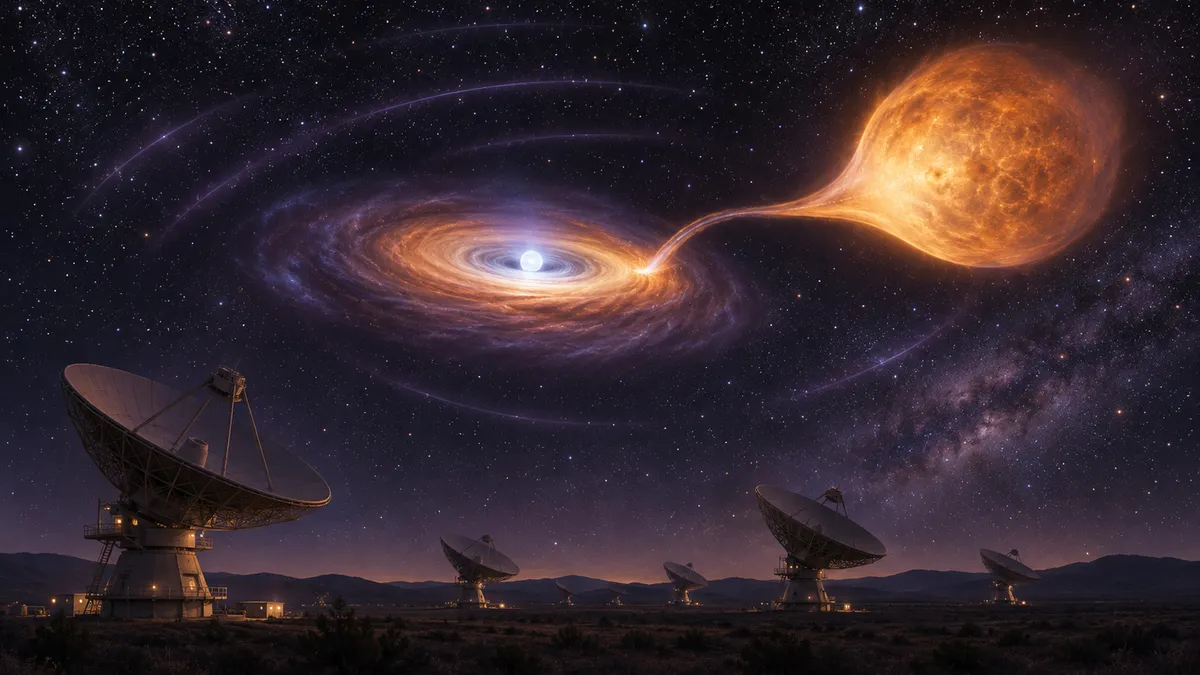
IX Velorum is bright in visible light but had escaped previous radio searches. A ten-hour observation with Australia’s ASKAP telescope has now revealed a weak radio signal, adding a new example to the small population of radio-detected cataclysmic variables—and leaving the signal’s physical origin unresolved.
A nearby binary joins the radio sample
A preprint posted on November 5, 2026, by Suhasini S. Rao and colleagues reports the first radio detection of IX Velorum. The discovery emerged from a systematic search of four wide-field radio surveys, rather than an observation targeted specifically at the system. Altogether, the researchers identified radio emission from six cataclysmic variables; the other five were already known radio sources.
Cataclysmic variables are close binaries in which a white dwarf draws matter from a lower-mass companion. Depending on the white dwarf’s magnetic field, that material can form an accretion disk or follow magnetic field lines toward the star. Some systems undergo recurring disk outbursts. Others, called nova-like variables, maintain relatively high accretion rates. IX Vel belongs to this latter group.
Radio observations offer clues about magnetic activity and energetic particles that are difficult to obtain from visible light alone. But the paper notes that fewer than 50 cataclysmic variables had been detected at radio frequencies, despite thousands being identified optically.
Finding genuine matches
The team searched VLASS, RACS, VAST and EMU, using observations spanning roughly 0.7–4 gigahertz. These surveys combine broad sky coverage with different observing durations, sensitivities and repeat schedules.
Before searching, the researchers repaired problems in two legacy optical catalogs, including duplicate entries, inaccurate coordinates and sources subsequently classified as something other than cataclysmic variables. Their parent catalog contained 2,225 candidates. Further filtering and matching to Gaia produced a final sample of 1,374 sources with sufficiently reliable Gaia counterparts.
Accounting for each star’s motion across the sky was important: a radio source near an old catalog position need not belong to the intended star. The team checked positional agreement, inspected images for background galaxies and imaging artifacts, and reviewed source classifications. These checks narrowed the result to SS Cygni, AM Herculis, V2400 Ophiuchi, RW Sextantis, AE Aquarii and IX Velorum.
What IX Vel’s signal reveals
IX Vel lies about 90 parsecs away and completes an orbit approximately every 4.6 hours. EMU detected it at 943.5 megahertz, with a flux density of 0.35 ± 0.05 millijanskys. Flux density measures the radio brightness received at Earth per unit frequency.
To examine the ten-hour observation, the researchers divided it into five two-hour intervals. Three intervals yielded detections; the upper limits in the remaining two were consistent with similar brightness. That supports the description “quasi-persistent” during this observation—not a claim that IX Vel emits continuously over months or years.
Its spectrum showed no clear features, and the data were insufficient to identify the emission mechanism. The authors’ brightness-temperature estimate argues against ordinary thermal free-free emission from hot ionized gas, but it does not establish a jet or another specific explanation. No circular polarization was detected, although the resulting limit still permits a polarization fraction below 50%.
Earlier searches had missed IX Vel, including a more sensitive MeerKAT observation lasting about two hours. The new detection therefore does not establish a fixed radio brightness or make sensitivity the sole explanation for previous non-detections.
Learning from the missing signals
Most observations yielded no detection. The researchers therefore combined images using median stacking: aligning observations on stellar positions and taking the middle pixel value across images. This reduces the influence of outliers and can expose faint emission hidden by noise in individual observations.
Combining non-detection epochs for individual objects in the VAST footprint revealed no additional sources above the five-sigma threshold. Population-wide stacks, constructed separately for different surveys and frequency bands, likewise showed no significant signal.
The strongest nearby constraint came from 14 EMU images of five systems within 100 parsecs. The authors report an upper limit of 3 × 10^14 erg s⁻¹ Hz⁻¹ on their median persistent specific radio luminosity—the emitted power per unit frequency. This is a limit, not a measured luminosity. Because detected epochs were excluded, it constrains low-level emission in the selected observations, not every system’s brightest episodes.
Limits and future prospects
The findings remain preprint results. The catalog is optically selected and retains some uncertain classifications; the surveys also have uneven coverage and sensitivity. Numerical inconsistencies between some table entries and the main text warrant caution with detailed population accounting.
The authors propose that SKA1-Mid, the Deep Synoptic Array and the next-generation Very Large Array could substantially expand the radio sample. Those forecasts extrapolate from a small nearby sample and assumed sensitivities, rather than demonstrating future detection rates. For now, IX Vel’s detection adds a useful case, while the non-detections constrain how bright persistent emission can be in the observations examined.
The source abstract gives a detected-luminosity range that does not encompass all detections listed in its Table 3, including IX Velorum. The paper also lists David L. Kaplan and Patrick A. Woudt as separate authors, although the arXiv landing page combines their names.
- cataclysmic variables
- IX Velorum
- white dwarfs
- radio astronomy
- ASKAP
- EMU survey
- image stacking
- accretion
Related reading
Automatically matched by shared topic keywords. These links do not imply that the sources agree or establish a consensus.
GRS 1915+105 fades to record radio lows, hinting at a long quiet phase
Source published
Shared keywords: radio astronomy
SWARA simulations explore how three antennas could locate solar radio signals
Source published
Shared keywords: radio astronomy
JACKS Maps Fine-Scale Ammonia Structure in the Milky Way’s Turbulent Centre
Source published
Shared keywords: radio astronomy
Radio galaxies masquerade as tiny gravitational lenses
Source published
Shared keywords: radio astronomy