TRANSMISSION // 2611.07428v1
SWARA simulations explore how three antennas could locate solar radio signals
Source published
A preliminary preprint models direction finding for the proposed Space Weather Radio (SWARA) Polarimeter. Its idealized three-antenna system achieves simulated localization errors below one degree across the tested arrival directions when signal-to-noise ratio exceeds approximately 5 decibels. The results provide a design baseline, not a demonstration of working space-weather warnings.
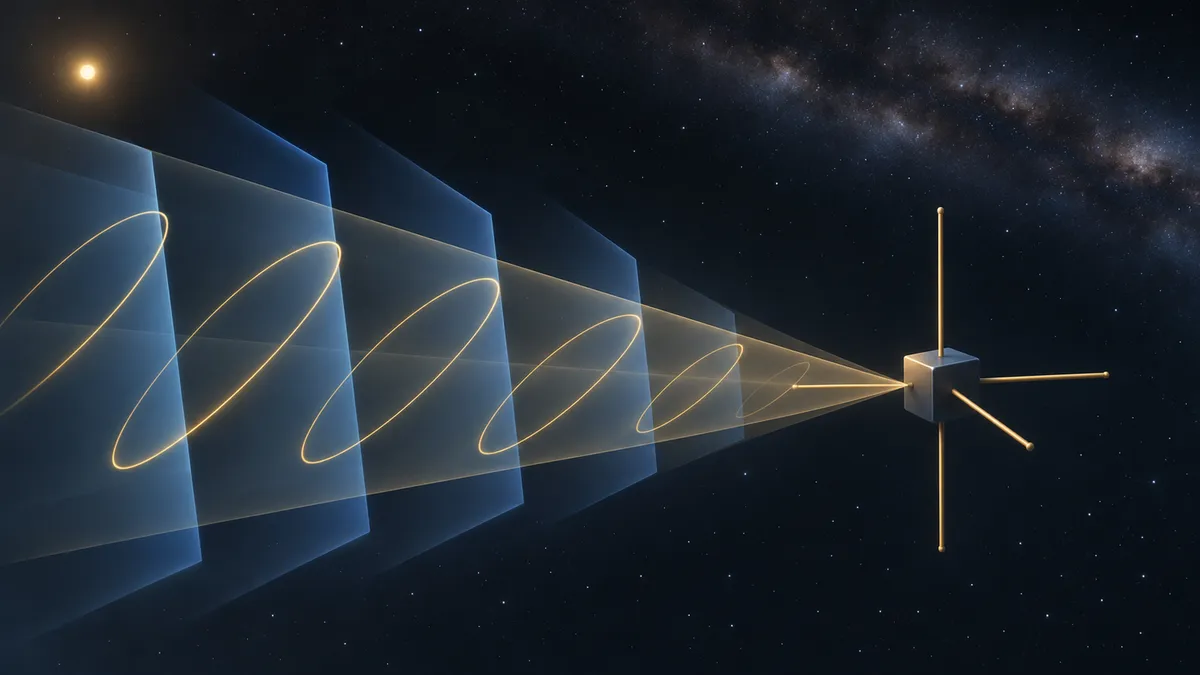
Finding where a radio signal comes from can help researchers study solar activity. For the proposed SWARA Polarimeter, researchers are investigating whether three perpendicular antennas could make those measurements without a large antenna array. Their first simulations show how background noise and arrival direction affect accuracy—and identify practical effects that still need investigation.
A compact approach to radio direction finding
The proposed Space Weather Radio (SWARA) Polarimeter is intended to support early warnings of space-weather events, including coronal mass ejections, solar flares and solar energetic particles. A preliminary preprint by Poorva Singh, Mugundhan V. and Anshu Kumari, posted on 5 November 2026, examines one part of that ambition: estimating the direction from which a radio wave reaches the instrument.
SWARA is being developed through a collaboration between the Indian Institute of Technology Kanpur and the Physical Research Laboratory. The proposed payload would operate between 300 kilohertz and 30 megahertz using deployable antennas along three axes. This study presents simulations rather than measurements from a completed instrument or a demonstrated warning system.
Reading the electric field
The technique, called goniopolarimetry, uses the electric field of a radio wave to infer its arrival direction. Polarization describes how that field is oriented and changes as the wave passes.
Three mutually perpendicular antennas measure different components of the field. Comparing their voltage amplitudes and relative phases provides information about the wave’s polarization and propagation direction. The researchers process those relationships through a covariance matrix—a mathematical description of how the measured signals relate to one another.
The attraction is compactness: directional information can be extracted from a single multi-component antenna system rather than requiring a large array. That makes the approach relevant to spacecraft, where size, power and processing resources are constrained.
What the simulations assumed
The MATLAB simulations represent an ideal tri-monopole: three perpendicular monopole antennas with identical gain and radiation characteristics. Each has an assumed effective length of one metre. Effective length describes the antenna’s conversion of an incident electric field into voltage; it is not a finalized hardware dimension.
Each simulation contains one distant radio source, producing a planar wavefront. Its polarization remains constant during the observation interval. Other sources, interference and multipath propagation are excluded.
The noise model combines frequency-dependent Galactic background emission with fixed equivalent noise temperatures of 10,000 kelvin for quasi-thermal noise and 300 kelvin for receiver noise. These temperatures express noise strength, not the physical temperature of the instrument. Quasi-thermal noise arises from thermal motions of charged particles in plasma. The combined noise is represented by additive complex Gaussian noise in the antenna voltages.
These assumptions establish a controlled baseline, not a complete representation of a spacecraft’s plasma environment or receiving electronics.
Stronger signals give smaller errors
Across the simulated operating band, signal-to-noise ratio increases with frequency. The paper associates this improvement with decreasing Galactic background noise. Because the assumed source electric-field amplitudes remain constant across frequency, the result should not be interpreted as evidence that real solar signals necessarily become stronger at higher frequencies.
The researchers also examine directional sensitivity at 1 megahertz. Signal quality varies with arrival direction relative to the antennas, affecting how accurately the incoming wave can be localized.
Accuracy is measured using angular localization error: the angular separation between the true direction and the estimated direction. Smaller errors mean a closer match.
The reported relationship is straightforward: higher signal-to-noise ratios produce lower localization errors. For favourable arrival directions, the simulations achieve errors below one degree even at 0 decibels, where signal and noise powers are equal. However, the authors report that a signal-to-noise ratio greater than approximately 5 decibels is needed to keep errors below one degree consistently across all tested azimuth and elevation directions at 1 megahertz.
That threshold is a result of this model, not an established performance specification for a flight instrument.
What remains to be demonstrated
The study does not establish warning lead times, event-detection reliability or performance during actual solar activity. Its ideal antenna geometry and simplified noise treatment leave practical questions unresolved.
The authors propose optimizing antenna effective lengths while ensuring suitable electrical matching to the receiver. They also describe developing a practical tri-dipole system for broadband operation, extending beyond the ideal tri-monopole configuration simulated here.
Further electromagnetic and plasma simulations would investigate how the surrounding plasma changes antenna behaviour, received signals and direction estimates. Calibration errors and partially polarized waves also remain subjects for future investigation.
The contribution is therefore a preliminary design baseline: under the stated assumptions, three orthogonal antenna measurements can support sub-degree direction finding when signal quality is sufficient. Whether SWARA can deliver comparable accuracy in space—and translate those measurements into useful warnings—remains to be demonstrated.
- SWARA
- goniopolarimetry
- space weather
- radio astronomy
- direction of arrival
- polarization
- tri-monopole antenna
- Galactic background noise
Related reading
Automatically matched by shared topic keywords. These links do not imply that the sources agree or establish a consensus.
Radio Surveys Catch IX Velorum for the First Time
Source published
Shared keywords: radio astronomy
Teaching AI to locate Earth’s magnetic boundary in simulated X-ray images
Source published
Shared keywords: space weather
JACKS Maps Fine-Scale Ammonia Structure in the Milky Way’s Turbulent Centre
Source published
Shared keywords: radio astronomy
GRS 1915+105 fades to record radio lows, hinting at a long quiet phase
Source published
Shared keywords: radio astronomy
Radio galaxies masquerade as tiny gravitational lenses
Source published
Shared keywords: radio astronomy