TRANSMISSION // 2611.07405v1
Reanalysis Finds No Significant Spiral Rotation in IM Lup’s Planet-Forming Disk
Source published
A preprint reexamining ALMA observations of IM Lup finds that its two-armed dust spiral shows no statistically significant rotation with revised disk geometry. The authors attribute an earlier report of faster motion to projection-related distortions, while leaving the spiral’s origin unresolved.
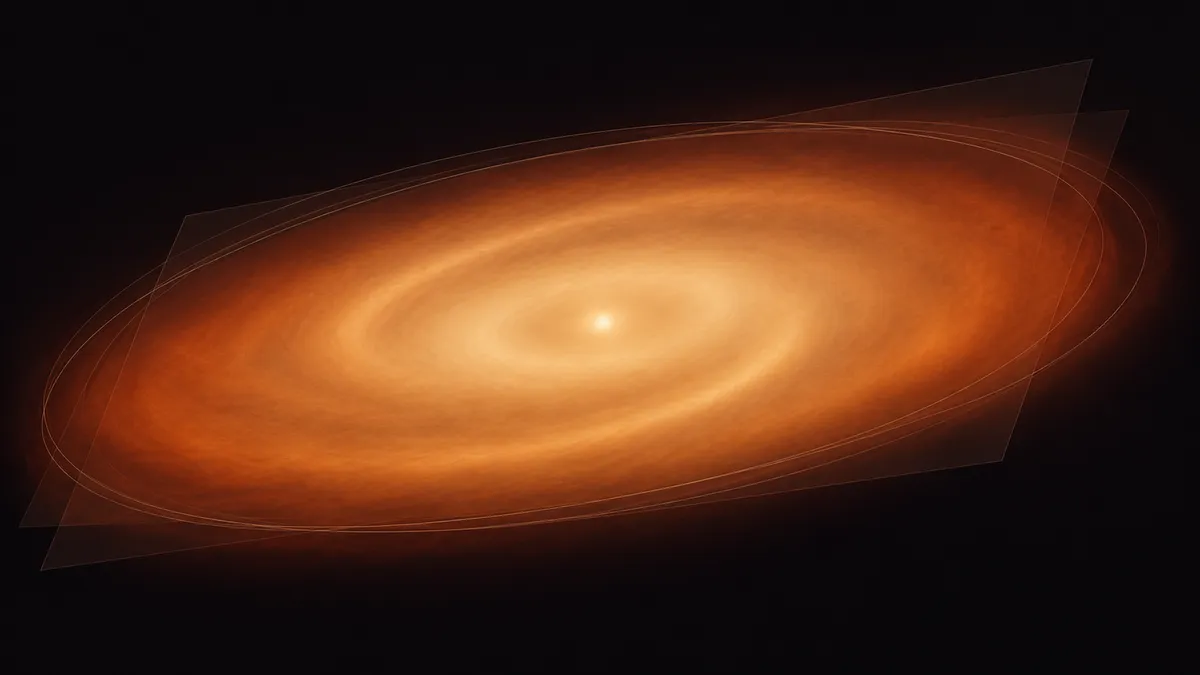
A small change in the assumed tilt of a young star’s disk can substantially change its apparent spiral motion. By revisiting observations spanning roughly seven years, researchers find that IM Lup’s spiral pattern could be rotating slowly—but the available measurements are also consistent with no rotation.
Why spiral motion matters
The disk surrounding the young star IM Lup contains a prominent two-armed spiral. Such structures interest astronomers because they may reveal processes connected to planet formation and the movement of material through disks. But a spiral’s appearance alone does not establish what created it.
One proposed explanation is an embedded planet disturbing the surrounding disk. Another is gravitational instability, in which the disk’s own gravity helps generate spiral structure. These mechanisms can produce different pattern speeds: planet-driven spirals are expected to turn approximately together at the planet’s orbital rate, while gravitational-instability spirals tend to follow the local orbital motion, which varies with distance from the star.
A 2025 study reported motion resembling that local orbital rotation in IM Lup, supporting a gravitational-instability interpretation. A new preprint posted on November 5, 2026, revisits the same observations and challenges that measurement—not the existence of the spiral itself.
Revisiting the disk’s tilt
The researchers analyzed four ALMA datasets, designated 2017, 2019a, 2019b and 2024. The earlier observations used Band 6, while the 2024 observations used the higher-frequency Band 7. The two 2019 datasets have different frequency settings and were treated separately.
Extracting a faint spiral requires separating it from the much brighter, approximately circularly symmetric disk emission. That separation depends on knowing the disk’s center, inclination and orientation on the sky. An incorrect geometry can leave artificial patterns behind after the smooth disk model is subtracted.
Using software called protomidpy, the team fitted the disk’s radial brightness distribution and geometry directly to ALMA’s interferometric measurements, rather than determining the geometry from reconstructed images alone. The model assumes a geometrically thin, circularly symmetric disk for this background component.
The mean inferred inclination was about 50.43 degrees, compared with the previously adopted 47.5 degrees. The mean orientation of the disk’s major axis was 143.88 degrees, compared with 144.5 degrees previously. The revised values also resemble an independent geometry estimate based on CN molecular emission.
Although these angular changes are small, they substantially affect the extracted spiral. The updated geometry leaves weaker residual emission and a more consistently winding spiral phase profile.
A different motion measurement
The researchers tracked the angular position of the two-armed pattern at different distances from the star. They also repeated a second method that compares brightness around corresponding rings between observations. Both approaches gave lower pattern speeds with the revised geometry.
Beyond approximately 20 astronomical units, the measurements were consistent with zero rotation within about twice their estimated statistical uncertainty, although the Fourier analysis showed a marginal positive deviation at 95 astronomical units. An astronomical unit is the Earth–Sun distance.
Most measured speeds were positive, potentially hinting at slow rotation. However, neighboring measurements are correlated, and the uncertainties may be underestimated. The Fourier analysis constrained the pattern speed to roughly no more than 1–2 degrees per year. That range includes the approximately 0.3 degrees per year expected for an orbit at 117 astronomical units, where an embedded planet has previously been discussed.
Reusing the older geometry recovered a pattern-speed profile resembling the earlier result. The authors argue that an inclination mismatch creates an artificial two-fold residual pattern aligned with the disk’s major axis. This contaminates the earlier Band 6 spiral measurements more strongly than the stronger spiral signal in the 2024 Band 7 data. The resulting difference between epochs can mimic motion resembling local orbital rotation.
Limits and an additional tentative feature
The images used for measuring motion have a common resolution corresponding to roughly 24 astronomical units. Measurements inside that scale are less reliable. At 15 astronomical units and inward, one method produced apparent backward rotation, but the authors do not regard this as reliable physical motion. The region is poorly resolved, and its bar-like structure is not clearly recovered in the Band 7 data.
The reported uncertainties primarily describe statistical errors, using an approximate treatment of correlated image noise. Unaccounted systematic effects could make them larger.
The team also identified a tentative one-armed feature extending to about 240 astronomical units. Its typical brightness in the 2024 image is only around one to two times the image’s root-mean-square noise. Similar morphology in independent observations is suggestive, but does not establish a secure detection. A tested planetary-wave model did not reproduce its shape well.
The slower measured motion leaves a planet-driven explanation possible without excluding gravitational instability. Continued infall of surrounding material could also modify spiral behavior, but the paper reports no clear evidence for infall in IM Lup. Higher-resolution Band 6 observations over a longer time span are needed to distinguish these possibilities.
- IM Lup
- protoplanetary disks
- ALMA
- spiral pattern speed
- disk geometry
- gravitational instability
- planet formation
Related reading
Automatically matched by shared topic keywords. These links do not imply that the sources agree or establish a consensus.
Finding Hidden Patterns in the Motions of Planet-Forming Disks
Source published
Shared keywords: protoplanetary disks
Magnesium-rich dust could offer another route to formamide in space
Source published
Shared keywords: protoplanetary disks
DQ Tau’s molecular gas follows a slower rhythm than its accretion bursts
Source published
Shared keywords: protoplanetary disks