TRANSMISSION // 2611.07363v1
Seven pulsar binaries sharpen measurements of stellar orbits and distances
Source published
A European Pulsar Timing Array preprint reports improved measurements of seven binary millisecond pulsars, including distances, mass constraints and orbital orientations. The researchers also use orbital measurements to estimate gravitational-wave upper limits, not detections, in frequency bands that could complement conventional pulsar-timing searches.
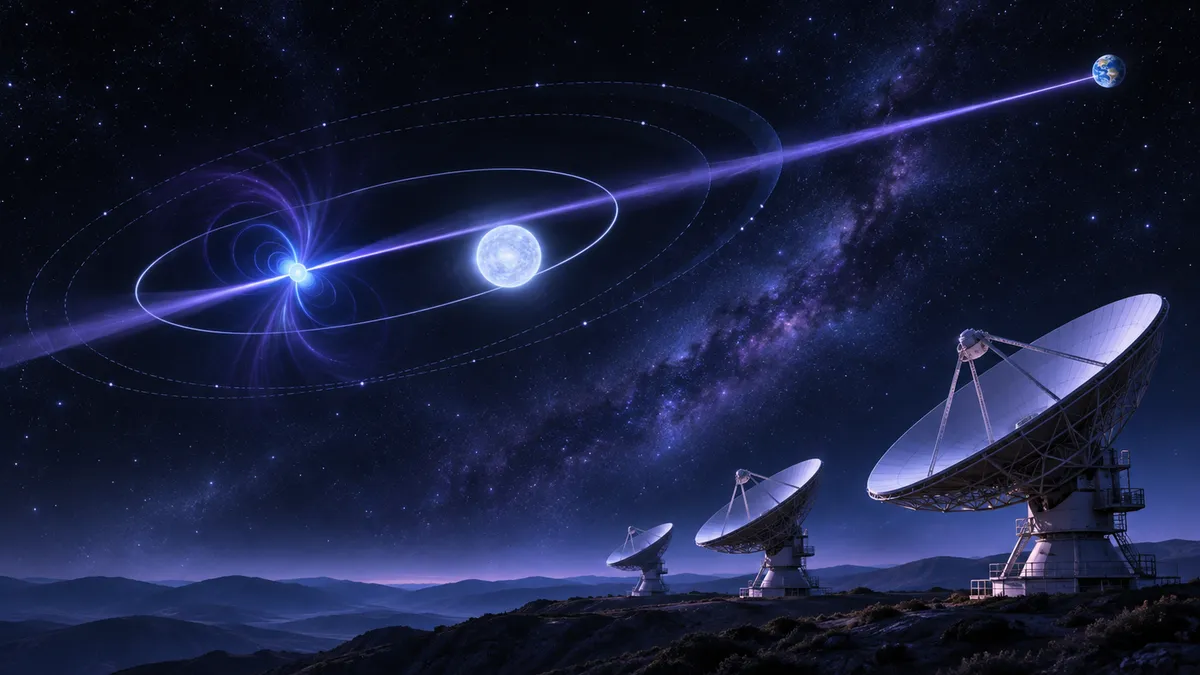
Rapidly rotating neutron stars can serve as precise astronomical clocks. By tracking their pulses over years, researchers have refined the properties of seven binary systems and explored how their orbits might help constrain extremely low-frequency gravitational waves.
Reading the clocks
Millisecond pulsars are neutron stars that rotate in a few thousandths of a second. Their exceptionally stable rotation makes pulse arrival times useful for measuring their motion through space and, in binary systems, around a companion. Small departures from predicted arrival times can reveal orbital geometry, intervening material and gravitational effects.
In a preprint posted on November 5, 2026, K. Liu and colleagues present high-precision timing results for seven binary millisecond pulsars monitored by the European Pulsar Timing Array. They obtain phase-coherent solutions for all seven: models that keep track of the stars’ rotations across their observations.
The sample comprises PSRs J0125−2327, J1125+7819, J1741+1351, J1911−1114, J2019+2425, J2033+1734 and J2043+1711. Their orbital periods range from about 1.5 to 76.5 days.
Combining observations and modelling noise
The study combines observations from European radio telescopes, including legacy data and newer recording systems. It also uses the Large European Array for Pulsars, which coherently combines signals from participating telescopes. The wider collaboration operates instruments in Germany, the United Kingdom, France, Italy and the Netherlands; the observations contributing to each pulsar’s dataset differ.
The researchers jointly analyse timing parameters and noise using Bayesian methods. Their models distinguish measurement noise from slower variations, including changes in the amount of ionised material along the radio signal’s path. Accounting for these effects is necessary before interpreting small timing signatures as properties of the binary.
J0125−2327 stands out for its precision. After subtracting the modelled red-noise contribution, its weighted timing residual scatter is approximately 294 nanoseconds. That describes the remaining differences between observed and modelled pulse arrival times, rather than the precision of every individual measurement.
Distances and uncertain masses
Annual parallax—the changing apparent geometry associated with Earth’s orbit—provides distance information. For J0125−2327, the team measures parallax with nearly three times the precision of the previous result it compares against. After correcting for statistical biases, the inferred distance is 1.24 ± 0.06 kiloparsecs.
Combining that distance with motion across the sky gives a transverse speed of 227 ± 11 kilometres per second. The distance differs substantially from predictions based on two Galactic free-electron models. The authors interpret this discrepancy as evidence that those models need improvement at very high Galactic latitudes.
The study also derives distances and transverse speeds for J2043+1711 and J1741+1351. Importantly, the latter calculation uses a previously published parallax measurement, not a new parallax detection in this dataset.
For these three systems, the researchers detect Shapiro delay: an additional travel time for pulses passing through the companion’s gravitational field. This constrains the companion and pulsar masses, but the pulsar estimates remain broad. For example, J0125−2327 has a median inferred pulsar mass of about 0.76 solar masses, with a reported interval extending from roughly 0.42 to 1.49 solar masses. The result therefore does not establish an unusually low-mass neutron star.
Separating motion from orbital change
An observed change in orbital period need not mean the binary itself is expanding or shrinking. Motion across the sky produces an apparent change known as the Shklovskii effect, while acceleration in the Milky Way also contributes.
The authors find that kinematic effects dominate the measured orbital-period changes for J0125−2327, J1125+7819 and J1741+1351. Assuming those changes are kinematic, they infer distances. For J0125−2327, the resulting 1.24 ± 0.02 kiloparsecs agrees with the parallax estimate and is about three times more precise.
They also report annual-orbital parallax signatures in J0125−2327 and J1741+1351: subtle changes in how Earth views each binary orbit. These strongly favour one orbital orientation for J0125−2327. For J1741+1351, the ascending-node direction is constrained to about 230 ± 9 degrees, but two inclination possibilities remain. Possible spin–orbit contributions are a caveat to interpreting their long-term orbital-projection changes.
Gravitational-wave limits, not detections
Finally, the team combines orbital results from this study and earlier work to estimate gravitational-wave strain upper limits in sub-nanohertz and microhertz bands. A wave near a binary’s orbital frequency could resonantly perturb its orbit.
The residual orbital-period changes used for these limits are consistent with zero. The microhertz estimates use a simplified scaling relation rather than a more sophisticated resonance calculation, and each binary constrains only a narrow frequency range. The preprint therefore demonstrates a potential complementary approach to gravitational-wave searches, not a new detection.
- millisecond pulsars
- binary stars
- European Pulsar Timing Array
- pulsar timing
- Shapiro delay
- annual-orbital parallax
- gravitational-wave upper limits
Related reading
Automatically matched by shared topic keywords. These links do not imply that the sources agree or establish a consensus.
A binary star in Sagittarius’s Teapot reveals its orbit—and a distance problem
Source published
Shared keywords: binary stars
DQ Tau’s molecular gas follows a slower rhythm than its accretion bursts
Source published
Shared keywords: binary stars
Stellar Accelerations and Jerks Could Help Gaia Find Hidden Black Holes
Source published
Shared keywords: binary stars
Lead-Rich Stars Offer Clues to a Hidden Heavy-Element Factory
Source published
Shared keywords: binary stars