TRANSMISSION // 2611.07338v1
Nearby galaxies offer clues to the Milky Way’s unusual brightness plateau
Source published
A preprint examines 65 nearby galaxies with inner brightness plateaus resembling the Milky Way’s. Their colors suggest different contributions from stellar populations, dust and possibly stellar redistribution, while comparisons reveal associations with bars and denser environments—not a single proven formation mechanism.
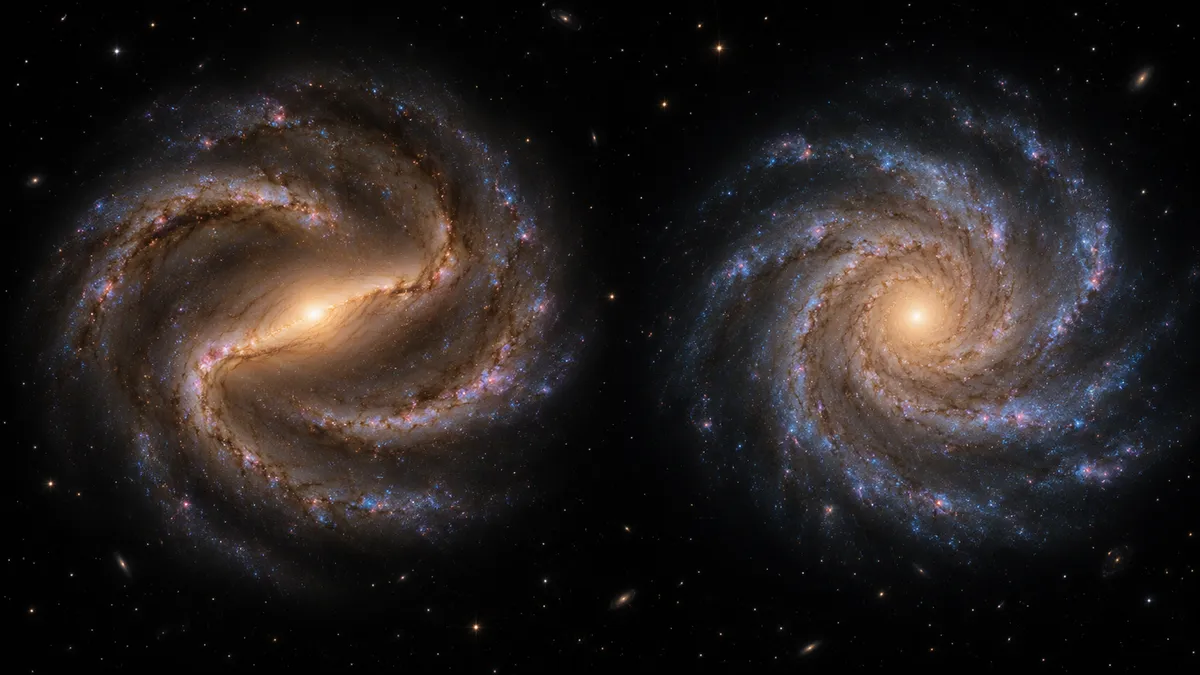
The Milky Way’s disk does not follow a simple, steadily fading brightness pattern. An unusually shallow inner region interrupts that decline. By studying similar structures in nearby galaxies, researchers are investigating whether this plateau reflects where stars reside, which stars shine brightest, or how dust obscures their light.
An unusual pattern in galactic light
A galaxy’s radial surface brightness profile describes how its light per unit apparent area changes with distance from its center. A simple exponential disk fades smoothly outward. Many galaxies depart from that pattern, but the Milky Way has a particularly unusual feature: a shallow inner plateau followed by a steeper decline.
Earlier research cited in the paper placed the Milky Way’s break at about 7.5 kiloparsecs, or 1.3 times its effective radius—the radius enclosing half its light. That is substantially farther inward than the breaks typical of galaxies with otherwise similar downward-bending profiles.
In a preprint, Yuze Zhao and colleagues investigate this structure through external galaxies. Their central question is whether a plateau primarily reflects differences in stellar populations, changes in the underlying stellar mass distribution, dust obscuration, or overlapping effects.
Finding nearby counterparts
The researchers began with a catalog of 15,424 galaxies within 50 megaparsecs. Imaging coverage, required optical bands and quality cuts reduced the working sample to 12,008 galaxies. They measured brightness in concentric elliptical rings, masking contaminating sources.
The search focused on relatively face-on galaxies and radii between 0.3 and 1.5 effective radii. Candidates needed a shallow segment extending more than 0.2 effective radii, followed by an outward decline at least twice as steep. This produced 306 candidates. Visual inspection retained 122 with regular shapes and no evidence of ongoing mergers; requiring available SDSS u-band imaging left 65 for detailed analysis.
The study combines SDSS, DESI and 2MASS imaging, supplemented by Mephisto observations of seven galaxies. Most selected galaxies are predominantly star-forming and have stellar masses above one billion solar masses. Within that mass regime, the authors report an occurrence rate of approximately 3.6% in the parent sample. This estimate concerns the study’s selected population, rather than establishing a universal frequency.
Different colors, different clues
A brightness plateau need not mean that stellar mass is distributed equally evenly. Young stars contribute strongly to blue light, while dust also changes a galaxy’s brightness and colors. Comparing wavelengths helps distinguish possible explanations, although it does not uniquely resolve them.
The galaxies show substantial diversity. NGC 3811 has a strongly wavelength-dependent plateau, whereas UGC 08741 has nearly identical plateau slopes across the observed bands. These contrasting profiles suggest that superficially similar structures can involve different contributions.
Among the 42 galaxies with available catalog bar classifications, 25 are barred and 17 are non-barred; 23 of the full sample remain unclassified. Bars are elongated stellar structures crossing galactic centers. Roughly 60% of classified plateau galaxies are barred, compared with about 32% of the 38 classified galaxies in a control sample. The full control sample contains 65 galaxies without plateaus, matched in stellar mass and g−r color.
This difference suggests an association with bars, not that bars are necessary or sufficient to produce plateaus.
Stellar populations, dust and dynamics
Across plateau regions, barred galaxies’ color changes tend to align more closely with models of aging stellar populations. Non-barred galaxies’ changes tend to follow the direction expected from dust reddening.
One proposed explanation for some barred systems is that bar-related gas redistribution suppresses recent star formation across an inner region. With fewer young stars, blue light would be reduced more strongly than red light, producing wavelength-dependent profiles. Another proposed pathway is dynamical redistribution of stars, changing the stellar mass profile itself and potentially producing weaker wavelength dependence. Neither pathway is established as dominant for individual galaxies by these data.
The team also fitted stellar population models separately in radial bins using CIGALE. Barred galaxies tended toward steeper age gradients and flatter dust attenuation gradients than non-barred galaxies. The authors explicitly describe these differences as tentative, not statistically significant distinctions. Broadband modeling constrains stellar mass more reliably than age and dust, and age, metallicity and dust can produce partially similar color changes.
Environment and the Milky Way
Two environmental measures—nearest-neighbor distance and density estimated from the third-nearest neighbor—show a consistent ordering. Non-barred plateau galaxies tend to occupy the densest environments, followed by barred plateau galaxies, with controls in the least dense environments. This is a correlation, not evidence that crowded surroundings cause plateaus.
Earlier Milky Way studies cited by the authors found both age-dependent plateau shapes and a feature persisting in stellar mass density. The authors therefore suggest that our Galaxy may combine stellar population effects with mass redistribution. The new comparison supports multiple possible contributors, while leaving their relative importance unresolved.
- Milky Way
- galaxy structure
- surface brightness profiles
- barred galaxies
- stellar populations
- dust attenuation
- galaxy environments
Related reading
Automatically matched by shared topic keywords. These links do not imply that the sources agree or establish a consensus.
A Sharper View of the Milky Way’s Hidden History
Source published
Shared keywords: milky way
Halo Stars Help Put the Milky Way’s Mass Near 1.3 Trillion Suns
Source published
Shared keywords: milky way
Euclid simulations expose the galaxies a bright-line survey can miss
Source published
Shared keywords: dust attenuation
Simulated Stars Put Milky Way Mass Measurements to the Test
Source published
Shared keywords: milky way
Astronomers propose a 1,000-hour JWST survey to read galaxies’ stellar histories
Source published
Shared keywords: stellar populations